Followers

Thursday, 12 December 2019

The Crusader Cannibals


Wars of religion often seem to lead to the most despicable acts of cruelty and barbarism, with both sides claiming to have divine sanction for the horrors that they choose to visit on their enemies. This was certainly the case on 12th December 1098 when a Crusader army breached the defences of Ma’arat al-Numan, a fortified town that lies in what is now Syria.

In 1095 Pope Urban II had called on the Christians of western Europe to recover the Holy Land for Christianity from the Muslims who now occupied it. Being utterly convinced of the rightness of their cause, and having a firm belief that Muslims were a depraved form of humanity who deserved no mercy or respect, the Christian armies swept towards Jerusalem, slaughtering anyone who opposed them.

The Crusaders did not have everything their own way. The city of Antioch withstood a siege that lasted 21 months, and when it fell the inhabitants were treated extremely badly with many civilians losing their lives.

However, the long siege had meant that there was very little food left in the city, and the Crusaders, whose own supplies were running low, found nothing to replenish their stocks. With winter approaching, the surrounding countryside had little to offer either, so a plan was drawn up to advance the short distance to Ma’arat al-Numan and hope for more luck there.

When the town fell to the Crusaders some 20,000 people were killed and the children captured as slaves, but there was still no food to be found.

The Crusaders then turned to the only solution they could think of. They started to feed on the bodies of the people they had killed. Some reports said that they went as far as killing people for the purpose of eating them, including impaling children on spits so that they could be grilled, but these accounts cannot be relied upon.

Even so, for an army to turn to cannibalism, in the belief that they were fighting against people who were animals rather than humans, was terrible enough. This event placed a huge stain on the reputation of the Crusaders, and Christianity in general. The Muslim world has long held the Christian west in detestation, and this incident was one that caused that view to be created and to prevail down the centuries.


© John Welford

Tuesday, 6 August 2019

Great Britain's mandates in the Middle East, 1920


The date was 25th April 1920, which was perhaps one that should “live in infamy” every bit as much as that on which Pearl Harbor was attacked or the Twin Towers felled.

This was when the League of Nations granted Britain and France the right to govern the territories of the former Ottoman Empire and split them up as they saw fit. What followed has led to problems ever since.

Part of the deal saw Britain gaining mandates over Palestine and Mesopotamia. For the latter, which became the modern state of Iraq, Britain installed Faisal Hussein as king in recognition of his father’s support for Britain during World War One.

As for Palestine, Britain divided the territory between the Emirate of Transjordan, to the east of the River Jordan, and the Palestine Mandate to the West. Faisal Hussein’s brother Abdullah became the ruler of Transjordan. 

An added complication was the fact that Britain had already, through the Balfour Declaration of 1917, declared its support for a Jewish “national home” “in Palestine”, both of which terms were intentionally vague.

The 1920 decision therefore pleased nobody, given that the British had also proposed that Palestine should be governed by an international body and that the Arabs should have their own independent state. 

The assumption that 85,000 Jews and 600,000 Arab Palestinians could co-exist peacefully turned out to be a false one. The consequences of that mistake have haunted the world ever since.
© John Welford

Monday, 15 July 2019

Gandhi's 1930 Salt March


A protest march in 1930 that started with 80 people was seen in later years as a major step on the path towards India’s independence from the British Empire.

Mohandas Gandhi (1869-1948) was a London-trained lawyer who sought to fight against the British Raj by wholly peaceful means. One cause of discontent was the tax levied on the Indian population for the purchase of salt, which was essential for the preservation of food in the notoriously hot climate of India.

The protest march began in the state of Gujarat. It lasted for 24 days, averaging ten miles a day. The route of the march led towards Dandi, on the Arabian Sea coast.

As the march progressed it attracted thousands more followers and eventually the procession of people was more than two miles long. Gandhi also addressed large crowds of people at stops along the way and at the march’s conclusion.

At the end of the march Gandhi encouraged his followers to break the law by making their own salt from seawater, this being a significant act of civil disobedience.

The Salt March was the first major example of non-violent direct action against India’s colonial rulers. Seventeen years later Gandhi and his followers achieved their aim when the independence of India was declared.

© John Welford

Thursday, 13 June 2019

A torrent of transatlantic emigration in the 17th century


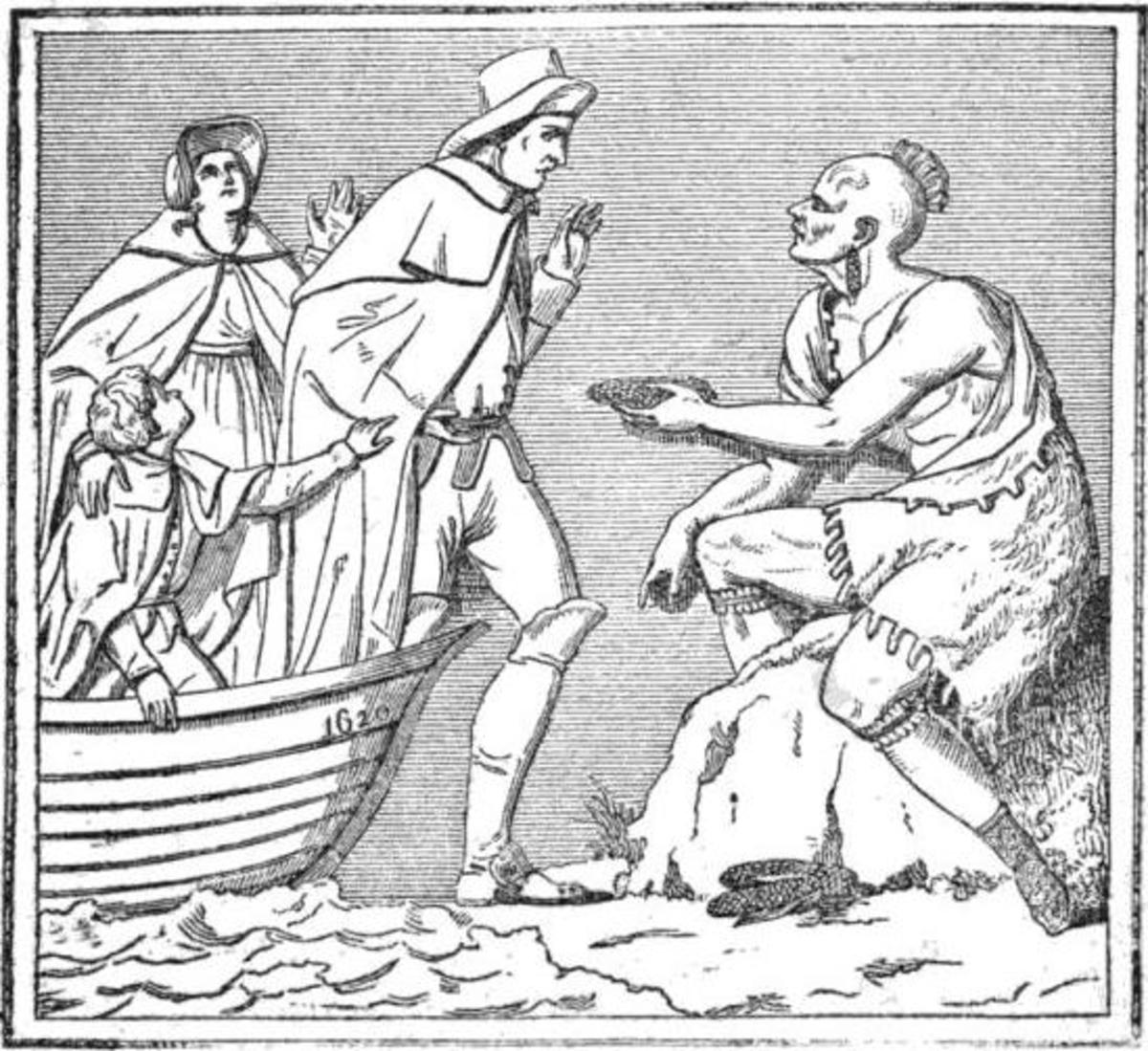
The story of the Pilgrim Fathers, who sailed across the Atlantic in the Mayflower from Plymouth (England) to the New World in 1620, is well known, but what is not so widely appreciated is that this was just the start of a virtual torrent of emigration from England to the colonies during the rest of the century.
Wave after wave of migrants left England for various reasons. It has been estimated that as many as 400,000 people may have set sail, with about half that number heading for North America and the rest going further south. Given that the total population of England at that time was about 5 million, that meant that getting on for 10% of the people of England simply departed and never came back. 
The first emigrants of the century – the Pilgrim Fathers – were Puritans who were sickened by what they regarded as lax religious standards on the part of the official Anglican clergy. They relied on God’s advice to Abraham to “Get out of thy country … unto a land that I will show thee”. They clearly believed that God was on their side when they arrived in America and vast numbers of the native population caught and died from diseases brought by the new arrivals and for which they had no immunity. God was obviously clearing the way for his new chosen people.
The next big wave of emigrants was in the late 1640s. Many of these had supported the cause of King Charles I against Parliament prior to and during the English Civil War, which eventually swung in Parliament’s favour. They could see no future for themselves under the regime that was likely to follow Charles’s defeat and headed off for Virginia and other American colonies. Given that the victors largely favoured the Puritan approach to religion, the new emigrants were of a very different nature from the previous batch.
The Restoration of King Charles II in 1660 caused problems for other religious groups in England, most notably the Quakers, who were appalled by the intolerance of the new regime towards non-conformist denominations. Most prominent of these emigrants was William Penn, the founder of Pennsylvania.
Not all the 17th century emigrants had political or religious motives for setting sail. There were plenty of economic migrants who left seeking to escape the poverty of their lives at home. Many had become victims of changes to the economic structure of England that made life very difficult for those at the bottom of the social pyramid. As woods and common land was enclosed to become private property, prices rose and wages fell.
As might have been expected, there was adequate opportunity for unscrupulous people to take advantage of the misery of others. Agents known as “spirits” became active at fairs, markets and taverns where they would entice people into emigrating with promises of vast riches to be made in the colonies.
A huge number of emigrants were indentured servants who had to work as virtual slaves for up to seven years before gaining their freedom, in return for board and lodging. It has been estimated that only around 10% of these people survived the experience.
Another source of emigration was the transportation of prisoners from English jails – a practice that lasted well into the 18th century until the American Revolution meant that Australia replaced North America in this respect.
Genuine emigration – i.e. by those who wanted to emigrate as opposed to doing so by force - waned towards the end of the 17th century, largely due to the increased toleration provided by the so-called “Glorious Revolution” of 1688.
A less acceptable reason was that the burgeoning slave trade, which shipped vast numbers of slaves to the colonies from Africa, meant that there was less need to import indentured servants from England, who were in any case less suited to the harsh conditions of the plantations in the southern colonies.
English migration may have declined at this time, but it was soon replaced by fresh sources of travellers from countries that included Ireland, Germany and Italy. However, the earlier dominance of English emigrants left several permanent marks on the population of what would eventually become the United States of America, most notably the universality of the English language.
© John Welford

Wednesday, 22 May 2019

Broadening the mind on the Grand Tour


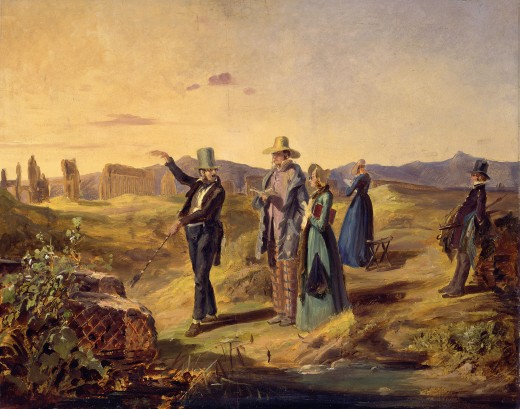
It is a well-respected maxim that travel broadens the mind. For many British young people this takes the form of a “gap year” before going to university. The equivalent in the late 18th and early 19th century – if you could afford it – was the Grand Tour.

Who were the Grand Tourists?

It has been estimated that some 40,000 Britons undertook the Grand Tour during the period from 1750 to 1825. They were nearly all the eldest sons of wealthy aristocrats and they would have undertaken the Tour when aged anything between 15 and 21.

The notion behind the Tour was that the education provided by the great Public Schools (i.e. institutions such as Eton, Harrow and Winchester) was not particularly well-rounded, and in order to be fully educated it was important to have first-hand knowledge of great art and architecture. In the days before public art galleries (London’s National Gallery dates from 1824) it was impossible to see the works of masters such as Titian and Raphael. You had to travel to where they were in order to see them, and in most cases that meant Italy.

Aristocratic young men were given an education that placed great emphasis on the classical languages, particularly Latin. In order to put flesh on the bones, where better to go than Rome to view the remains of its ancient past?

Also, many people of this class were expected to play a role in politics and diplomacy. That meant knowing foreign languages, the teaching of which was largely ignored by the Public Schools. In order to learn French or Italian you had to spend time in France or Italy.

An Expensive Business        

The Grand Tour was only available for families with very deep pockets. A tour could last up to five years, and the participants did not expect to spend much time in student hostels! A tourist would take at least one servant with them, and some would be accompanied by several. They would travel in their own horse-drawn carriage, with all the expense that that entailed, and they might well hire extra staff such as porters during their travels.

It has been estimated that some fathers spent as much as £10,000 a year on financing their son and heir’s Grand Tour – the equivalent of millions today.

Some Danger Involved

As soon as a tourist set foot in France they would become open to the attentions of highwaymen and tricksters. Some learned – the hard way – the benefits of keeping gold coins hidden about their person.

Tourists would be exposed to many threats to their health, such as diseases to which they had no immunity and untrustworthy water supplies. Many took well-stocked medicine chests with them.

On reaching Marseilles, the route to Italy was either by sea – with the risk of being attacked by pirates – or across the Alps. The latter route meant traversing Alpine passes shrouded in furs against the cold and sometimes having to follow narrow tracks with sheer drops to the valley below.

Indulging in the Arts

Once in Italy, the tourist could head for Venice, hopefully in time for the annual carnival. This was an opportunity for enjoying oneself at masked balls or taking part in gondola races, and for soaking up the culture provided by Venetian architecture and the artistic works of Canaletto and many others.

Another popular destination was Florence, where many great works by the Old Masters could be seen. However, Rome was always the greatest magnet, not least for the ruins of the Forum and better preserved buildings such as the Colosseum.

Some tourists ventured further south to visit the ruins towns of Pompeii and Herculaneum, although these have become far more visible in more recent times thanks to later excavations.

It must also be pointed out that not all Grand Tourists were as conscientious in soaking up the culture as their fathers might have wished. It should surprise no-one that sending a rich young man off to France and Italy, far away from parental control, might offer temptations to behave badly, and that was certainly the case in many instances.

What did the Grand Tourists Come Back With?

Many deep-pocketed tourists were able to buy works of art that took their fancy and return with them to Britain. Many great country houses today have their walls lined in part with purchases made by past Grand Tourists. Some of these works have subsequently found their way into public collections such as those of the National Gallery and major regional art galleries.

Landscapes by artists such as Claude and Poussin were sometimes used by estate owners to guide garden designers such as “Capability” Brown and Humphrey Repton towards the production of their own classical landscapes.

It also became the custom for Grand Tourists to have their own portraits painted in front of a famous antiquity. This was a somewhat more expensive – and far more time-consuming – version of the modern in situ “selfie”.

Apart from paintings, tourists collected sculptures, pottery, objets d’art and furniture, many examples of which can still be seen today in properties now owned by the National Trust and English Heritage.

Sons of aristocrats who later inherited their fathers’ estates were sometimes inspired to re-design their great houses along the lines of sketches they had made while on tour. The Italianate “Palladian” designs of Robert and James Adam owe their origin to this tendency.

Always a Success?

By no means. As mentioned earlier, not every Grand Tourist took the event as seriously as was intended. Although the average tourist returned to England as a far more sophisticated person than they had been when they left, some had acquired habits that attracted mockery and ridicule from stay-at-homes.

These included ornate clothes, extravagant wigs and foppish attitudes.

The Scottish economist and philosopher Adam Smith was of the opinion that the average tourist returned “more conceited, less principled, more dissipated and more incapable of study or business than if he had stayed at home.”
© John Welford

South African history: the Great Trek


South Africa’s Afrikaners (Whites of Dutch origin) regard the Great Trek as the event that marked their identity as a people.

The Causes of the Great Trek

When – over a five-year period between 1835 and 1840 - some 14,000 Afrikaners packed their belongings into ox carts and set off from the Cape Colony to find new lands that they could call their own, they did so because life was becoming steadily less desirable for them where they were.

Dutch settlers had first arrived in the Cape in 1652, but they were later joined by British colonists who eventually seized control of the territory in 1805. The British had different ways of doing things – for example, they abolished slavery, gave Blacks and Whites equal status and introduced English as the official language in schools and churches.

Apart from these legal moves, perhaps the most important source of discontent for the Afrikaners was the fact that the influx of British settlers placed increasing pressure on the availability of land for farming. Many Afrikaner farmers decided that they would be better off if they found new lands for themselves further east and north.

The Routes of the Trek

The Great Trek was not a single journey by a large group of people but a succession of “treks” from various starting points in the Eastern Cape that used a number of different routes.

The first two “Voortrekker” (forward journeyer) parties were led by Louis Trichardt and Hans van Rensburg. They set off together in 1835 northwards across the Orange River but later split up after a quarrel, just south of the Limpopo River.

Van Rensburg took his group northwards along the course of the river but encountered hostile Tsonga tribesmen who wiped them out.

Trichardt’s party headed for the coast, although they were in no great hurry to reach it. When they did so, three years later, nearly half of them, including Trichardt himself, died of malaria. The survivors made their way to Port Natal.

Meanwhile, thousands more trekkers had set out on the journey of some 300 miles, many of them making for the mountain of Thaba Nchu, north of the Orange River. From there, they headed eastwards over the Drakensberg Mountains.

Making the Trek

The Trekkers had many different environments to contend with on their journey, including vast stretches of dusty veldt and steep mountain slopes. All a family’s possessions would be loaded into an ox-drawn wagon and at night the wagons would be arranged in a circle to provide some protection from attack.

Progress was never rapid, averaging around 6 miles (10 km) a day. When climbing or descending steep slopes there was always the danger that the ox wagons would run out of control, so the practice was to remove the rear wheels and tie branches under the axles.

The Trekkers were not advancing into empty territory and they met considerable opposition from native tribes, especially the Zulus. Zulu power was eventually broken at the Battle of Blood River in December 1838.

The End of the Trek

The Trekkers, who became known as Boers (meaning farmers) set up a republic in Natal, on the east coast. However, this was annexed by the British in 1843 and the Afrikaners had to move again, finally settling in the high veldt to the north and west. Two Boer republics were established and recognized by the British, these being the Orange Free State and the Transvaal (or South African Republic).

An unexpected consequence of the Great Trek, and the expulsion from Natal, was that the Boers now controlled areas that contained extensive gold and diamond reserves. Not surprisingly, the British sought to take over these areas, and this ambition was a major cause of the two Boer Wars (1880-1 and 1899-1902) which led to the Boer Republics becoming part of the British Union of South Africa.
© John Welford

Thursday, 2 May 2019

How tobacco got from America to Europe


There can be few people today who would say that the use of tobacco, mainly by smoking it, has not been an unmitigated disaster in terms of public health and unnecessary early deaths. A tobacco-free world would surely be a much happier and healthier one.

From a European perspective the chief culprit for its introduction is generally held to be Sir Walter Raleigh (c.1554-1618), although this is only part of the story, given that tobacco was in use in Europe long before Raleigh was even born. However, Raleigh, who had explored the southern part of North America that would eventually form the Dominion of Virginia, became acquainted with the tobacco plant and the uses to which it was put by the native Americans. He certainly popularised its use in England.

The leaves of plants of the Nicotiana genus (the name comes from the Frenchman Jean Nicot who introduced tobacco to France in 1560) are hallucinogenic when dried and smoked in very high concentrations, and it is thought that this is the use to which tobacco was originally put by the priestly class of early native Americans. Once in a tobacco-induced trance they believed that they could communicate with the spirits of ancestors or gods.

The Mayas of central America are known to have used tobacco for recreational purposes during the height of their civilization around 900 CE. Stone carvings on temple and palace buildings show high-ranking Mayas enjoying their “smoking tubes”. They also used a form of snuff (tobacco dust that is sniffed up the nose), and tobacco leaves were also chewed as well as smoked.

The Aztecs who dominated central America in the centuries prior to the Spanish conquest used tobacco for both recreational and ceremonial purposes. The drug was assigned its own goddess, Cihuacoatl, whose priests wore gourds that contained tobacco during ceremonies in which human sacrifices were performed. Again, the assumption is that tobacco was used to send the priests into a trance-like state during which they would carry out their grisly rituals.

The first Spaniards to arrive in the region noted the widespread use of tobacco, which was not limited to the privileged classes. Aztec banquets would start with smoking tubes being passed to the guests, and these would be given at the end of the meal to the servants and poor people in the vicinity, so that any unused tobacco was not wasted.

It is commonly thought that the cigarette is a modern invention, but these smoking tubes were a half-way house between pipes and cigarettes, in that they often consisted of combustible materials such as reeds that might be partially burnt during use and thus be reusable on at least one other occasion, as mentioned above. Cigars, consisting wholly of tobacco leaves, were also in use in central and south America.

However, in north America these forms of smoking arrived much later. European settlers, on making contact with native Americans, were often invited to smoke a “pipe of peace”, and it is in this form that the idea of tobacco smoking originally crossed the Atlantic.

It is not difficult to see how the idea arose that tobacco had medical benefits. If someone was put into a trance by smoking tobacco, they would be far more relaxed and thus less likely to feel pain. Any pleasurable experience makes one “feel better”, even if the symptoms of one’s disease or discomfort have not been tackled. When the symptoms return the obvious answer is to take more of the “medicine” that alleviates them. Visitors from the Old World who succumbed to a tropical disease might be persuaded to try tobacco and take a supply home with them so that they could continue with what they supposed was the cure.

Given the highly addictive nature of nicotine, which is the chief active ingredient in tobacco, it is clear that there would be another reason why a returned traveller would want to ensure a constant supply of the leaves, not only for himself but also for his friends and family who had also been induced to try the wonder drug from the New World. It is little wonder that, once discovered, tobacco use spread round the world with great rapidity, even before the aggressive marketing of tobacco companies got to work to force their poisonous wares on to unsuspecting millions of people in both the developed and developing world.

One of the great tragedies of the modern world, namely the massive toll of tobacco-related illnesses and deaths, was therefore imported under false pretences from people in the Americas who had as little idea of the harm they were causing themselves as would smokers across the world for centuries afterwards.

© John Welford