Followers

Friday, 18 December 2015

The Battle of Agincourt, 1415


25th October 1415 is one of the great dates in English history, because it was on this day that King Henry V defeated a much larger French army at Agincourt and gave inspiration (albeit some 180 years later) to William Shakespeare to write some of his greatest speeches to put into the mouth of King Henry (“Once more unto the breach” and so on).

The Battle of Agincourt

Henry V (reigned 1413-22) laid claim to parts of what is now France, as a result of his Angevin ancestry. He saw an opportunity soon after coming to the throne, due to France being in a very weak state under the rule of King Charles VI, whose mental state was always “delicate” to put it mildly. In what might be regarded as a reversal of the Norman invasion of 1066 (which was also in support of a dubious territorial claim) Henry landed in France in August 1415 and soon captured the fortress at Harfleur (near present day Le Havre).

However, his army had been reduced to around 6,000 men due to battle casualties and disease, and Henry decided that, rather than advance further into France, his best bet would be to proceed along the French coast towards Calais, which had long been in English hands.

The French response was to send an army of between 20,000 and 30,000 men to intercept Henry’s troops. They met at Agincourt, a village (spelled Azincourt today) about halfway between Boulognes-sur-Mer and Arras.

The English defended a narrow front, only about 1,000 yards wide, between two areas of thick forest. This meant that the French could not bring their full force to bear on the English and neither could their knights mount a cavalry charge. Instead, the knights fought on foot in full armour on land that soon became a mud-bath.

The English archers and light infantry soon gained the upper hand and the battle was all over in half an hour as the French retreated, having lost many of their best fighting men and leading noblemen.

Henry’s actions after the battle were nothing like as noble as Shakespeare might lead one to believe, in that he ordered the killing of all the French prisoners taken during the battle. The massacre had to be done by members of Henry’s personal guard because the ordinary soldiers refused to obey the order.

Henry’s activities in France led to a treaty being signed (the Treaty of Troyes) by which he would inherit the French throne on the death of King Charles. However, Henry made the mistake of dying two months before Charles so his dream was never realised.

© John Welford

The Congress of Vienna, 1814


15th September 1814 was the opening day of the Congress of Vienna, an assembly of many of the crowned heads of Europe, together with politicians from many others, with the aim of sorting Europe out after the defeat of Napoleon Bonaparte.

At least, that was the intention. Napoleon had been forced to abdicate at the palace of Fontainebleau on 11th April, after which he was exiled to the island of Elba, off the coast of northern Italy. The surrender of France was officially recognised in the Treaty of Paris on 30th May 1814.

However, he escaped from Elba on 26th February 1815, raised a fresh army, and enjoyed his “hundred days” of renewed power until his final defeat at Waterloo, near Brussels, on 18th June 1815.

Despite these events, the Congress of Vienna carried on redrawing the map of Europe, on the assumption that Napoleon would eventually be defeated a second time. Indeed, the “Final Act” of the Congress was only signed on 9th June, several days before the Battle of Waterloo took place. Had that battle had a different conclusion, a lot of time and effort, not to mention expense, would have been wasted.

The Congress was both a diplomatic conference and a celebration. With all those royals and dignitaries descending on the most glamorous city in Europe, it was to be expected that they would enjoy themselves at the same time as restoring the balance of power. There were therefore balls, concerts and banquets a-plenty during the months of the Congress, with the immense wealth of the hosts and their guests being on display and each delegation seeking to impress the rest. A notable event was a concert conducted by Ludwig van Beethoven that included his 7th Symphony.

Despite all the partying, the Congress did succeed in creating a Europe that worked, although the “great powers” of Austria-Hungary, Prussia and Russia came out of it considerably strengthened, often at the expense of lesser powers. It cannot be said that Europe during the 19th century was entirely peaceful, but at least the boundaries established at Vienna were largely those that existed at the outbreak of World War I, almost exactly a century later.

© John Welford

The bombing of Dresden, 1945


On 13th February 1945 Great Britain committed one of the worst war crimes ever perpetrated, namely the senseless and unnecessary bombing of Dresden that killed more than 130,000 people and destroyed one of the most beautiful and historic cities of Europe.

Dresden lies about 100 miles south of Berlin in Germany. It had been the capital of Saxony in the 17th and 18th centuries and was stuffed full of exquisite buildings and priceless art treasures, as well as being home to about 650,000 people. It is possible that the population at the time was more than one million, due to the number of refugees who had flocked there as the Russians advanced from the east.

The raid that caused all the destruction was mounted by more than 750 Lancaster bombers which dropped 2,500 tons of high explosive and incendiary bombs. The firestorm that ensued destroyed more than 90% of the inner city, including 22 hospitals.

Dresden was an easy target because it had no strategic importance and no major industries, and was therefore not protected by anti-aircraft guns.

The blame for this tragedy lies squarely at the door of the head of RAF Bomber Command, Air Marshall Arthur Harris. His policy had been to undermine civilian morale, thus overlooking the fact that the effect of German bombing on British cities had been precisely the opposite – people became even more determined to fight on in response to the bombing of London and Coventry.

Harris was therefore a terrorist, in that he sought to use terror as a weapon of war against defenceless civilians.

However, the bombing of Dresden was even worse than that, because the war was as good as won by this stage, with allied forces well on their way towards German territory in the west and the Russians advancing rapidly from the east. The bombing therefore played no part whatever in helping to shorten the war.

The prime motive would appear to have been pure revenge for the bombing of Coventry much earlier in the war, when a similarly historic city centre was obliterated with the loss of some 600 lives. However, Coventry was also an important centre for armaments manufacture and was therefore a legitimate target in terms of waging a war. Harris may also have had in mind the “Baedeker” raids that Germany had launched against historic English cities such as Exeter, Norwich and York in 1942.

Even if the Dresden bombing could be justified in terms of revenge for past German misdeeds, the result was overkill to an amazing degree. The 130,000 civilian deaths at Dresden need to be seen alongside the 70,000 victims at Hiroshima and the figure of 51,500 that represents the total number of British civilian deaths caused by all German air raids throughout the war.

The role played by Winston Churchill in the decision to bomb Dresden is far from clear – certainly Arthur Harris thought that he had the Prime Minister’s backing. However, it is noticeable that Harris was alone among Britain’s war leaders not to be honoured with a peerage after the war ended. Harris moved to South Africa to escape the torrent of criticism that came his way once all the facts were known. He eventually returned to Britain in 1953 and was given a baronetcy. He died in 1984 at the age of 91.

There has been much debate in the years since the war over whether Bomber Harris should be honoured with a statue in view of his undoubted contribution to winning the war in the years leading up to the Dresden raid, when the targets were strategically important cities such as Hamburg and Cologne. A statue was eventually erected in London in 1992, being unveiled by Queen Elizabeth the Queen Mother. Even so, the event led to many complaints, including from the German government, because of the Dresden raid.

© John Welford

John Brown leaves his body to folklore, 1859


2nd December 1859 was the day on which John Brown was hanged and his body consigned to the grave, “but his soul goes marching on”.

John Brown was a drifter who tried his hand at various occupations but failed in everything apart from producing a large family who followed him across several American states as he sought work to support them.

One thing that John Brown was passionate about was his opposition to slavery, and he had few reservations about using violence to promote his cause. In the Kansas Territory he led a night raid against a slave-holding community in which five men were beaten to death.

The culmination of Brown’s campaign was an armed raid, by a band of sixteen white and five black men, on the federal armoury at Harper’s Ferry in what is now West Virginia. After an initial exchange of fire in which two non-combatants were killed, Brown’s men took about 60 hostages and waited in the armoury for what they hoped would be a slave uprising.

However, all that happened was that first the state militia and then the US Marines (led by Colonel Robert E Lee) stormed the armoury, killed ten of Brown’s troops including two of his sons and captured John Brown himself.

Not surprisingly, John Brown was sentenced to death for offences including treason and murder, and he was hanged at Charleston before a crowd of around 1,000 people. He was aged 59 at the time of his death.

The cause that John Brown had supported in his own brutal and unsuccessful fashion was not a lost one, and within 18 months of his death the American Civil War had broken out between the “slave” and “free” states. People in the northern states chose to ignore the methods that Brown had used and instead elevated him to the status of folk hero, hence the composition of the famous song to which Northern troops were happy to march.

© John Welford


The Battle of Gaugamela, 331 BC


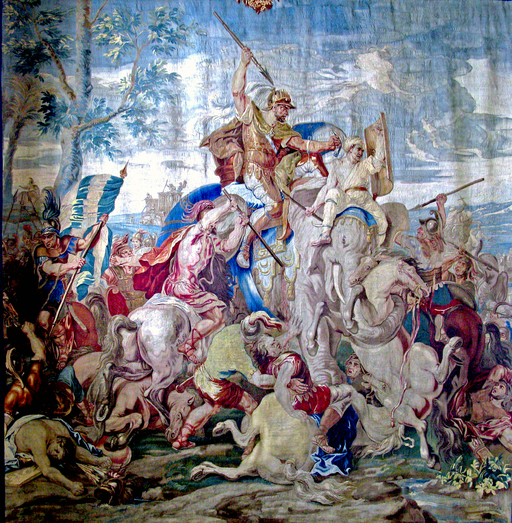
Alexander the Great, King of Macedonia, had his greatest military victory on 1st October 331 BC. This was his defeat of the Persians, under King Darius III, at Gaugamela (the battle is also referred to as the Battle of Arbela.


Alexander versus Darius

Alexander began his campaign against the Persian Empire in 334 BC and had a number of victories as he moved steadily eastwards, most notably at Issus in 333 BC. This defeat for Darius had destroyed the Persian army’s best infantry division and forced him to place much greater reliance on his cavalry, chariots and elephants.

Darius had tried to buy Alexander off with massive bribes, plus the hand of his daughter in marriage, but Alexander was determined to fight and gain  the whole of Darius’s kingdom rather than the half that he was being offered.


The Battle of Gaugamela

Knowing that he could not avoid a battle, Darius arrayed his army of 200,000 men in two lines, one behind the other, on a broad plain near Gaugamela in what is now northern Iraq. He knew that his force was considerably larger than Alexander’s (about 47,000 strong), so he had some trees felled in order to give his chariots room to outflank the Macedonians.

Alexander was a master of tactics, and he showed this now by giving the Persians every indication that he was going to mount an immediate night attack but not actually doing so. This meant that he could rest his troops and allow them a good night’s sleep, whereas Darius’s men had to maintain their positions throughout the night and were therefore exhausted from lack of sleep when Alexander eventually made his move.

Alexander sent a cavalry charge towards the centre of the Persian front line, thus appearing to play right into Darius’s hands, but then drifted off to the right. This encouraged the Persian chariots to drift correspondingly to their left, but this then created a gap in the line that Alexander’s second wave was able to exploit. Alexander had ensured that his flanks were protected by a force of light horse and infantry, and these were able to fight off the expected encircling moves of the Persians.

Alexander was thus able to force his way straight through the gap in the Persian line and head for the position held by Darius himself. The Persian king promptly turned tail and fled, thus enabling Alexander to turn back and attack the rear of the Persian force that was now attacking the Macedonian reserve force.


The aftermath

With the whole remaining Persian army in disarray, the Macedonians were able to chase them off the field. Persian losses were probably around 50,000 whereas Alexander only lost around 500 dead and 3,000 wounded. He was thus able to enter Babylon without opposition and then march into the heart of the Persian Empire, taking only 60 men with him in the final hunt for Darius. This ended when the Persian king was murdered by his own nobles, although Alexander also pursued the assassins and despatched them as well.

Alexander was thus the unquestioned ruler of the Persian Empire, having defeated an enemy that had been a threat to the Greek world for centuries. 


© John Welford


Thursday, 17 December 2015

The sinking of USS Maine, 1898


On 15th February 1898 the battleship USS Maine exploded and sank off the coast of Cuba, thus precipitating the Spanish-American War. However, the facts seem to suggest that this event was just the excuse that a bellicose American government needed to launch hostilities that would bring it new colonies at a time when the world’s great powers all seemed to be intent on grabbing what they could.

Cuba was a Spanish colony but it was undergoing considerable unrest at the time with native Cubans rebelling against their lamentable conditions. There was also a sizable American population living there, and it was in order to reassure them that President McKinley sent the Maine to lie off Havana and show the Spanish that any aggression against American citizens would not be tolerated.

During the evening of 15th February a massive explosion ripped through the front half of the ship which then sank to the bottom of the harbour, leaving only the bridge and stern above water. Of the ship’s complement of 350 men, 260 died.

Blame for the explosion was immediately assigned to the Spanish, not least by the newspaper magnate William Randolph Hearst. With absolutely no evidence to support his claim, he lambasted the Spanish colonisers for their act of war against the United States, even publishing artists’ impressions in his newspaper, the New York Journal, that showed Spanish saboteurs placing mines on the hull of the Maine.

Hearst sent reporters and a war artist to Cuba to report on the war then taking place between the colonisers and the Cuban rebels, despite the fact that there was no such war. When the artist told Hearst that this was the case, his reply was, “You furnish the pictures, I’ll furnish the war”.

Hearst soon persuaded the vast majority of the American people that the Maine had been blown up by Spanish terrorists out of contempt for the United States, and Congress duly demanded that Spain withdraw from Cuba. When this did not happen, war was declared in April 1898.

The hostilities were very one-sided and Spain was forced into a humiliating peace treaty within eight months. As a result, the United States gained control of Puerto Rico, Guam and the Philippines.

Behind it all lay the ominous figure of William Randolph Hearst, who had engineered a war that cost tens of thousands of lives, most of them from disease rather than actual combat. Hearst’s motive, although cloaked in patriotism, was simple naked greed – he merely wanted to increase the circulation of his newspapers. Hearst’s way of doing business would become a byword for the criminal manipulation of world affairs by corrupt and immoral capitalists.

Hearst’s methods were satirised very competently by the British novelist Evelyn Waugh in his 1938 novel Scoop, although it was British newspaper owners such as Northcliffe and Beaverbrook that were his principal targets. However, the idea that powerful press barons could turn fiction into reality by telling downright lies and persuading gullible people to believe them, to the extent of world history being changed, surely owes its origin to Hearst.

As for the USS Maine, the most likely explanation for its demise was an accidental detonation in a coal bunker, caused by an oversight on the part of a crew member. One simple mistake was to lead to devastating and far-reaching consequences.

© John Welford

The Battle of Nicopolis, 1396


The Battle of Nicopolis on 25th September 1396 was the final action of one of the last flowerings of the Crusader spirit and, like just about all its predecessors, it was an ignominious failure.

A new Crusade

In 1395 the Sultan of the Ottoman Turks, Bayezid, had begun a campaign of conquest into mainland Europe. He besieged and captured the fortress of Nicopolis (modern day Nikopol) on the Danube in Bulgaria in July 1395, killing the Bulgarian tsar in the process, and this caused panic further west as the threat to Christian Europe became fully appreciated.

Pope Boniface IX, like so many popes before him, called upon the faithful to launch a crusade to defend Christianity against the forces of Islam. The call was heeded by Jean de Nevers, the son of the Duke of Burgundy, and by July 1396 he had assembled an army that was headed by 10,000 Frenchmen, augmented by troops from Germany, England, Poland, Austria and other countries. When the army reached Buda it was joined by King Sigismund of Hungary who contributed a huge force of 30,000 men.

The aim of the crusade was to sweep the Turks out of Europe and then continue through Syria to Jerusalem, which would in turn be recaptured. First, however, they needed to seize control of Nicopolis.

The Nicopolis campaign

Knowing that the first task was going to be to capture a well-defended fortress, it is surprising that the European army did not equip itself with siege equipment. However, they did not, and so were unable to do anything other than surround Nicopolis and wait for it to fall. This gave the Turks time to await reinforcements, which arrived in the shape of Sultan Bayezid himself (nicknamed the Thunderbolt) at the head of a large army, which dug defensive positions on the road leading to the fortress.

The battle began when the French mounted knights, acting on their own initiative, attacked the Turks. They made good progress until they came up against the Turkish defences of sharp stakes planted in the ground, which forced them to dismount. Even fighting on foot they killed many Turkish soldiers but were eventually cut off from the rest of the army and suffered heavy losses with many of them being taken prisoner.

The Hungarian infantry also enjoyed initial success but were then beaten back after being ambushed by the Sultan’s Serbian allies. King Sigismund was able to escape by taking a ship up the Danube, but Jean de Nevers was captured and held for ransom.

On the following day Bayezid took revenge for his heavy losses by killing most of his prisoners and giving the rest to his soldiers as slaves.

Another Crusader failure

Bulgaria was now firmly under Turkish control and would stay that way for the next 500 years. Although the term “last Crusade” is commonly applied to an action in 1443-4, the Nicopolis crusade was the last occasion on which a Pope would call on the nations of Europe to wage war against Islam.

© John Welford