Followers

Saturday, 24 March 2018

The end of the Holy Roman Empire, 1806


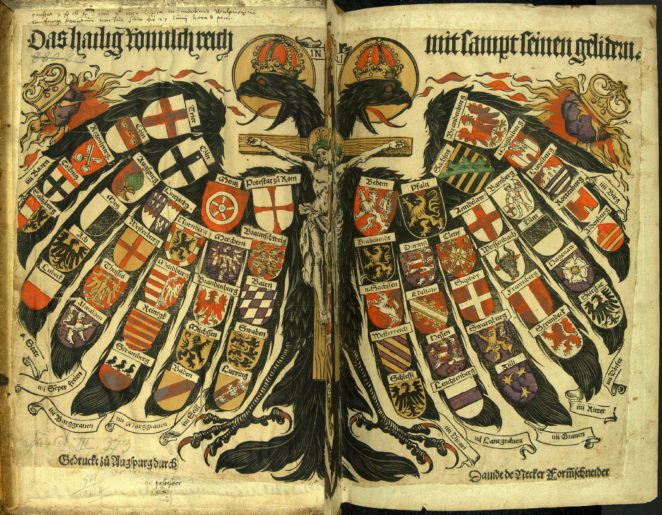
6th August 1806 saw the end of an institution that could trace its origins back for 1000 years, namely the Holy Roman Empire. However, as Voltaire said, it was neither holy nor Roman, and not much of an empire. Its formal dissolution in 1806 was merely the recognition of an obvious reality.

It began in 800 when Charlemagne thought of reviving the western Roman Empire, but based in Aachen (on the border of what are now Belgium and Germany) rather than Rome. The empire consisted of a band of territory across central Europe, and at its peak included what is now the whole of Germany, Switzerland, Austria, the Czech Republic, Belgium and The Netherlands, plus parts of eastern France and northern Italy.

The empire disintegrated early in the 10th century but was revived by “Otto the Great” in 962, after which there was an unbroken line of emperors for more than 800 years. In 1273 the first Habsburg emperor, Rudolf I, claimed the title, and the Habsburgs continued the line (with only minor exceptions) for the rest of the empire’s existence.

The “Holy” part of the title came from the fact that, at first, the Pope crowned the emperor, although this practice ended in the 16th century when the Protestant Reformation broke the link between the Empire and the Papacy.

The power of the emperor – who was nominally elected to office, but not democratically – rose and fell across the centuries, but for much of its history the Empire consisted of a patchwork of many tiny dukedoms and principalities, each ruler of which held controlling power within his territory.

In 1806 it was very clear where real power lay in central Europe, namely with Napoleon Bonaparte, whose own French Empire was all-powerful. Emperor Franz II – another Habsburg – decided that he would rather be Emperor of Austria than Holy Roman Emperor, so the wholly anachronistic title vanished for ever as the 67th emperor became the last one.

© John Welford

The Battle of Towton,1461


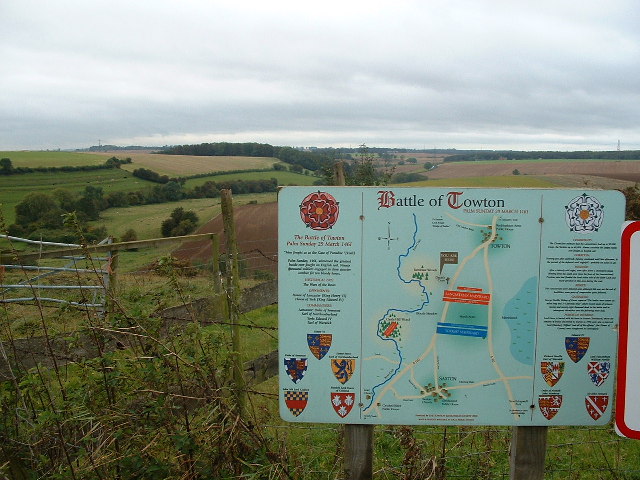
The Battle of Towton, fought on 29th March 1461, holds the record as the bloodiest battle ever fought on English soil with an estimated 20,000 men (maybe more) being killed. The battle marked an important stage in the so-called Wars of the Roses because it ended the reign of King Henry VI (although he was to return to the throne briefly nine years later) and saw the triumph of King Edward IV.

The term Wars of the Roses was not a contemporary one and only came into common use during the 19th century. It is based on a fiction invented by William Shakespeare in his play King Henry VI Part 1 (Act 2 Scene IV), in which nobles pick red or white roses to indicate which side they are on.

The two opposing houses of Lancaster and York took their names from the third and fourth surviving sons of King Edward III, namely John, Duke of Lancaster and Edmund, Duke of York. They were the great-grandfathers, respectively, of Henry VI and Edward IV. The house of Lancaster has traditionally been represented by a red rose and the House of York by a white one, but, although the Yorkist forces did use the white rose as their badge, there is no evidence that the Lancastrians used the red rose.

The civil war for the mastery of England had already been running for 18 months when the armies of Henry and Edward met at Towton, which is 12 miles southwest of York. The day was Palm Sunday and the weather was bitterly cold with a strong wind whipping snow flurries into the faces of the troops – possibly as many as 50,000 – who were camped in readiness for battle. The Lancastrians probably outnumbered the Yorkists by as many as 5,000 men.

No eyewitness accounts of the battle have survived, but it seems clear that, after a preliminary exchange of arrows, Henry’s army charged and at first seemed to have the upper hand. Edward (aged18) fought in the front line and his personal bravery inspired his men. He was greatly helped by the arrival of fresh troops under the command of the Duke of Norfolk, these joining the fray as the snowstorm grew steadily worse.

Perceiving that the battle was lost, many Lancastrian soldiers tried to escape, but in the confusion caused by the poor visibility many found themselves trapped in the Cock Beck, a stream of no great width but fast-flowing with extremely cold water. Many men were weighed down by their armour and pushed under by those following behind. Many of the casualties suffered by the Lancastrians were caused by this means.

Henry, who did not take an active part in the battle due to his fragile mental state, escaped and fled to Scotland, leaving Edward to usurp the crown. However, the Lancastrian cause was not completely lost. Henry would have a second reign after Edward lost support in 1470 and his former ally the Earl of Warwick (known to history as the “Kingmaker”) turned against him and was instrumental in Henry regaining the throne. This would prove to be a short interregnum for Edward IV, who triumphed at later battles (Barnet and Tewkesbury in 1471) and continued to reign until his death in 1483.

©John Welford

The Battle of Bouvines, 1214


The story of the Battle of Bouvines, fought in 1214, is one of a “dead cert” plan that turned out to be far from cut and dried.

Otto IV, the Holy Roman Emperor, thought that a good way of keeping his barons loyal would be to invade France and reward his followers by giving them large pieces of captured territory. However, he was not sure that he could do this without some help, so he called on three other supposedly powerful warlords to join him in this quest.

These were Ferrand (Count of Flanders), Reginald (Count of Boulogne), and King John of England, who would presumably have had some sympathy with a fellow monarch who had problems with his barons.

The plan was for King John to land on the French coast and head for Paris, creating mayhem as he did so, while the other three invaded from the northeast. The problem with the plan was that it depended on John being able to get something right, but Otto should have known better.

The French King Philip Augustus met King John’s army at Angers on 2nd July 1214 and had an overwhelming victory. That left him free to concentrate on the other invaders and to gather reinforcements for his own army as he moved towards them.

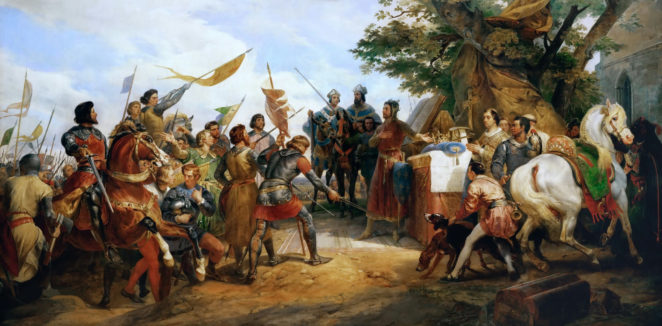
The opposing forces met at Bouvines near Lille on 27th July. Philip’s army was still smaller than that ranged against him, and it looked at first as though Otto and his allies would prevail. However, Philip’s cavalry eventually got the better of the allies’ infantry and were able to achieve a decisive victory.

Philip’s personal bravery was an important factor in battle, as he was able to encourage his men to redouble their efforts after he had been unhorsed and almost killed but was then able to remount and carry on.

Otto’s failure to conquer France led to his own removal as Emperor and his replacement by Frederick II. John’s defeat only served to reinforce his weakness in the eyes of his own barons, who were emboldened to push through their own “revolution” of forcing King John to sign Magna Carta the following year.

The actions of Philip Augustus in recruiting men from the merchant class of France to join his army showed that French nationalism was not the sole prerogative of the knightly class. This was itself an important development in the history of Europe.

© John Welford

Friday, 23 March 2018

The Battle of Adwa, 1896


During the 19th century the continent of Africa was thoroughly colonized by the European powers – Great Britain, France, Germany, Belgium, Spain and Portugal; to the extent that eventually only two nations remained “free”, these being Liberia – settled by former slaves from the United States – and Ethiopia.

That meant that when the Italians decided that they also wanted a piece of the action, their choice was severely limited. Ethiopia was by far the more attractive option, so that became their target.

Their efforts at conquering Ethiopia met with only partial success at first, with defeat at the hands of King Johannes IV at Bogali in 1887, but they did manage to control much of the country, at least nominally, for the next nine years.

However, in 1995 King Menelek II decided that the Italians should go. The Prime Minister of Italy, Francesco Crispi, was determined to resist and sent an army to Ethiopia under General Baratieri.

The Italians were convinced that they would have no trouble in defeating the Ethiopians, whom they regarded as primitives when compared with their own army with its superior training and technology.

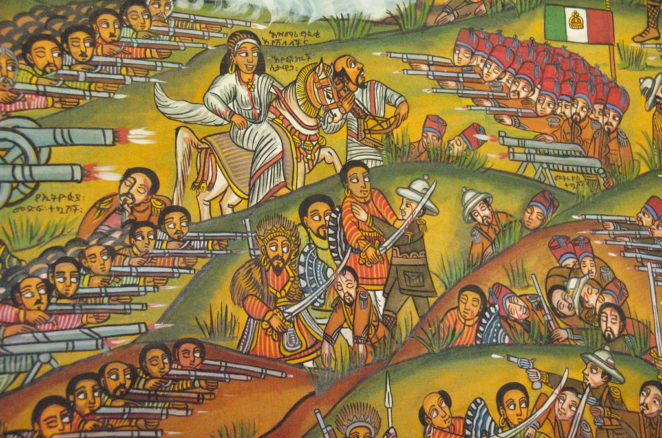
The Italian force of 17,000 men and 50 artillery pieces was supplemented by a brigade of local troops from Eritrea who were known as askari. The Ethiopians could muster an army of 100,000 riflemen with significant cavalry support.

The forces joined battle at Adwa, in northern Ethiopia, on 1st March 1896. The result was not long in doubt, with the Italians being caught in crossfire and overwhelmed by vastly superior numbers.

Some Italians were able to escape the slaughter, but more than 10,000 were killed, wounded, or captured and held for ransom. 3,000 captives were eventually released, but the Ethiopians did not treat the askari as well as they did the Italians. 800 of them suffered the loss of their right hands and left feet.

The defeat put paid, for the time being, to Italy’s ambition of becoming a colonial power in Africa. In 1935 Benito Mussolini had another go at conquering Ethiopia and was successful, with the “Empire of Ethiopia” lasting from 1936 to 1941.

However, the Battle of Adwa stands as the only example of a would-be colonial power being thwarted by an African nation.
© John Welford

Tuesday, 20 March 2018

Kamikaze: the Divine Wind


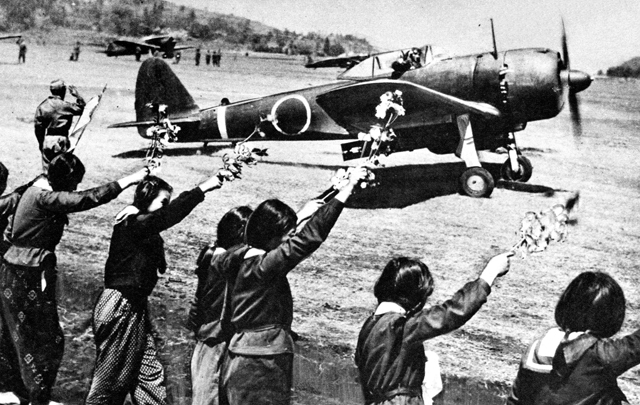
Towards the end of World War II, desperation by the Empire of Japan led them to adopt the extreme tactic of flying suicide missions against allied shipping. Planes laden with explosives would be deliberately crashed into ships with the object of causing maximum casualties for the loss of a single Japanese pilot.

These missions were termed “kamikaze”, which means “divine wind”. But where did the term originate?

It relates to an important incident in Japanese history back in 1281. The Mongols of central Asia had established a vast empire that stretched from Hungary in the west to Korea in the east. This had been due largely to the campaigns of Genghis Khan, but it was his grandson Kublai Khan who was determined to add Japan to what had, up to that point, been a contiguous land-based empire.

In August 1281 he assembled a vast fleet of ships that were capable of transporting 140,000 soldiers. These were landed at Hakata Bay on Kyushu, the southernmost of Japan’s four main islands, but they were met by a fierce response in the form of Japanese samurai warriors. The invaders withdrew to their ships to plan their next move.

Traditionally, the Japanese had always feared the 1st of September, which is day 210 of the lunar calendar then in use in Japan. This was called the “day of storms” because it was the mid-point of the typhoon season and bad weather often occurred on that day.

Had the Mongols spent more time at sea and less on land during their many years of conquest, they might have realized that this was not a good time of the year to mount an invasion from the sea, but that was the mistake they had made. A terrible typhoon duly arrived on 1st September and caused utter havoc to the Mongol fleet.

Many of the ships were sunk in the storm, with others being driven on shore and the shipwrecked soldiers promptly killed by the Japanese defenders. One estimate of the disaster put the casualty figure as high as 100,000.

The typhoon therefore became the divine wind – the kamikaze that would deliver Japan from its enemies.
© John Welford

Monday, 19 March 2018

John Appleby reluctantly takes to the air


The first man to take off from the ground and fly was not Orville Wright in 1903 but (it is believed) John Appleby, a coachman who was a highly reluctant pioneer of aviation fifty years earlier. He had his employer, Sir George Cayley, to thank for that.

Sir George Cayley

Born in 1773 at Brompton in Yorkshire, George Cayley was born into wealth and privilege. He inherited his father’s baronetcy in 1792, with which came ownership of Brompton Hall and its large estate. At one time in his life he represented Scarborough as its Whig Member of Parliament.

However, having a considerable amount of leisure time on his hands, he decided to put that time to good use in the investigation of scientific and engineering matters. He had varied interests but is best remembered for his lifelong desire to find a way of getting a man to fly like a bird.

From watching seagulls gliding on the wind he soon deduced that something as heavy as a man could only get airborne if his “wings” were still rather than flapping, and from that he proposed that there were four fundamental forces that had to be co-ordinated, namely gravity, lift, drag and thrust.

He was the first man to realise that a wing would provide lift if it was shaped in such a way that the airflow above and below moved at different speeds when the wing was in forward motion. This is the principle that has been behind fixed-wing flight ever since.

A machine takes shape

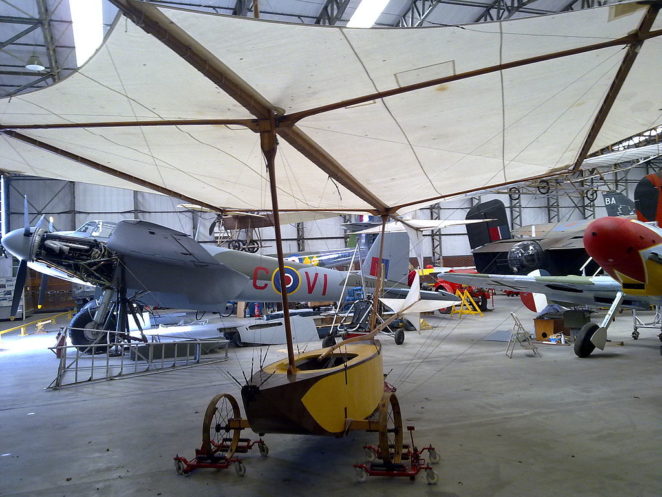
Sir George Cayley spent many years working on his theories and building models that put these theories into practice. However, it was not until 1853 that he was able to build and test a real man-carrying flying machine. This was a monoplane with kite-shaped wings made from cloth to the extent of around 500 square feet (46 square metres), an adjustable tail and fin, a boat-shaped cockpit slung underneath and a tricycle undercarriage.

Sir George, having spent a lifetime working on this project, was now an old man of 80, and therefore not suitable as the first pilot. There have been suggestions that he would have liked to make the experiment but his wife would have none of it!

Step forward, John Appleby

The next part of the narrative is admittedly uncertain, because there are conflicting versions of it, but it makes a good story and could possibly have been true.

John Appleby was Sir George’s coachman, who had witnessed all Sir George’s previous contraptions and experiments with bemused interest. When the glider was pulled into the open in front of the entire household, John peered at it a little too closely and was duly spotted by Sir George.

“Just the chap I was looking for”, said Sir George, and John Appleby found himself strapped into the cockpit before he knew what was happening.

The machine was wheeled to the top of a slope and pushed downhill. The basic theory proved correct and the forward momentum was enough to provide enough lift on the cambered wing to take the craft, and John Appleby, into the air above the valley in front of Brompton Hall.

The flight was a short one, with the craft making a crash landing on the other side of the valley. Sir George and the entire household rushed across on foot, to find the coachman only slightly injured but far from pleased. 

John Appleby glared at Sir George and promptly resigned his position, stating that he had been hired to drive carriages and not flying machines.

Sir George Cayley’s place in history

Sir George died in 1857 and so was not able to make any further experiments, such as building an improved design. It was therefore left to others to carry forward the notion that manned flight was possible.

The invention of the internal combustion engine made it possible to think of flight that not only started from level ground but could also be sustained in the air, despite the extra weight that would have to be carried. This was clearly where the future lay, but it would be another 50 years before the Wright brothers were able to make this dream a reality.

That said, Sir George Cayley’s theories were largely correct and only lacked other technologies to make them realisable. For that reason, Sir George and John Appleby (assuming that this part of the story is true) deserve their place in the history of aviation.


© John Welford
Sunday, 18 March 2018

How the journey of Lewis and Clark had an impact on American English


Lewis and Clark were two explorers who were sent by President Thomas Jefferson to explore the interior and west of the North American continent. Inadvertently, they also made important contributions to the development of American English.


The western adventure of Lewis and Clark

It cannot be denied that American English exhibits many features that are peculiar to it and which set it apart from other varieties of English spoken around the world, noticeably that of the “home” country of English, namely the United Kingdom.

One contribution that is not always appreciated is that of Lewis and Clark, two explorers who were sent west by President Thomas Jefferson to, if possible, discover a river that flowed to the west coast.

This expedition was made possible after the American government doubled its territory in 1804 through the Louisiana Purchase, surely one of the best bargains of all time. However, little was then known about what this new land contained, whether it offered enticing prospects for development or dangers for the unwary, whether the natives were friendly or hostile, and much else besides.

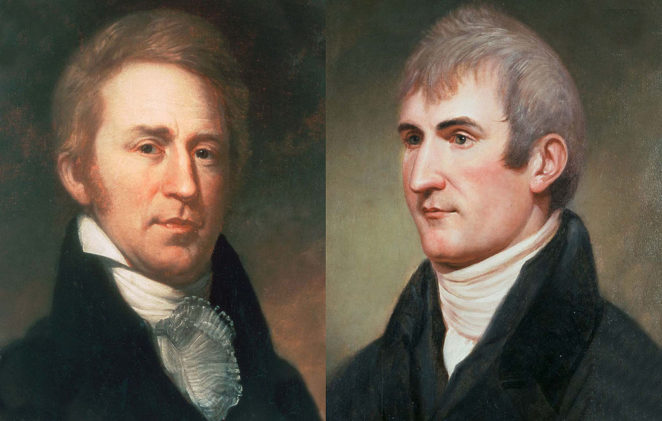
Meriwether Lewis (1774-1809) and William Clark (1770-1838) were army captains (technically, Clark was only a 2nd lieutenant but this detail was overlooked) who led an expedition that totalled 33 individuals, setting off on 14th May 1804.


The journals of Lewis and Clark

For the story of American English, the important thing to note is that Lewis and Clark kept meticulous daily journals throughout their travels, at President Jefferson’s insistence. On their return, these journals were published, becoming hugely popular and widely read, and from them came a whole host of words that had never been seen before.

Lewis and Clark were not highly educated men, having spent much of their young lives exploring the outback and fighting small campaigns against various native tribes. Clark, who seems to have done much of the writing of the expedition journal, was particularly conscious of his lack of skill as far as grammar and spelling were concerned. It was, in any case, a time when spelling had not yet been standardised by dictionaries such as Noah Webster’s which first appeared in 1806.


New uses for old words

The journals therefore describe places, geographical features, animals, and much else besides, in the best language that Lewis and Clark could manage. This was partly due to their ignorance as a result of poor education but also from the need to find names for the unfamiliar. For example, the word “creek”, which means a tidal inlet in British English, was now used to mean any sort of stream. The word “rapid” is an adjective, but it could do excellent service to describe water moving rapidly over a rocky bed, as “rapids”.

When Lewis and Clark had no word for something, they were apt to stick two words together to create a new one. A snake which shook its tail to make a rattling sound could best be described as a “rattlesnake”. A wood of trees bearing tufts that looked like cotton gave rise to “cottonwood”. There are hundreds of such examples in the journals.


Mistakes and new words

Some of the mistakes of modern American English can be laid at the doors of Lewis and Clark, due to their lack of knowledge. The animal known to Americans as a “buffalo” has no connection with the African or Asian animals of that name, as what Lewis and Clark thought were buffaloes were in fact bisons, which are a completely different species. The same is true of “elk”, which is not the same species in Europe that it is in America.

On their travels, Lewis and Clark came across several native American tribes and picked up many names from them. Some 500 words in the journals are of native origin, including “maize”, “opossum”, “hickory” and “toboggan”.

Noah Webster declared that his dictionary contained only about fifty words that could be said to be peculiarly American. That is far from the case with the journals of Lewis and Clark, which are full of “Americanisms”, many of which have since flowed out of America and into the English spoken in other parts of the world. Without in any way intending to create a revolution in the way English was written and spoken in North America, Lewis and Clark did precisely that.

© John Welford