Followers

Showing posts with label American history. Show all posts

Monday, 17 August 2020

The Puritan colonies of New England


The first English colony in what is now the United States of America was that of the Virginia Company, founded in 1607 during the reign of King James I. The first township was called Jamestown, after the king.

The next American colony was of a very different character; it was formed by religious exiles from England. A few Puritans, mostly from Lincolnshire, were disgusted with their treatment in England under King James I and left England to seek refuge in Holland. After ten years there, some of them decided to emigrate to North America. Other Puritans joined them, and the exiles, who became known as the Pilgrim Fathers, left Plymouth in the Mayflower in September 1620. They landed just north of Cape Cod and founded the first township which they called Plymouth.

Eight years later a larger body of Puritans in England formed a company which they called the Massachusetts Bay Company. The following year King Charles I granted them a charter and the whole body of shareholders crossed the Atlantic in 1630 to form the colony of Massachusetts. A steady flow of English immigrants during the next eleven years meant that the colony prospered. By 1644 the total population was more than 20,000.

Despite the fact that these Puritans had left their home to escape from religious intolerance, their own government was no less intolerant. John Winthrop, the first governor, was a man of considerable ability but had narrow views. Political rights in Massachusetts, no less than in England, depended on conformity with the narrow religious creed. This creed was determined by a small circle of strict Puritans who supported the governor. Anyone who differed from their rulers on minor points of religion could be subject to harsh punishment. Roger Williams, a clergyman who was driven from Massachusetts by this persecution, founded a new colony, that of Rhode Island, in 1636.

Other colonies followed, namely Connecticut and New Hampshire, the whole group becoming known as new England. These Puritan colonies were on the whole very prosperous, continuing to receive emigrants from England. Although the New Englanders tend to be less aristocratic than the Virginians, narrow religious opinion prevented the growth of a real democracy. The severance from England was more marked that of Virginia, because they regarded themselves as exiles rather than colonists.

© John Welford

Wednesday, 1 April 2020

The Shakers: The "Shaking Quakers" best known for their furniture


The Shaking Quakers, better known as Shakers, were a remarkable group of Christians that flourished in the United States during the late 18th and early to mid 19th centuries. Although their numbers were never all that large their name lives on mainly because of the artefacts they left behind them.
History of the Shakers
Although they are always thought of as an American religious sect, the Shakers had their origins in England. Their founder was Ann Lee, who was born in Manchester in 1742. She came from a very poor background and had to work in a factory. She sought solace in religion and joined a group that held meetings in which dancing and shouting in strange languages were encouraged.
Ann Lee fell out with this group over her belief that the root of all evil was lust, which was the real reason, according to her, why Adam and Eve were expelled from the Garden of Eden. She felt herself called to spread the word about the need for chastity, and became convinced that the American colonies would be the most receptive place for her message. She therefore left England for America in 1774, accompanied by her husband and a few followers.
It was not until 1780 that Ann Lee began her public ministry (at Niskeyuna near Albany, New York), but this was followed by a missionary journey through New England from 1781 to 1783. This led to the setting-up of a number of “Shaker villages” that were to become the nucleus of the sect. Ann Lee’s message about the value of hard work, meekness and simple living went down well with the Yankees in their newly freed states, but many were not so happy about the idea of enforced celibacy and this led to physical attacks on Shaker worshippers.
Ann Lee and her husband both died in 1784, but the movement was then led by James Whittaker, who was followed by Joseph Meacham. Whittaker stressed the need for communal ownership of property and Meacham developed the blueprint for gathering Shakers into communal villages. He was joined in the leadership by Lucy Wright, and this established a pattern within the villages of a male leader or official being matched by a female one.
There were originally eleven villages in the New England states, and the movement later spread westwards into Ohio, Kentucky and Indiana. 
Shaker communities
Shakers were allowed to marry but could not have sexual relationships. They therefore lived in separate dormitory-like buildings and children were raised in their own groups rather than directly by their parents.
Although new recruits to the movement would have brought their children with them, no further babies were born. Shakers therefore adopted orphans from outside their communities, and this no doubt solved many problems for non-Shaker women who bore children out of wedlock.
Shaker communities were founded on hard work and sharing various labours, but they did not believe in drudgery for its own sake. Shakers were responsible for producing several labour-saving devices, including the circular saw and a washing machine.
They traded extensively with the outside world, becoming known not only for the quality of their work but for their honesty in business dealings. Shakers became particularly well known for their furniture, which was basic in design but well-made and comfortable. Many pieces have survived to the present day.
By removing the burden of child-bearing from their women, the latter were able to play a full part in the life of their community to the extent that the sexes were regarded as equal in all material respects. It was true that certain tasks were regarded as men’s work and others as women’s work, but this did not mean that men’s tasks, such as blacksmithing and cabinet-making, were seen as being more important than the women’s tasks of cooking and cleaning. They were different in kind, not in status.
This attitude to gender roles and the importance of dual leadership were grounded in the Shakers’ theological view that God was both male and female and all creation was based on that duality. Ann Lee, who was revered as “Mother Ann” was the female counterpart to the male Jesus. 
The “shaking” of the Shakers continued to be an important feature of their worship meetings, in which the sober behaviour of the people in their day-to-day activities was replaced by dancing and shouting. However, at times during the 19th century the Shakers adopted a less exuberant form of worship, with choreographed dance movements and songs that were sung unaccompanied. They allowed non-Shaker visitors into these more restrained Sabbath meetings and drew large crowds. 
The decline of the Shakers
The Shaker movement was not attuned to modern times and it eventually faded away, starting from the late 19th century. The ban on sexual intercourse not only made it impossible for Shakers to maintain their numbers unless they adopted orphans, but it also made their way of life less attractive to those orphans when they grew up and, to be blunt, realised what they were missing. Many of them left the villages at the first opportunity. The Shaker lifestyle was in any case unappealing to most outsiders and recruitment became increasingly rare.
There is, however, one Shaker village still in existence. This is Sabbathday Lake in Maine, where the last few Shakers live out their days and the village acts as a museum of Shakerism. Meanwhile, genuine Shaker furniture attracts very good prices at antiques sales across the world on the rare occasions that it comes on the market.
© John Welford

Saturday, 22 February 2020

Peter Minuit's big buy


On 24th May 1626, a director of the Dutch West India Company named Peter Minuit, a Dutch-speaking German, bartered a consignment of pots, pans, fish hooks, tools and cloth, together worth around 60 guilders, for an island at the mouth of the Hudson River. The value of that island, named Manhattan (“island of hills”) by the local Algonquin tribe, has risen considerably between then and now!

Two years before Peter Minuit had joined them, the Dutch West India Company had established the colony of New Netherland in the lower Hudson valley and had landed its first settlers there who subsequently established small communities dotted around the bay into which the Hudson River empties. However, war broke between local tribes over the fur trade they were conducting with the settlers, and the purpose of Minuit’s purchase from the native Lenape people was to provide a safe haven for the settlers at its southern tip.

He called the settlement New Amsterdam and had a wooden fort built at its centre into which the settlers could retreat if they came under threat.

In 1631 the Dutch West India Company called Peter Minuit back to Holland and, after more adventures in the New World, some on behalf of the Swedish government, he was drowned in 1638 in the West Indies when his ship foundered during a hurricane.

Even without Peter Minuit’s leadership the colony of New Amsterdam went from strength to strength, but things changed in 1664 when the colony was under the despotic and controversial governor Peter Stuyvesant.

As a prelude to the second Anglo-Dutch War, the English King Charles II decided that it would be a good move to annex the territory of New Amsterdam and join it to other English possessions in North America.  A fleet of warships was duly dispatched. Control of the colony was duly wrested from the Dutch after usual combination of threats and assurances had been delivered and received.

The English crown now held a colony named New Amsterdam, which clearly unsatisfactory. The king’s younger brother James, the Duke of York, was Lord High Admiral and nominally in charge of the naval action that seized the colony, so changing the name from Amsterdam to York seemed to be an appropriate move. It was therefore not the case that the colony took its name directly from the city of that name, which was typically the case when settlers from a particular town or city in Great Britain established a settlement in the New World.

James, Duke of York, who would later succeed his brother as King James II, had a personal interest in acquiring New Amsterdam because he foresaw a good deal of money flowing his way if Dutch sea power could be destroyed. He was far from being alone in this ambition and was therefore extremely popular with those colonists who shared his point of view. The choice of New York as the name did not therefore meet with much opposition.

However, once he became king in 1685, attitudes towards James changed considerably. After a reign of only three years he was forced to abdicate the throne and leave the country. He was never popular in England, having acquired the nickname “Dismal Jimmy” in contrast to his flamboyant brother who became known as “The Merry Monarch”.

Despite his later fall from grace, New York stayed as New York and that also became the name of the territory that the colonists settled between the Atlantic and Lake Ontario. Not only that, but another city also owes its name to James. This is the capital of New York State, Albany, this having been James Duke of York’s other royal title.


© John Welford


Sunday, 17 June 2018

Disneyland's first day, 1955


Walt Disney opened Disneyland, at Anaheim, California, on Sunday 17th July 1955. Despite the fact that it has been a mega-success ever since and welcomed more than 650 million visitors, the first day was a disaster.

For one thing, far more people turned up than had been anticipated. 11,000 tickets had been sold, but many fake ones had been printed and pirated, and security was so lax that thousands of people just walked in by climbing over the fences.

July in California is often hot, but the day in question was exceptionally so, with temperatures exceeding 100°F (38°C). The asphalt melted in the park and on surrounding streets, with the result that high heels sank into the surface and traffic jams formed in all directions.

Some of the rides broke down, there were gas leaks, food and drink sold out, and the water fountains ran dry due to a plumbers’ strike.

The TV coverage was terrible, caused in part by the incompetence of one of the presenters, a certain Ronald Reagan.

One might have imagined that “Black Sunday” would have been enough to condemn the venture to an early grave, but that was not the case. Disney had invested millions of dollars in the project, which had been developing ever since 1948, and public interest had grown throughout this period. It was simply too big to fail, and it clearly did not do so. Disney theme parks – in California, Florida and France – have continued to be major international attractions that show no sign of ceasing to be so.

© John Welford

Wednesday, 4 April 2018

The Kensington Runestone hoax


During the early 20th century much excitement was caused by the “discovery” of an ancient stone that seemed to prove that Scandinavians had colonised part of what is now the United States in the 14th century.

The Kensington Runestone

Kensington is a small community in central Minnesota, which is well-known for having attracted relatively large numbers of immigrants from Scandinavia. However, a reported discovery in 1898 seemed to suggest that the area was home to Scandinavians centuries before the Minnesota Territory became a state in 1858.

In 1898 a farmer of Swedish extraction, named Olof Ohman, claimed to have found on his land a stone slab that was carved with an ancient inscription in runic lettering – runes are a type of alphabet that was once widely used in northern Europe, including by the ancient Vikings.

It was known that explorers from northern Europe had reached the North American continent about 500 years before Columbus set sail, but could they possibly have advanced as far as Minnesota? The runes on the stone slab seemed to suggest that this was possible.

The message of the runes

When translated, the inscription read as follows:

 “Eight Goths and 22 Norwegians on an exploration journey from Vinland to the west. We had camp by two skerries one day’s journey north from this stone. We were out [to] fish. One day after we came home [we] found 10 men red of blood and dead. AVM Save [us] from evil. [We] have 10 men by the sea to look after our ships 14 days’ travel from this island. [In the year] 1362.”

(A skerry is a small rocky island. AVM is an abbreviation for Ave Maria)

 Quite clearly a fake

There are many reasons to suppose that the Kensington Runestone was a fake.

For one thing, one has to wonder why a group of explorers who had set up camp and lost some of their number to a raid (presumably by Native Americans) would have bothered to go to the trouble of carving a message on a stone which they clearly had every intention of leaving in place before heading back to their ships. Who did they expect would read it? And what would the purpose have been of leaving such a message?

On the other hand, a farmer with Scandinavian roots who was also a former stonemason might well have thought that this was a good way of establishing some sort of ancient claim to the territory for his fellow Scandinavians. 

People who have examined the Runestone have been quick to point out that nobody writing in 1362 would have expressed themselves in the language used on the stone. It uses phrasing that was common among Swedes and Norwegians living in 19th century Minnesota but not 14th century Scandinavia.

The runes are a mixture of letters known to have been used in the 9th to 11th centuries, plus some homemade symbols. However, by the 14th century runes were only used for monumental and celebratory inscriptions, and not for general messages. On the other hand, they would not have used Arabic notation for the date.

Could a Scandinavian expedition have taken place?

When the Kensington Runestone was first “discovered” by Olof Ohman there were plenty of people who were perfectly happy to accept it as genuine. Many settlers from Europe were unhappy with the notion that they were usurpers in someone else’s land, and they therefore welcomed evidence of former settlement by people of the same genetic background as themselves. 

However, there is no evidence that any such event as detailed on the stone could have happened. Mention is made of “Vinland”, this being an area – possibly in what is now the Canadian province of New Brunswick – that was settled very briefly by Viking explorers in the early 11th century. It was certainly not in Viking hands in the mid-14th century.

Various claims have been made for the authenticity of Viking “finds” on mainland North America, but none have been convincing. The only item that looks to be at all genuine is an 11th century Norwegian coin that was found at a Native American site in Maine. However, there is nothing to suggest that this could not have been “planted”.

The evidence all points to the fact that, although Scandinavians did reach the mainland of North America towards the end of the 10th century, they did not stay for long. They had little reason to settle, and did not do so.
© John Welford

Sunday, 1 April 2018

Seward's Folly: the Alaska purchase


On 30th March 1867 William Seward, the American Secretary of State, completed the purchase of a parcel of land that was seven times the size of Great Britain. He committed the expenditure of $7.2 million, which many people at the time thought was a complete waste of money, especially as the land in question comprised a vast frozen wilderness. That was why the deal was known by some as “Seward’s Folly”.

The seller was Russia, and the tract of land is what is now the State of Alaska, although it only acquired this status in 1959, after nearly a century of merely being an American territory. Comprising nearly 600,000 square miles, Alaska is easily the largest State of the Union, being twice the size of Texas, although its population, at around 600,000 – one per square mile – is the smallest of any state.

On the face of it, one can see why Seward’s Folly might have been well named at the time. This mountainous, icy land is not suitable for agriculture and – at the time of the purchase – there were no known mineral deposits that were ripe for exploitation. Even though the price worked out at two cents an acre, it hardly seemed to be a bargain.

The reasons for the purchase had much more to do with international politics than with economic concerns. Russia was keen to sell Alaska because it feared its capture by Great Britain in any future conflict. This would have been entirely possible, given the British presence in what are now the Northwest Territories of Canada. Were Britain to capture Alaska, Russia would have a potential enemy to the east as well as the west.

From the American perspective, keeping the British in check was also a sound move. If Alaska was American, then British Canada would be constrained by American territory on both sides.

As things turned out, William Seward’s purchase was also a good move in economic terms. Modern Alaska has huge fishing and timber industries, but its main asset, which meant absolutely nothing back in 1867, is oil. It has been estimated that the value of the oil lying underneath Alaska equates to $1 million per inhabitant, although all sorts of environmental issues arise in terms of how that value might be realized.

Had William Seward invested his $7.2 million at 5 per cent, it would be worth around $7 billion today. That sounds like very small beer compared with the $600 billion of Alaska’s potential oil wealth.
© John Welford

Tuesday, 27 March 2018

What was a slave worth in 18th century America?


Debates about slavery in the United States went back many years before the American Civil War brought “slave” and “free” states into bloody conflict in the 1860s. A debate at the Constitutional Convention of 1787, for example, led to a strange compromise over slavery that had more to do with mathematics than the morality of slave ownership.

The issue was over the decision to establish a House of Representatives, of which each state’s membership would be decided by its population. The greater the population of a state, the more representatives it would have in the lower house of Congress.


Slavery in the Late 18th Century

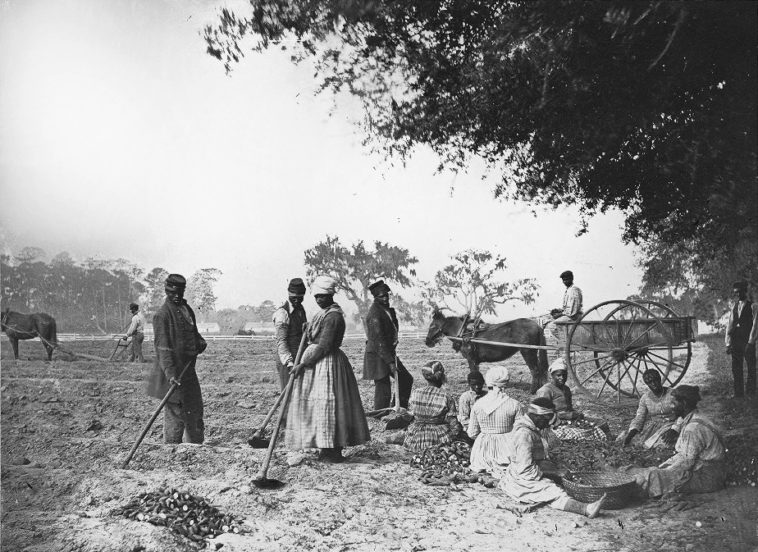
Slavery was not a particularly burning or divisive issue in the 1780s. Indeed, as an institution it had been in decline for some time. The northern states did not need huge numbers of slaves, although there were still as many as 10,000 slaves in New York State in 1820. Even in the states of Maryland and Virginia, tobacco production had exhausted the soils and large gangs of slave labour were impractical on the cereal farms that took the place of tobacco plantations. However, the production of rice and indigo in the swamps of Georgia and the Carolinas did require the use of slaves, and this was where the largest numbers were employed.

It was only when Eli Whitney’s cotton gin made production possible across a much wider sweep of territory, from the 1790s onward, that the plantation system really took hold in the South, and with it the development of slave labour on a much larger scale.


Slavery and Representation of the States

Of the 13 ex-colonies that were to become the first “United States”, only five regarded the institution of slavery to be essential to their economies (although this was a dubious claim in the cases of Virginia and Maryland, as noted above). With membership of the upper house of Congress, the Senate, being fixed at two members per state, these five states would always be in a minority. However, could they work out a way of achieving something like parity in the lower house?

On the face of it, this was also unlikely. Although industrialization had yet to take off in the northern states, that was where the larger cities were, such as Boston, New York and Philadelphia. Despite the larger geographical areas of states like Georgia as against Rhode Island and Connecticut, their populations were either smaller or disproportionate to their relative sizes.

Unless, that is, you counted the slaves.


The Constitutional Compromise over Slavery

There was no disagreement about the status of Native Americans. They did not count for purposes of representation, but then they were distributed across all the colonies at this time. However, if the southern states could count their slaves, they would quite easily be able to overcome their disadvantage in Congress.

The northern delegates at the Convention pointed out, with some justification, that it was strange that southern slave owners should regard their slaves as being mere items of property when it suited them to do so, but equal with them as human beings when the occasion so demanded.

However, it became clear that, for the Convention to succeed, a compromise would be needed, and this was that each slave would count as three-fifths of a free person. This allowed, for example, the Carolinas to have ten representatives between them, as against the eight from Massachusetts. Although the balance of representation was still tipped in favour of the free states against the slave states, at 33 to 29, it was much closer than it would have been otherwise.


The Illogical Nature of the Compromise

Many northerners were distinctly unhappy with this state of affairs. One wit even proposed that horses, being as useful as slaves, should surely count as being two-fifths of a person, and man’s best friend, the dog, had a good claim to count as one-fifth of his master, for purposes of representation.

This was just one example from history of how expediency can take precedence over justice and logic. It was not until the 14th Amendment to the Constitution was ratified in 1868 that this nonsense ceased to be part of the American Constitution.


© John Welford

Monday, 26 March 2018

The Seven Cities of Cibola


The Spaniards who explored the Americas in the 16th century had one basic aim in mind, which was to become enormously wealthy by discovering and claiming the vast hordes of gold that they were quite convinced lay in the lands across the sea.

The legend of Antillia

One legend that was widely believed was that when the Moors invaded Spain in the 12th century seven bishops and their followers had escaped and sailed to the west. They had found a new land to settle and each bishop had established a city-state that had grown rich and magnificent. The land was supposed to be an island called Antillia.

The belief in Antillia was so ingrained that maps of the time actually depicted it, and this was somewhere that Christopher Columbus expected to visit as a stopover en route to the Indies. There was even a legend that a ship had landed there and found that the beaches comprised only one-third sand, the rest being gold dust!

Further west?

Needless to say, the early explorers did not discover the Seven Cities of Gold on Antillia, although the islands of the Caribbean were named the Antilles. However, this did not kill the legend. The cities must therefore be somewhere else.

In 1528 an expedition into the interior of North America brought back stories that the natives lived in fabulously wealthy cities, seven in number, of which the greatest was called Cibola. This was all that was needed to get the Spaniards excited and a new expedition was organized with a view to finding the Seven Cities of Cibola and plundering their riches.

This was led by Don Francisco Vasquez de Coronado, who failed in his aim but did achieve something that no European had done before, which was to view the Grand Canyon.

So what were the seven cities?

It has to be assumed that what the early explorers had discovered were the pueblos of the Zunis and other tribes in what is now New Mexico and Arizona. These were structures built largely from adobe mud. Many of these buildings were multi-roomed and on more than one storey. A notable feature was the method of entering buildings from the roof via a ladder. Many such structures were grouped around courtyards and were home to hundreds of people.

The pueblos certainly counted as cities, but why golden? That might well be explained by the fact that straw was often mixed with the mud to help to bind it, and sunlight glinting on straw might look like gold from a distance.

So did the explorers leave well alone and go home disappointed? Not exactly. The Pueblo Peoples, like the rest of the Native American population, would soon find to their cost that Europeans sought only conquest, not cooperation.
© John Welford

Sunday, 18 March 2018

How the journey of Lewis and Clark had an impact on American English


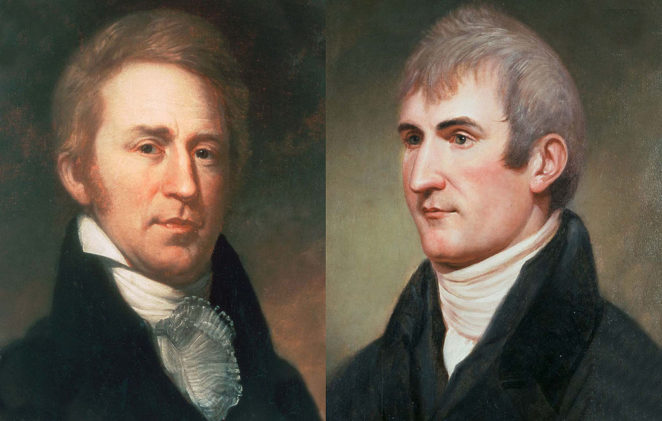
Lewis and Clark were two explorers who were sent by President Thomas Jefferson to explore the interior and west of the North American continent. Inadvertently, they also made important contributions to the development of American English.


The western adventure of Lewis and Clark

It cannot be denied that American English exhibits many features that are peculiar to it and which set it apart from other varieties of English spoken around the world, noticeably that of the “home” country of English, namely the United Kingdom.

One contribution that is not always appreciated is that of Lewis and Clark, two explorers who were sent west by President Thomas Jefferson to, if possible, discover a river that flowed to the west coast.

This expedition was made possible after the American government doubled its territory in 1804 through the Louisiana Purchase, surely one of the best bargains of all time. However, little was then known about what this new land contained, whether it offered enticing prospects for development or dangers for the unwary, whether the natives were friendly or hostile, and much else besides.

Meriwether Lewis (1774-1809) and William Clark (1770-1838) were army captains (technically, Clark was only a 2nd lieutenant but this detail was overlooked) who led an expedition that totalled 33 individuals, setting off on 14th May 1804.


The journals of Lewis and Clark

For the story of American English, the important thing to note is that Lewis and Clark kept meticulous daily journals throughout their travels, at President Jefferson’s insistence. On their return, these journals were published, becoming hugely popular and widely read, and from them came a whole host of words that had never been seen before.

Lewis and Clark were not highly educated men, having spent much of their young lives exploring the outback and fighting small campaigns against various native tribes. Clark, who seems to have done much of the writing of the expedition journal, was particularly conscious of his lack of skill as far as grammar and spelling were concerned. It was, in any case, a time when spelling had not yet been standardised by dictionaries such as Noah Webster’s which first appeared in 1806.


New uses for old words

The journals therefore describe places, geographical features, animals, and much else besides, in the best language that Lewis and Clark could manage. This was partly due to their ignorance as a result of poor education but also from the need to find names for the unfamiliar. For example, the word “creek”, which means a tidal inlet in British English, was now used to mean any sort of stream. The word “rapid” is an adjective, but it could do excellent service to describe water moving rapidly over a rocky bed, as “rapids”.

When Lewis and Clark had no word for something, they were apt to stick two words together to create a new one. A snake which shook its tail to make a rattling sound could best be described as a “rattlesnake”. A wood of trees bearing tufts that looked like cotton gave rise to “cottonwood”. There are hundreds of such examples in the journals.


Mistakes and new words

Some of the mistakes of modern American English can be laid at the doors of Lewis and Clark, due to their lack of knowledge. The animal known to Americans as a “buffalo” has no connection with the African or Asian animals of that name, as what Lewis and Clark thought were buffaloes were in fact bisons, which are a completely different species. The same is true of “elk”, which is not the same species in Europe that it is in America.

On their travels, Lewis and Clark came across several native American tribes and picked up many names from them. Some 500 words in the journals are of native origin, including “maize”, “opossum”, “hickory” and “toboggan”.

Noah Webster declared that his dictionary contained only about fifty words that could be said to be peculiarly American. That is far from the case with the journals of Lewis and Clark, which are full of “Americanisms”, many of which have since flowed out of America and into the English spoken in other parts of the world. Without in any way intending to create a revolution in the way English was written and spoken in North America, Lewis and Clark did precisely that.

© John Welford

Friday, 29 December 2017

The Amistad case and the slavery debate


A revolt aboard a ship transporting slaves from one part of Cuba to another in 1839 led to a celebrated case before the US Supreme Court that some have seen as a precursor to the US Civil War.

La Amistad was a two-masted schooner in private ownership that was used to transport goods along the coast of Spanish-owned Cuba and to other parts of the Caribbean. On 28th June 1839 La Amistad set sail from Havana bound for a small port in eastern Cuba. The ship’s crew was captained by the owner, Don Ramon Ferrer.

On this occasion the ‘cargo’ included 53 slaves who had been sold in Havana and were being taken to the sugar plantation where they would be put to work and probably spend the rest of their lives. Also on board were the slaves’ new owners. The slaves were members of the Mende tribe from Sierra Leone who had been shipped across the Atlantic not long before. By this time the Atlantic slave trade had been declared illegal, although the institution of slavery had not.

The slaves were not conveyed in La Amistad in the conditions that they would probably have experienced during their previous voyage. Some of them were kept in the ship’s hold and others on deck.

After a few days at sea the slaves in the hold were able to free themselves and get hold of knives that were used for cutting cane. They overpowered the crew, some of whom were killed, including the captain. They demanded that the navigator set a new course, namely for Africa. However, he was able to trick the slaves and sailed north instead of east. The ship was eventually intercepted by an American naval ship, USS Washington, and escorted to New York.

The United States was now in possession of a Spanish ship together with its cargo of slaves, and it was the status of that cargo that was to occupy the best legal minds of the country over the next two years or so.

The Spanish demanded the immediate return of La Amistad and the slaves, and President Martin Van Buren was at first minded to agree with the request. However, it was pointed out to him that the transport of slaves in ships had been outlawed by both the United Kingdom and the United States, so under American law the slaves were the victims of a crime, not the perpetrators of one.

When the case came before the Supreme Court it was stated that the slaves had been ‘unlawfully kidnapped and forcibly and wrongfully carried on board’. This view was supported by Justice Joseph Story and the slaves therefore won their case, the verdict being delivered on 9th March 1841.

There was already a strong abolitionist movement, especially in the northern United States, and funds were raised to accommodate the freed slaves and give them lessons in English, as well as Bible classes. Further funds were raised to pay for their repatriation to Sierra Leone, which happened the following year.

One of the former slaves later returned to the United States to study at college, after which she became a Christian missionary back in Sierra Leone.

The Amistad case exposed the deep divide in American society between those who supported the institution of slavery and those who did not. Many southerners took the line that the slaves were non-persons who were the property of their owners and should therefore be returned to them, as would any other stolen and subsequently recovered goods. The abolitionists (led by former President John Quincy Adams) argued that persons who had been illegally transported to Cuba, and were therefore free, were entitled to the protection of the American legal system.

The Supreme Court verdict undermined the racist assumptions of the southerners and gave the abolitionists a significant moral victory. Tensions between north and south were heightened, and the case therefore constituted a step on the path that would eventually lead to civil war.

The case was remembered in 1997 when Steven Spielberg directed the film ‘Amistad’ that brought the case before a modern audience. Criticisms have been levelled at the film for its historical inaccuracies, and for portraying the case as a vital turning point in the story of the ending of slavery in the United States. It has to be remembered that the former slaves of the Amistad had returned home nearly 20 years before the first shot was fired in the war that finally settled the matter.

© John Welford

Saturday, 13 February 2016

The Pig War of 1859


The Pig War of 1859 scarcely deserves to be called a “war” at all. Only one shot was fired, which accounted for the aforementioned pig, but the rest of the affair was a matter of threats and gestures, although it was not fully resolved for another thirteen years.


A border dispute

This dispute between the United States and Great Britain arose from the uncertainty over where the border should run between the US and Canada, which was then under British control. The decision to set the border at the 49th parallel, arrived at in 1818, only applied as far west as the Rocky Mountains, with anything west of there, which was largely unexplored, being jointly assigned to both nations although it was still largely in the hands of various Native American tribes.

However, by 1844 settlers both north and south had pushed west to the Pacific coast into what was then known as the Oregon Territory. With absolutely no regard for the wishes of the Native Americans who, as usual, were disregarded in any territorial claims by the immigrant settlers, the Americans sought to set the border in the Rockies at 54.40 degrees north which, had that happened, would have meant that the United States would today have occupied the whole Pacific coastline from Mexico northwards, because the modern state of Alaska extends south of that line.

However, after much negotiation, it was agreed that the 49th parallel should be extended as the international border all the way to the coast, thus granting all the territory north of that line, to the originally desired 54.40 line and beyond, to what is still known as British Columbia.

There was still a problem, though, because the 49th parallel, being a line on a map, did not accord well with the ins and outs of the western coastline. There was the little matter, for example, of a small peninsula that juts across the line to the south of the city of Vancouver, and the much larger issue of Vancouver Island, quite a considerable portion of which is south of the line.

In 1846 a treaty was agreed under which the whole of Vancouver Island would belong to British Columbia but the small peninsula of Point Roberts, covering no more than five square miles, would be American territory. To this day, Point Roberts is part of the State of Washington but can only be reached by sea unless one travels through part of Canada to get there by road.

However, this was not the whole story, because there are a number of smaller islands that lie between Vancouver Island and the mainland south of the 49th parallel, and the ownership of these was not made clear in the 1846 treaty. One of these is San Juan Island, and this was the site of the Pig War.


A pig makes a fatal mistake

The island had been settled by people of both British and American origin. When an American settler shot a pig that had strayed into his garden and which belonged to a neighbour, who was British, both men sought the support of their respective governments. As might have been expected, both sides over-reacted to an alarming degree. The British sent a fleet of five warships and the Americans landed a force of more than 450 soldiers on the island. Things could have turned very nasty indeed.

Fortunately, sanity prevailed and no shots were fired. The sides agreed that San Juan Island should, for the time being, be jointly administered with troops from both sides providing security for the settlers. However, this state of affairs could not last for ever and in 1872 the matter was referred, in what sounds today like an extremely bizarre decision, to the Emperor of Germany, Kaiser Wilhelm I. It was thought that he was neutral enough to provide an unbiased opinion on who should be the owner of San Juan Island. He came down on the side of the United States, which has remained in charge of the island ever since.

It could well be argued that all wars are stupid, but some are more stupid than others. Had the United States and Great Britain engaged in a shooting war over a straying pig, the 1859 Pig War would have been a strong candidate for the title of most ridiculous war of all time.


© John Welford

Sunday, 24 January 2016

The birth of the United States Republican Party


On 28th February 1854 a meeting was held at a church in Ripon, Wisconsin, that would lead to the foundation of the United States Republican Party.

The issue at stake was slavery, and in particular the threat of its expansion into the territories of Kansas and Nebraska under the Kansas-Nebraska Act that was about to overturn the 1820 Missouri Compromise. The group that met at Ripon, under the leadership of Alvan Bovay, passed an anti-slavery resolution and agreed to meet again a month later.

The first two meetings attracted a great deal of attention from people who agreed with the Abolitionists, and the third meeting had to be held at a larger venue, in Jackson, Michigan. This became the inaugural conference of a new political party which adopted the name “Republican” after Thomas Jefferson’s “Democratic-Republican Party”. Despite the obvious admiration of Jefferson as a role model, the new Republicans were apparently not willing to be reminded that Jefferson had been the owner of 250 slaves!

The new party achieved success remarkably quickly, gaining 33% of popular support in the 1856 Presidential election and getting their man, Abraham Lincoln, into the White House in 1860. There have been a total of 18 Republican Presidents, which sounds like a proud boast until you remember that these included Richard Nixon, Ronald Reagan and the two Bushes!

The Republican Party delights in the name of the “Grand Old Party”. This sounds like a strange definition of “old”, given that it has been in existence for only 160 years and is younger than the Democrats, who also took their inspiration from Jefferson’s Democratic-Republicans, but 22 years earlier!


© John Welford