Followers

Showing posts with label slavery. Show all posts

Thursday, 2 April 2020

The poisonous myth of the Hamitic heritage


It should come as no surprise when people seek to justify immoral actions by appealing to a Biblical precedent. That was the case with the enslavement of black people by whites, which they claimed was sanctioned in the Book of Genesis.


Noah and Ham

Genesis Chapter 9 tells the story of Ham, the third son of Noah, finding the latter drunk and naked in his tent and telling his brothers, Shem and Japheth, who avert their gaze as they go into the tent to cover their father up and prevent any further embarrassment. On waking up, Noah is angry with Ham and lays a curse on the latter's youngest son, Canaan, which is that he is to be a bondservant to his two uncles. 

On the face of it, this seems to be particularly unfair to both Ham and Canaan. If Ham had not been first into the tent, presumably it would have been one of the other two. And why does Canaan, who was presumably only a child at the time, get it in the neck? However, that is the story as given, whatever the justice or otherwise of the case. Later interpreters have ascribed various degrees of significance to this passage. 


The descendants of Noah

Genesis Chapter 10 outlines the descendants of the three sons of Noah. This is not exactly a riveting read, but it is important as an account of how the world was repopulated after the Flood, bearing in mind that, according to Genesis, these were the only human beings left alive. 

Shem’s descendants are therefore the Semites, who include the Jews, with Abraham being a direct descendent of Shem by nine generations. Ham’s descendants are the Hamites, whose tribes include the Canaanites, who were to become the enemies of the Jews. This may explain the curse placed on Canaan. Other descendants of Ham were to populate much of North Africa.


Fact or myth?

Whether or not one regards the foregoing as fact or myth, depending on one’s interpretation of Genesis, what follows surely comes under the heading of myth, because it is based on such things as supposition, misreading and prejudice, with little if any Biblical justification. In short, Ham is judged to have been the father of the black races of the earth, and these are seen to be inferior to the white races.

For example, one early Jewish text has it that Ham was the only brother who had sexual intercourse during his time in the Ark (he is the only one mentioned as having a son immediately after the Flood) and for this he was “smitten in his skin”. Later writers also connected punishment with being made black, and linked blackness with slavery. For example, Patriarch Eutychius of Alexandria wrote: “Cursed be Ham and may he be a servant to his brothers … He himself and his descendants, who are the Egyptians, the Negroes, the Ethiopians…” 


The curse in modern times

These myths persisted down the centuries, so that the most terrible things could be written by people who were well-respected and venerated in their time and later. For example, the visionary Anne Catherine Emmerich (1774-1824), who was placed on the road to sainthood in 2004 by Pope John Paul II, was able to write: 

“I saw the curse pronounced by Noah upon Ham moving toward the latter like a black cloud and obscuring him. His skin lost its whiteness, he grew darker. His sin was the sin of sacrilege, the sin of one who would forcibly enter the Ark of the Covenant. I saw a most corrupt race descend from Ham and sink deeper and deeper in darkness. I see that the black, idolatrous, stupid nations are the descendants of Ham. Their color is due, not to the rays of the sun, but to the dark source whence those degraded races sprang".

One of the worst Victorian exponents of the myth was the explorer John Hanning Speke (1827-1864) who made three explorations of Africa in searching for the source of the Nile. He claimed that the Tutsis of Rwanda were superior to the Hutus because they had more “white” characteristics and did not suffer from the curse of Ham. This division into “good” and “bad” races led indirectly to the genocide of 1994 in which maybe as many as a million Tutsis and thousands of Hutus died within a hundred days.

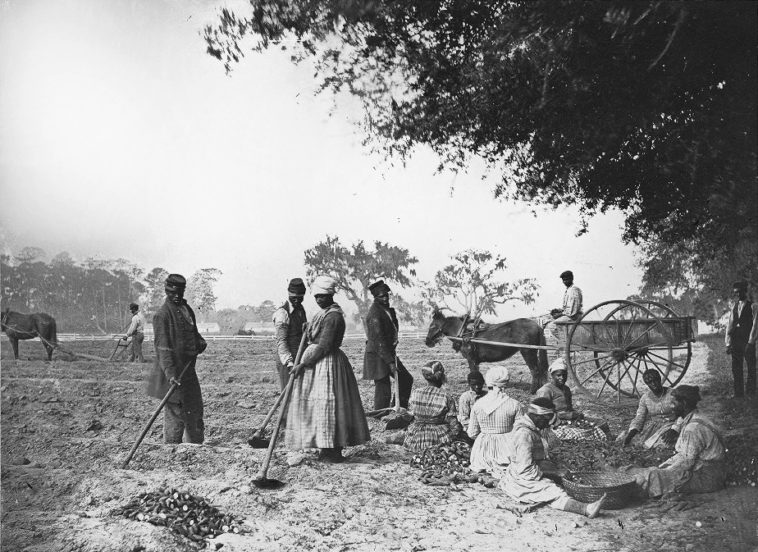
It is an undisputed fact that the curse of Ham has been used as a justification for the enslavement of black people. Indeed, some have even regarded it as a virtual duty of white people to enslave black people, because of the Biblical example. In seeking to defend slavery at the time of the American Civil War, the crime of Ham was blown up to include rape and incest, with the clear implication that his black descendants were still guilty and deserved his punishment.

It is unfortunate that, in the eyes of many misguided people even today, black is bad and white is good. The perniciousness of this view, that has caused so much misery and injustice down the centuries, is largely due to the Hamitic heritage, and it is high time that we, as the human race, grew up and came to recognize the evil of maintaining this belief, and others that have no basis in reality but lurk under the cloak of religion to destroy so many innocent lives.

© John Welford

Tuesday, 27 March 2018

What was a slave worth in 18th century America?


Debates about slavery in the United States went back many years before the American Civil War brought “slave” and “free” states into bloody conflict in the 1860s. A debate at the Constitutional Convention of 1787, for example, led to a strange compromise over slavery that had more to do with mathematics than the morality of slave ownership.

The issue was over the decision to establish a House of Representatives, of which each state’s membership would be decided by its population. The greater the population of a state, the more representatives it would have in the lower house of Congress.


Slavery in the Late 18th Century

Slavery was not a particularly burning or divisive issue in the 1780s. Indeed, as an institution it had been in decline for some time. The northern states did not need huge numbers of slaves, although there were still as many as 10,000 slaves in New York State in 1820. Even in the states of Maryland and Virginia, tobacco production had exhausted the soils and large gangs of slave labour were impractical on the cereal farms that took the place of tobacco plantations. However, the production of rice and indigo in the swamps of Georgia and the Carolinas did require the use of slaves, and this was where the largest numbers were employed.

It was only when Eli Whitney’s cotton gin made production possible across a much wider sweep of territory, from the 1790s onward, that the plantation system really took hold in the South, and with it the development of slave labour on a much larger scale.


Slavery and Representation of the States

Of the 13 ex-colonies that were to become the first “United States”, only five regarded the institution of slavery to be essential to their economies (although this was a dubious claim in the cases of Virginia and Maryland, as noted above). With membership of the upper house of Congress, the Senate, being fixed at two members per state, these five states would always be in a minority. However, could they work out a way of achieving something like parity in the lower house?

On the face of it, this was also unlikely. Although industrialization had yet to take off in the northern states, that was where the larger cities were, such as Boston, New York and Philadelphia. Despite the larger geographical areas of states like Georgia as against Rhode Island and Connecticut, their populations were either smaller or disproportionate to their relative sizes.

Unless, that is, you counted the slaves.


The Constitutional Compromise over Slavery

There was no disagreement about the status of Native Americans. They did not count for purposes of representation, but then they were distributed across all the colonies at this time. However, if the southern states could count their slaves, they would quite easily be able to overcome their disadvantage in Congress.

The northern delegates at the Convention pointed out, with some justification, that it was strange that southern slave owners should regard their slaves as being mere items of property when it suited them to do so, but equal with them as human beings when the occasion so demanded.

However, it became clear that, for the Convention to succeed, a compromise would be needed, and this was that each slave would count as three-fifths of a free person. This allowed, for example, the Carolinas to have ten representatives between them, as against the eight from Massachusetts. Although the balance of representation was still tipped in favour of the free states against the slave states, at 33 to 29, it was much closer than it would have been otherwise.


The Illogical Nature of the Compromise

Many northerners were distinctly unhappy with this state of affairs. One wit even proposed that horses, being as useful as slaves, should surely count as being two-fifths of a person, and man’s best friend, the dog, had a good claim to count as one-fifth of his master, for purposes of representation.

This was just one example from history of how expediency can take precedence over justice and logic. It was not until the 14th Amendment to the Constitution was ratified in 1868 that this nonsense ceased to be part of the American Constitution.


© John Welford

Friday, 29 December 2017

The Amistad case and the slavery debate


A revolt aboard a ship transporting slaves from one part of Cuba to another in 1839 led to a celebrated case before the US Supreme Court that some have seen as a precursor to the US Civil War.

La Amistad was a two-masted schooner in private ownership that was used to transport goods along the coast of Spanish-owned Cuba and to other parts of the Caribbean. On 28th June 1839 La Amistad set sail from Havana bound for a small port in eastern Cuba. The ship’s crew was captained by the owner, Don Ramon Ferrer.

On this occasion the ‘cargo’ included 53 slaves who had been sold in Havana and were being taken to the sugar plantation where they would be put to work and probably spend the rest of their lives. Also on board were the slaves’ new owners. The slaves were members of the Mende tribe from Sierra Leone who had been shipped across the Atlantic not long before. By this time the Atlantic slave trade had been declared illegal, although the institution of slavery had not.

The slaves were not conveyed in La Amistad in the conditions that they would probably have experienced during their previous voyage. Some of them were kept in the ship’s hold and others on deck.

After a few days at sea the slaves in the hold were able to free themselves and get hold of knives that were used for cutting cane. They overpowered the crew, some of whom were killed, including the captain. They demanded that the navigator set a new course, namely for Africa. However, he was able to trick the slaves and sailed north instead of east. The ship was eventually intercepted by an American naval ship, USS Washington, and escorted to New York.

The United States was now in possession of a Spanish ship together with its cargo of slaves, and it was the status of that cargo that was to occupy the best legal minds of the country over the next two years or so.

The Spanish demanded the immediate return of La Amistad and the slaves, and President Martin Van Buren was at first minded to agree with the request. However, it was pointed out to him that the transport of slaves in ships had been outlawed by both the United Kingdom and the United States, so under American law the slaves were the victims of a crime, not the perpetrators of one.

When the case came before the Supreme Court it was stated that the slaves had been ‘unlawfully kidnapped and forcibly and wrongfully carried on board’. This view was supported by Justice Joseph Story and the slaves therefore won their case, the verdict being delivered on 9th March 1841.

There was already a strong abolitionist movement, especially in the northern United States, and funds were raised to accommodate the freed slaves and give them lessons in English, as well as Bible classes. Further funds were raised to pay for their repatriation to Sierra Leone, which happened the following year.

One of the former slaves later returned to the United States to study at college, after which she became a Christian missionary back in Sierra Leone.

The Amistad case exposed the deep divide in American society between those who supported the institution of slavery and those who did not. Many southerners took the line that the slaves were non-persons who were the property of their owners and should therefore be returned to them, as would any other stolen and subsequently recovered goods. The abolitionists (led by former President John Quincy Adams) argued that persons who had been illegally transported to Cuba, and were therefore free, were entitled to the protection of the American legal system.

The Supreme Court verdict undermined the racist assumptions of the southerners and gave the abolitionists a significant moral victory. Tensions between north and south were heightened, and the case therefore constituted a step on the path that would eventually lead to civil war.

The case was remembered in 1997 when Steven Spielberg directed the film ‘Amistad’ that brought the case before a modern audience. Criticisms have been levelled at the film for its historical inaccuracies, and for portraying the case as a vital turning point in the story of the ending of slavery in the United States. It has to be remembered that the former slaves of the Amistad had returned home nearly 20 years before the first shot was fired in the war that finally settled the matter.

© John Welford