Followers

Showing posts with label European history. Show all posts

Wednesday, 30 September 2020

The Defenestration of Prague, 1618


This incident, with a somewhat remarkable title, was one of the causes of the bloody and destructive Thirty Years War that tore Europe apart between 1618 and 1648.

“Defenestration” simply means “throwing out of the window”, and that is precisely what happened to three unfortunate men at Prague Castle, Bohemia, on 23rd May 1618. They were Count Vilem Slavata, Count Jaroslav Bořita and Philip Fabricius. The first two were regents representing Ferdinand, the new King of Bohemia, and the third was their secretary.

Catholics and Protestants had been in conflict across Europe for many years, occasioned by the Papacy and Catholic monarchs trying to impose their religious views on the Protestant communities and states within Europe. One of the most ardent Catholic monarchs had been Philip II of Spain, whose avowed aim was to eliminate Protestantism, particularly in the Low Countries that were part of his empire. He had also, in 1588, sent an Armada up the English Channel with the aim of conquering England and re-converting the country to the Catholic faith.

In France, persecution of the Protestant Huguenots had culminated in the St Bartholomew’s Day Massacre of 1572 which lasted for several weeks and left thousands dead.

A peace of sorts was achieved after the Edict of Nantes was promulgated in 1598 by the French King Henry IV, but the underlying problems still remained in Europe, especially as the loose alliance known as the Holy Roman Empire that covered much of central Europe was ruled by the Catholic Habsburgs but contained many Protestants within its borders, including in Bohemia.

Emperor Matthias had been happy to grant his Protestant subjects the right to worship as they wished. He did this this by ratifying the “Letter of Majesty” that had been signed by his predecessor Rudolf II which guaranteed freedom of worship and certain other rights to Protestants, but his successor Ferdinand was an ardent Catholic who felt himself to be under no such obligation to honour these pledges. The result was a re-igniting of the dispute that had existed in Bohemia since the first stirring of the Protestant Reformation in the 15th century.

Ferdinand’s regents met a group of Protestant nobles in an upper room of Prague Castle. The nobles wanted to be assured that Ferdinand would not remove the previously granted religious freedoms, but the regents refused to give this assurance. The reaction of the Protestants was to seize the nobles and their secretary and throw them out of the window. The fall of some 20 metres would probably have killed them had it not been for the pile of dung stacked at the foot of the castle wall that broke their fall. The three men were injured but able to recover and tell Ferdinand what had happened.

The Protestants then attempted to depose Ferdinand as King of Bohemia (which he had been as well as Holy Roman Emperor) and replace him with a suitable Protestant alternative, namely Frederick. This did not work out well – when battle was joined between the Protestants and Catholics at White Mountain in 1620 the Bohemians were crushed with heavy losses and forced to accept Catholicism.

However, this did not mean the end of hostilities. The conflict spread and involved other powers, notably Protestant King Adolphus of Sweden, as well as France and Spain, both these nations having their own political and strategic motives. It did not take long for virtually every country in in Europe to be involved in the war.

Some of the battles fought during the thirty years of the war were on a huge scale, with the losses being proportionally vast. Terrible atrocities were committed with enormous areas of land being laid waste, from which it would take decades to recover.

Both sides were eventually worn down and ready to make peace. This took the form of the Peace of Westphalia that was concluded in 1648. This established a new balance of power and general recognition that the religious complexion of Europe would be mixed for the foreseeable future.

© John Welford

Thursday, 12 December 2019

The Crusader Cannibals


Wars of religion often seem to lead to the most despicable acts of cruelty and barbarism, with both sides claiming to have divine sanction for the horrors that they choose to visit on their enemies. This was certainly the case on 12th December 1098 when a Crusader army breached the defences of Ma’arat al-Numan, a fortified town that lies in what is now Syria.

In 1095 Pope Urban II had called on the Christians of western Europe to recover the Holy Land for Christianity from the Muslims who now occupied it. Being utterly convinced of the rightness of their cause, and having a firm belief that Muslims were a depraved form of humanity who deserved no mercy or respect, the Christian armies swept towards Jerusalem, slaughtering anyone who opposed them.

The Crusaders did not have everything their own way. The city of Antioch withstood a siege that lasted 21 months, and when it fell the inhabitants were treated extremely badly with many civilians losing their lives.

However, the long siege had meant that there was very little food left in the city, and the Crusaders, whose own supplies were running low, found nothing to replenish their stocks. With winter approaching, the surrounding countryside had little to offer either, so a plan was drawn up to advance the short distance to Ma’arat al-Numan and hope for more luck there.

When the town fell to the Crusaders some 20,000 people were killed and the children captured as slaves, but there was still no food to be found.

The Crusaders then turned to the only solution they could think of. They started to feed on the bodies of the people they had killed. Some reports said that they went as far as killing people for the purpose of eating them, including impaling children on spits so that they could be grilled, but these accounts cannot be relied upon.

Even so, for an army to turn to cannibalism, in the belief that they were fighting against people who were animals rather than humans, was terrible enough. This event placed a huge stain on the reputation of the Crusaders, and Christianity in general. The Muslim world has long held the Christian west in detestation, and this incident was one that caused that view to be created and to prevail down the centuries.


© John Welford

Friday, 7 September 2018

The assassination of King Carlos of Portugal


The Kingdom of Portugal began in 1139 when Afonso I (“The Conqueror”) declared himself King. It ended in 1910 when the last monarch, Manuel II, was chased into exile and Portugal became a republic. During that time only one King was assassinated, that being Carlos, who was the last King but one.
Carlos came to the throne in 1889, at the age of 26, and proceeded to demonstrate his unsuitability for the role by maintaining a profligate lifestyle at the time of a severe economic downturn. As the crisis got worse and republican agitation grew, Carlos appointed Joao Franco as Prime Minister, which meant virtual dictator. The popular perception was that Franco was siphoning off money from the treasury to fund Carlos’s personal spending at the same time as causing great distress to the people with his attempts to get the economy back on track.
Eventually, government oppression coupled with hatred of King Carlos led to open revolt and the deaths of Carlos and his son Luis Filipe. They were gunned down on 1st February 1908 as they rode in an open carriage through Lisbon. Their two assassins, who were immediately killed by Carlos’s bodyguards, may have been members of the Carbonaria, a republican secret society.
Carlos’s 18-year-old second son, Manuel, was also in the carriage but only suffered a minor injury. He was declared King but only reigned for two years before a second Carbonaria revolt, in October 1910, ended the monarchy for all time. Manuel spent the rest of his life in England, where he died in 1932.
© John Welford

Thursday, 14 June 2018

The Battle of Solferino, 1859


The Battle of Solferino was fought on 24th June 1859 between imperial Austria and a combined force of French and Piedmontese troops. It was an exceptionally bloody affair but one from which a lasting and unexpected benefit accrued.

In March of that year King Victor Emmanuel II of Sardinia/Piedmont saw an opportunity to renew the campaign for Italian independence from Austria. He had been promised French support and this was forthcoming as soon as Austria demanded that Piedmont back down and the latter refused to do so.

The Battle of Solferino was the third clash between the opposing forces and by far the most serious. Emperor Franz Joseph of Austria took personal command of an army of about 160,000 men, and was met by a comparable force, led by King Victor Emmanuel and Emperor Napoleon III of France. The battle took place near Lake Garda in northern Italy.

The emperors did not prove to be particularly good as generals and soon lost control of their forces, which continued to pummel each other all day in a series of engagements strung out along the Mincio River.

The end result was victory for the French-Piedmontese army, but at huge cost in terms of casualties. It is estimated that both sides had around 15,000 men killed or wounded.

Politically, the battle was a step closer towards Italian reunification and independence, and France gained control of Nice and Savoy.

One of the stretcher-bearers with the unpleasant task of retrieving broken bodies from the battlefield was a Swiss man named Henri Dunant. He was deeply affected by the horrors he had witnessed and later wrote a book that described them. More than that, he went on to found an organization devoted to the task of helping the victims of war and conflict. This became the International Red Cross, which continues this work – and more - to the present day.
© John Welford

Tuesday, 27 March 2018

Tulip mania in 17th century Europe


Human beings seem to have a penchant for throwing their money away by speculating on something that looks to be a “dead cert” to make them a fortune but turns out to be precisely the opposite. The world’s current economic ills (as of 2013) can be traced to speculation over house prices in the United States, just as the Wall Street Crash of 1929 was based on the mistaken belief that share prices would continue to rise for ever. Such “bubbles”, which burst with disastrous consequences, can be traced back to the early 17th century, where the object that excited the mania was the humble tulip bulb.

Tulips were unknown in Europe before the 16th century, when merchants and travellers began to bring bulbs back from central Asia. In the Netherlands, tulips became sought after not only for their attractiveness as Spring flowers but also because of their rarity. Having these exotic plants growing outside one’s house was clearly a status symbol that indicated not only good taste but considerable wealth. Anything that is rare and desirable is always going to be expensive, in any age.

It was soon discovered that the tulip was capable of being cross bred to produce a variety of colours, shapes and other characteristics. As early as the 1590s work was being done at the University of Leiden (by the botanist Charles l’Ecluse) to develop new varieties that would lead eventually to a major Dutch industry that continues to the present day. The most exotic varieties became even more highly prized than “ordinary” tulips and wealthy people became desperate to acquire tulips that their neighbours did not possess, even though individual tulips come into flower for a only a couple of weeks at most.

The next stage was for people to start investing money in advance so that they would be the first to own tulip varieties that had not yet been developed. Contracts were signed for the purchase of next year’s bulbs while they were still in the ground and not yet harvested. This was therefore the first example of a “futures” market that has been a staple ingredient of financial trading ever since.

Nothing could stop the growth of speculation in the tulip market, especially when money started coming in from foreign investors, and prices inevitably started to rise steeply. Before long the money changing hands as people gambled on the future value of tulip bulbs that did not yet exist was out of all proportion to what the bulbs were really worth.

As the bubble expanded in the early 1630s, more and more people, most of whom had absolutely no interest in owning tulips, put increasing sums of money into the market, buying and selling futures contracts in the expectation of always making a profit. Even people with relatively modest means sold possessions in order to have money to invest in tulips.

It paid the people who actually owned the tulip bulbs not to sell them, because they knew that they would be able to charge a much higher price for them at some future date. At the height of the market, in 1636, one bulb was traded for the equivalent of $35,000 dollars, a sum that the average Dutch worker would take more than 16 years to earn.

The bubble had to burst, and it did so in February 1637 when the price of tulips collapsed as nobody could afford to buy them. Some people who saw the end coming, and traded in their investments at the right time, made huge fortunes, but for most investors it was a disaster as they lost virtually all their money. Those people who had foolishly put more into tulip futures than they could afford to lose were the biggest losers and many became destitute as a result.

It would be encouraging to be able to say that this experience taught people across Europe and the world a salutary lesson in why one should never invest money in schemes that are not founded on real and substantial assets. However, human greed and the chance of making a quick buck for relatively little effort are factors that are guaranteed to lead people astray. Whether it is the South Sea Bubble and the Mississippi Land Bubble of the 1720s, or the dot-com bubble of the 1990s, people with more money than sense will always, it seems, find innovative ways of losing it. Unfortunately, as the more recent Subprime Mortgage Bubble has shown, the consequences of such disasters do not just affect those people who make the mistakes.

© John Welford

Monday, 26 March 2018

The Palomares hydrogen bombs, 1966


Not many people know that hydrogen bombs have fallen on to European soil, but fortunately they did not explode, and could not have done so. The incident had nothing to do with enemy action and was the result of a tragic accident.

During the Cold War the United States was prepared at all times for the outbreak of hostilities and regularly flew bombing missions over Eastern Europe, although no bombs were ever released intentionally. The bombs were nuclear as well as conventional, and many flights by B-52 bombers took place on a daily basis.

On the morning of 16th January 1966 a B-52 was flying over the western Mediterranean and preparing to return to the United States. It carried a cargo of four 1.5 megaton hydrogen bombs, each about 20 feet long. As usual, the plane needed to be refueled before flying back across the Atlantic, and this entailed an aerial rendezvous with a tanker aircraft carrying 30,000 gallons of fuel.

The procedure was a standard one, carried out at 30,000 feet. It was one that the captains of both aircraft had carried out many times before, and they had no reason to doubt that that morning’s operation would not also go according to plan. However, on this occasion things went disastrously wrong when a misjudgment was made as the bomber approached the tanker and the two planes collided.

Three crew members on board the B-52 were able to eject safely, but four others, and all seven men on board the tanker plane, were not so lucky. The planes fell from the sky and crashed on Spanish territory close to the coast, as did three of the four hydrogen bombs.

Because the bombs had not been primed there was no chance of a nuclear explosion, but there was certainly a danger that the casings could have been damaged by the fall, or more probably by explosions caused by their TNT detonators. If the casings had been breached, there was every chance that radioactive materials could have leaked out and threatened the well-being of local residents.

As might have been expected, the American military authorities were extremely anxious to hush the matter up as much as possible. Nothing could be less welcome to the general public than the news that nuclear weapons were regularly being flown over their heads and could – should disaster strike – land at their feet. The press were told that a military aircraft had crashed in Spain but no mention was made of its cargo. Reporters were, however, barred from the area which made them highly suspicious that they were not being told the whole truth.

Also kept in the dark were the inhabitants, mainly farmers, of the region near Palomares, to the east of Almeria in southern Spain. While being told to stay calm and not be unduly concerned, they were also instructed not to work on their land or venture outside their village. Reports of thousands of military personnel swarming over their fields clad in protective garb cannot have been particularly reassuring.

Two of the bombs, in open countryside, were found quite quickly, but the third had fallen close to a villager’s home and was not easily visible from the air. The villager in question had stood on top of it and given it a kick, possibly in the hope of stopping the flow of smoke that was issuing from it. It was probably a good thing that he went off to find someone who might know what it was and did not examine it any more closely, given that it was venting radioactive dust. This was also true of one of the other bombs that had already been discovered.

As mentioned above, the B-52 had been carrying four bombs, so where was the fourth? It soon became clear that it had fallen into the sea, because it had been seen to do so by a local fisherman. However, his news took a long time to reach the Americans, partly due to the cloak of secrecy that they had thrown over the incident. Not even the local police – to whom the fisherman reported his sighting – were aware that anything had happened that involved nuclear weapons.

Eventually a huge operation got going with the aim of finding the fourth bomb. Although the chances of it threatening immediate danger were slim, the Americans were worried about the Russians finding it before they did. It took two months to locate it, through use of a mini-submarine, but it was eventually spotted on an undersea ledge above a 500-feet precipice. The operation to recover the bomb took another three weeks.

The net result of the accident was that nuclear disaster was averted, although the leakage of radioactive material did have long-term knock-on effects. Decontaminating the affected land was a huge job, given that about 50 acres were involved. Large quantities of soil were removed and taken to the United States for processing, but there is evidence to show that there is still contamination in the area more than 50 years after the event.

Compensation was paid, although the amount was never disclosed and some farmers complained that they never received what had been promised to them.

The incident just goes to show how one person’s carelessness – for that is almost certainly what caused the accident – can lead to extremely serious consequences, especially when nuclear weapons are involved.
© John Welford

The origin of the Molotov cocktail


Most people will not need to be told that a Molotov cocktail is not a drink, although some of the earliest ones were actually made in a vodka factory! They are in fact home-made weapons of war.

The Molotov Cocktail

A Molotov cocktail is (usually) a glass bottle filled with an inflammable liquid, such as petroleum spirit, with a rag or something similar stuffed in the top. When lit and thrown it is likely to explode on landing, thus spreading burning fuel towards anyone unfortunate enough to be in the way. A Molotov cocktail is therefore a cheap and crude weapon that is often used today when street protests against the forces of law and order get violent.

Molotov’s name is not attached to the “cocktail” because he invented it, given that he did not do so. However, the term was originally used as an insult and has stuck ever since. Few people today will know who Molotov was, and his name is only remembered for something that only had an indirect connection with him.

Molotov the hammer

Vyacheslav Mikhailovich Skriabin (1890-1986) was a Russian revolutionary who took the name “Molotov” (meaning “hammer”) and led something of a charmed life, not only surviving to an advanced age (96) as the last of the Bolsheviks, but managing to do so through the era of Stalin’s purges of the 1930s. Only four members of the original Bolshevik government of 1917 achieved this feat, and Molotov did so by being one of Stalin’s most loyal deputies and a prime mover in instigating the purges. He was, in short, as unpleasant a character as Stalin himself.

The Finland campaign and the resulting “cocktails”

As Soviet foreign minister, it was Molotov who was responsible for launching the “winter war” against Finland in November 1939, not long after the outbreak of World War II. The Soviet Union believed that it could simply help itself to Finland while the rest of Europe was otherwise engaged, and on paper this looked entirely feasible. The Soviet forces were vastly greater than those of Finland, both on land and in the air, but they were led by commanders who were relatively inexperienced, given that the purges mentioned above had stripped out a large number of competent military leaders, leaving the less competent ones to take over. For this, Molotov himself was largely to blame.

Molotov’s campaign against Finland was completely illegal and against the rules of the League of Nations, of which the Soviet Union was a signatory.

Molotov thought that he would get away with this action by pretending that his cluster bombs were actually food parcels that were being dropped to support starving people. In response, the Finns decided that such “bread baskets” deserved a decent “cocktail” to accompany them, thus the Molotov cocktail was named as a piece of black humour.

The device did not originate with the Finns, as it had been used to good effect during the Spanish Civil War that had concluded earlier that year. The Fascists led by General Franco had triumphed over the Republicans, who had used Soviet-built tanks that could be disabled by the use of well-placed petrol bombs. If they worked in Spain, they could also do so in Finland.

Some 450,000 Molotov cocktails were assembled in a vodka factory and thrown at the Soviet invaders. They were not the only weapon that the Finns had at their disposal, but they proved to be very effective. The Soviets eventually had to sign a peace treaty, after 103 days of fighting, having gained only part of their original objective.

The Finns had national pride on their side and a determination not to be defeated by the forces of the giant next door. Their reputation as guerrilla warriors was greatly enhanced by their conduct during the winter war, of which their use of the Molotov cocktail was an important part.

It is ironic that the name Molotov might have become known only to historians had it not been for its borrowing for a device adopted for his defeat and used by revolutionaries and rioters ever since. 

© John Welford

Saturday, 24 March 2018

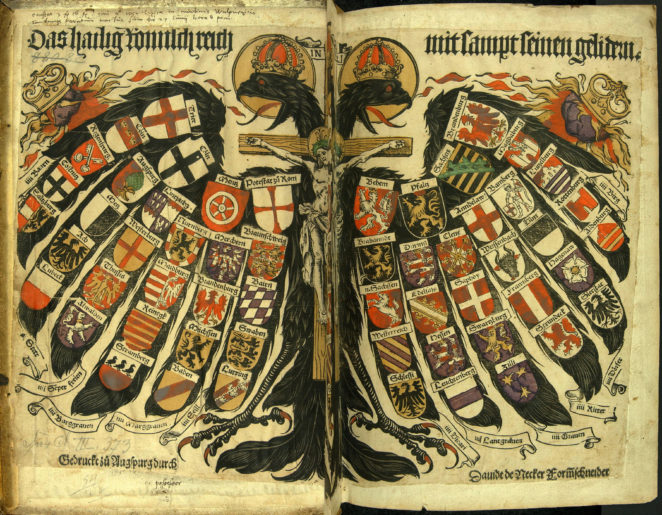
The end of the Holy Roman Empire, 1806


6th August 1806 saw the end of an institution that could trace its origins back for 1000 years, namely the Holy Roman Empire. However, as Voltaire said, it was neither holy nor Roman, and not much of an empire. Its formal dissolution in 1806 was merely the recognition of an obvious reality.

It began in 800 when Charlemagne thought of reviving the western Roman Empire, but based in Aachen (on the border of what are now Belgium and Germany) rather than Rome. The empire consisted of a band of territory across central Europe, and at its peak included what is now the whole of Germany, Switzerland, Austria, the Czech Republic, Belgium and The Netherlands, plus parts of eastern France and northern Italy.

The empire disintegrated early in the 10th century but was revived by “Otto the Great” in 962, after which there was an unbroken line of emperors for more than 800 years. In 1273 the first Habsburg emperor, Rudolf I, claimed the title, and the Habsburgs continued the line (with only minor exceptions) for the rest of the empire’s existence.

The “Holy” part of the title came from the fact that, at first, the Pope crowned the emperor, although this practice ended in the 16th century when the Protestant Reformation broke the link between the Empire and the Papacy.

The power of the emperor – who was nominally elected to office, but not democratically – rose and fell across the centuries, but for much of its history the Empire consisted of a patchwork of many tiny dukedoms and principalities, each ruler of which held controlling power within his territory.

In 1806 it was very clear where real power lay in central Europe, namely with Napoleon Bonaparte, whose own French Empire was all-powerful. Emperor Franz II – another Habsburg – decided that he would rather be Emperor of Austria than Holy Roman Emperor, so the wholly anachronistic title vanished for ever as the 67th emperor became the last one.

© John Welford

The Battle of Bouvines, 1214


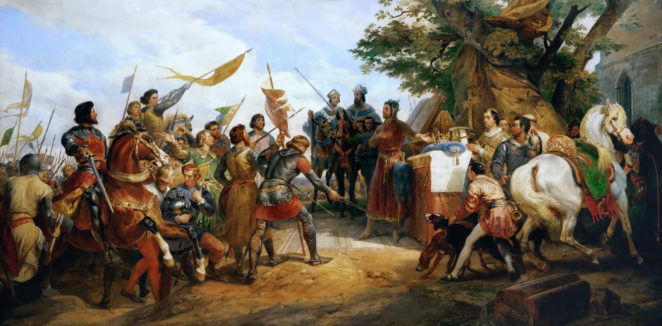
The story of the Battle of Bouvines, fought in 1214, is one of a “dead cert” plan that turned out to be far from cut and dried.

Otto IV, the Holy Roman Emperor, thought that a good way of keeping his barons loyal would be to invade France and reward his followers by giving them large pieces of captured territory. However, he was not sure that he could do this without some help, so he called on three other supposedly powerful warlords to join him in this quest.

These were Ferrand (Count of Flanders), Reginald (Count of Boulogne), and King John of England, who would presumably have had some sympathy with a fellow monarch who had problems with his barons.

The plan was for King John to land on the French coast and head for Paris, creating mayhem as he did so, while the other three invaded from the northeast. The problem with the plan was that it depended on John being able to get something right, but Otto should have known better.

The French King Philip Augustus met King John’s army at Angers on 2nd July 1214 and had an overwhelming victory. That left him free to concentrate on the other invaders and to gather reinforcements for his own army as he moved towards them.

The opposing forces met at Bouvines near Lille on 27th July. Philip’s army was still smaller than that ranged against him, and it looked at first as though Otto and his allies would prevail. However, Philip’s cavalry eventually got the better of the allies’ infantry and were able to achieve a decisive victory.

Philip’s personal bravery was an important factor in battle, as he was able to encourage his men to redouble their efforts after he had been unhorsed and almost killed but was then able to remount and carry on.

Otto’s failure to conquer France led to his own removal as Emperor and his replacement by Frederick II. John’s defeat only served to reinforce his weakness in the eyes of his own barons, who were emboldened to push through their own “revolution” of forcing King John to sign Magna Carta the following year.

The actions of Philip Augustus in recruiting men from the merchant class of France to join his army showed that French nationalism was not the sole prerogative of the knightly class. This was itself an important development in the history of Europe.

© John Welford

Saturday, 30 December 2017

The Battle of the Herrings, 1429


The Battle of the Herrings did not involve any herrings as combatants, and none of them was actually alive at the time, but their presence was a vital factor in an incident during the Hundred Years War that would come to have important and unexpected ramifications.

In February 1429 an English army was besieging the French city of Orleans. The season of Lent was approaching, during which time meat was off the menu for Christians, which naturally meant the entire English army. With starvation being preferable to eternal damnation, an alternative source of protein was needed, and the solution took the form of a convoy of carts loaded with barrels of salted herrings.

The herring carts were under the protection of Sir John Fastolf, whose name would later be the inspiration for William Shakespeare’s Sir John Falstaff. Problems arose when the convoy, protected by Fastolf’s troops, reached Rouvray, north of Orleans, on 12th February. A combined French and Scottish army intercepted the English and opened a bombardment of cannon fire against which the English had no reply.

This assault should have been enough to put paid to the herrings, but the Scottish commander made the mistake of sending in his men on foot to finish the job. The English had no cannons but they did have archers, and as soon as the Scots came within range they were the recipients of volleys of arrows. The French commander then sent his men in to rescue the Scots, but they suffered the same fate. Sir John then attacked with his own men-at-arms and put the combined French/Scottish force to flight.

The herrings were thus able to continue their journey to Orleans and the besiegers of the city could carry on with the siege.

The net result of the battle was that the French had to have second thoughts about lifting the siege of Orleans. It so happened that on the very day of the Battle of the Herrings, when the force that should have been doing the job of relieving Orleans was being routed at Rouvray, a would-be commander was pleading for a chance to show how it should be done. With no other alternatives on offer, the high command agreed and thus the legend of Joan of Arc was born.

© John Welford

Wednesday, 4 October 2017

The Battle of Aljubarrota, 1385


14th August is an important date in the history of Portugal and in Portuguese/British relationships. It was the day of which the Battle of Aljubarrota was fought in 1385, with far-reaching consequences.

The central figure of the story was João o Bastardo, which translates as John the Bastard. He was the illegitimate son of King Pedro I, and therefore not able to inherit the throne when his father died. However, when João’s half-brother also died the throne fell vacant and widowed Queen Leonor was persuaded to invite John I of Castile (a Spanish kingdom) to become King of Portugal as well.

This move did not please a group of Portuguese noblemen, one of whom, Pereira Nuno Alvares, urged João to seize power on his own behalf. Queen Leonor fled the country and implored John of Castile to invade Portugal in order to defeat her late husband’s half-brother. This he did, assisted by a contingent of 2,000 knights from France.

John’s army was met by that of João and Pereira at Aljubarrota, which was on the road to Lisbon. João also had a powerful ally, namely England, which supplied a brigade of longbowmen.

1385 was well within the period known as the “Hundred Years War” when English and French monarchs did battle against each other for mastery within western Europe. On this occasion the struggle for Portugal became a proxy battle in a much larger conflict. The battle turned out to be an echo of earlier ones (notably Poitiers in 1356) and a model for later ones (such as Agincourt in 1415) in that it featured French mounted troops facing English bowmen and coming off worse.

The most familiar feature was the ability of a relatively small force to defeat a much larger one by the use of superior tactics. John of Castile sought to outflank the Portuguese/English force by taking a long march on a hot day that only succeeded in exhausting his troops. João and Pereira merely had to wait in their well-defended positions for the enemy to approach and be soundly defeated. Losses were heavy on both sides, but the Portuguese victory was decisive.

The French and Castilians were eventually forced to withdraw, with many of them being killed by Portuguese civilians as they tried to escape back to Spain. King John fled the field but was able to escape by sea to Seville.

João, now firmly established as King of Portugal, thus established the independence of his country. He showed his gratitude to the English the following year by signing the Treaty of Windsor that pledged “an inviolable, eternal, solid, perpetual and true league of friendship”. The alliance has indeed remained solid down the centuries and is the oldest in European history. João cemented the alliance by marrying Philippa, the daughter of John of Gaunt, brother to Edward the Black Prince.

Pereira was also well rewarded for his efforts and later used his riches to found a Carmelite monastery. Some would say that his reward was the best of that of all the participants in the Battle of Aljubarrota, in that – some 500 years later – he was declared a saint.
© John Welford

Saturday, 27 February 2016

Events leading to the Russian Revolution


The October Russian Revolution, which actually took place on 6th and 7th November 1917 (the discrepancy was brought about by differences between the Julian and Gregorian calendars), had causes that went back many years and many events can be cited as contributory factors.

However, in order to distinguish between what characterised the October Revolution and that of March 1917 that overthrew the Tsar, one needs to go back to 1903 and the Second Congress of the Social-Democratic Party that was held in London because such a meeting on Russian soil would have been impossible.

Who should lead the peasantry?

At that meeting there was a fundamental disagreement about the means that should be used to bring about a revolution in Russia. It was agreed that the revolution must involve both the workers in the factories and the peasants on the farms, but who should be responsible for leading the peasantry, as they did not have the degree of organisation that was being built among the factory workers?

The choice lay between the workers and the bourgeoisie (i.e. the middle classes). One view was that the workers did not have the education or influence to lead the peasantry, which did not have the political will to move forward to Socialism given that its main interest was in getting control of the land. The bourgeoisie was therefore the class that should lead the peasantry into overthrowing the Tsar and creating a provisional government that would be largely capitalist in nature, with Socialism waiting until conditions were more conducive for its emergence.

The other view was that the bourgeoisie was, at heart, counter-revolutionary and not suited to leading the peasantry. The workers had become imbued with Marxism and were aware of their role in changing society. The bourgeoisie was not driven by this philosophy and was therefore not intellectually minded to lead the Revolution. The Revolution, when it came, must be a working-class one with no input from the bourgeosie.

At the 1903 Congress the majority of delegates took the latter view and were therefore dubbed the “Bolsheviks” from the Russian “bolshinstvo” meaning “majority”. The minority became known as the “Mensheviks”, from “menshinstvo” (minority). The Bolsheviks were led by Lenin and the Mensheviks, who included Trotsky, by Martov.

One long-term consequence of this split was that the Bolsheviks concentrated their efforts on party organisation at the factory level, with the middle classes being largely excluded from the underground groups that were being formed in all the large factories and which would develop into the “soviets” (delegates from all the factories in a city) that became the driving force of the October Revolution.

The Mensheviks continued to seek to appeal to middle-class intellectuals and to inculcate a liberal spirit that would be acceptable both to workers and capitalists.
  
The first two Revolutions

There were three Russian Revolutions. The first, in 1905, was put down with great brutality by the Tsar’s troops, although it had never threatened to use physical force except in a few localities.

The Revolution of March 1917 (known as the February Revolution for the reason given above) occurred under very different circumstances, with Russia being nearly three years into a war against Germany that was taking a very heavy toll not only of lives but in terms of economic chaos. A wave of strikes and demonstrations led to workers disarming the police and finding increased support among the soldiers who were sent against them. A Provisional Committee of the Duma, which was a Parliament of sorts but with very limited powers and consisting almost entirely of members of the bourgeoisie, declared itself to be the new authority in the country.

In support of the Duma, a new soviet was created in Petrograd (as St Petersburg had been called since 1914) that consisted of deputies from factories both large and small and also from every unit of the armed forces. This adopted the title of the Council of Workers’ and Soldiers’ Deputies, and was largely a creation of the Mensheviks.

The Bolsheviks had been outsmarted by the February Revolution. One of their problems was that their organisations in the factories were illegal and many activists had been arrested and sent into exile. The Mensheviks, on the other hand, had managed to avoid over-stepping the mark and their organisations were still largely intact. The February Revolution, which forced the Tsar to abdicate, was therefore the Menshevik Revolution.

The Provisional Government that ruled Russia between the two 1917 revolutions was led by Alexander Kerensky, a lawyer and the only Socialist member of the Duma Committee. However, the new government was very much a middle-class one and the prospect for the workers and peasants was that they would only have a limited role in determining the future direction of the country.

The rise of the Bolsheviks

That was not what Lenin and the Bolsheviks wanted. Lenin had not even been in the country at the time of the February Revolution but in exile in Switzerland. When he returned to Russia, in a sealed train as it crossed Germany, he declared in his “April theses” his demand for “all power to the soviets” because he did not envisage the Provisional Government giving way to working-class government any time soon.

Lenin had a point. Actions by the Provisional Government during the summer of 1917 included opposing any transfer of land to the peasants and support for factory owners in resisting takeovers by workers’ committees. When a massive demonstration by workers and soldiers, in July, called for the government to be overthrown, the policy of the government, supported by the Mensheviks, was for the Bolsheviks to be suppressed by force.

However, in order to do this the Provisional Government had to call upon the forces of the old regime that had formerly supported the Tsar, namely officers from the elite army regiments and the police, led by an old-style general named Kornilov. It soon became clear that, if this force were to prevail, the result would be a swing back to what had existed before the February Revolution and thus the restoration of the Tsar. This was not something that many people outside the ruling class wanted to happen and so allegiances began to switch back once again.

The Bolsheviks now picked up support in soviets across the country, becoming the majority in more than 200 as well as the soldiers’ soviets of the front-line armies. The war was so unpopular that the soldiers refused to support the Provisional Government any longer, and without that support it was impossible for it to continue.

The point of no return

At midday on 6th November the military committee of the Petrograd soviet instructed the armed workers’ guards in the factories, units of the Petrograd garrison, and sailors in the Baltic fleet, to seize the key points in the city as a preliminary to marching on the Winter Palace and arresting the Provisional Government.

The industrial working class of Russia, led by the Bolsheviks, had therefore brought to a conclusion a long process of overthrowing Tsardom and setting free the creative forces of the Russian people. Once the Bolshevik Revolution had succeeded there was no way by which the process could be reversed.


© John Welford

Wednesday, 27 January 2016

The Battle of Stalingrad, 1942-3


31st January 1943 saw one of the major turning points of World War II when the German Sixth Army surrendered at Stalingrad.

When Adolf Hitler had ordered the capture of Stalingrad the previous September he believed that the Red Army was on the point of collapse and that the fall of the city named after the Soviet leader would be the knockout blow, both physically and psychologically. However, he had completely overlooked not only the size of the force that was ready to be launched against the Germans but also the determination of the Russian people to oppose him. Also, just like Napoleon Bonaparte more than a century before, he had ignored the effects of the Russian winter which comes early and with devastating consequences.

The battle for Stalingrad was savage and costly, as troops fought their way through the city street by street and building by building, most of which were soon reduced to rubble.

The snow began falling on 12th November and on 22nd November the entire Sixth Army, of nearly 300,000 men, was surrounded and cut off from its supply lines. Thousands of men died from exhaustion and starvation, as well as from Red Army attacks.

When surrender was eventually forced on the Germans there were only 91,000 prisoners to be taken, including 22 generals. An eye-witness remarked that the generals appeared to be in considerably better shape than the soldiers under their command.

Of those 91,000 men, only 5,000 survived being prisoners of war and were released when the war ended. Even so, the final tranche of 2,000 men did not get home until 1955, ten years after peace had been declared.


© John Welford

Tuesday, 26 January 2016

A double suicide with tragic consequences


On 30th January 1889 an event occurred that was to have tragic consequences years later, although the event itself was tragic enough for those involved.

This was the double suicide of Prince Rudolf, son and heir of Emperor Franz-Joseph of Austria-Hungary, and his young mistress, Baroness Maria von Vetsera.

Rudolf was a married man, but it was not a happy marriage and Rudolf resorted to a string of mistresses, most notably a 16-year-old that he met at a ball in Vienna. This infuriated Franz-Joseph and caused a deep rift to open between father and son.

On 28th January Franz-Joseph told Rudolf that both he and the Pope were completely opposed to a divorce and that Rudolf would have to fall into line and not cause a royal scandal. Rudolf’s response was to leave Vienna the next day for his hunting lodge at Mayerling, 15 miles from the capital. He took Maria with him.

The actual events of the early morning of 30th January have been the subject of speculation ever since. A double suicide seems the most likely scenario, with Rudolf killing Maria before shooting himself, but there are many other theories including murder by agents of Emperor Franz-Joseph.

The result, however, was clear enough. Franz-Joseph’s only son was dead, so the succession passed to his nephew, Archduke Franz-Ferdinand. The second tragedy, therefore, was that on 28th June 1914 it was Franz-Ferdinand and his wife Sophie, rather than Crown Prince Rudolf, who were in the firing line when assassins struck in Sarajevo, thus precipitating the outbreak of World War I.


© John Welford

Tuesday, 12 January 2016

The Battle of Trafalgar, 1805


21st October is one of those dates that many people in Great Britain recognise as having special significance, because this is Trafalgar Day, the day on which Admiral Lord Nelson won the Battle of Trafalgar in 1805 but lost his life thanks to a sniper’s bullet.

The Battle of Trafalgar was like many British victories down the centuries, whether at sea or on land, that was won against the odds. Nelson had a fleet of 27 ships at his disposal, including his flagship “HMS Victory”, as against a combined French/Spanish fleet of 33 ships. However, by the end of the day 19 of the latter fleet had been sunk, crippled or captured whereas the British fleet was still intact. The British lost 1,500 men as against the French losses of 14,000 killed or captured.

Nelson’s triumph was due to his decision to throw away the rulebook in terms of naval warfare. Instead of the two fleets lining up so that they could fire broadsides at each other, Nelson went for a frontal assault, with two columns of ships breaking through the French lines before the latter could get into position to fire at the British ships.

However, Nelson’s decision to be among his men at the height of the battle was to prove personally fatal. The medals glinting on his uniform offered a tempting target to a French sniper high in the rigging of “Redoubtable”, and his shot shattered Nelson’s spine. The Admiral died three hours later, knowing that victory was assured.

Trafalgar was one of the most decisive naval victories of all time, because it ensured British domination of the seas, meaning that any plans Napoleon Bonaparte might have had for an invasion of Britain went out of the window. Although the final defeat of Napoleon was ten years away (at Waterloo) all future battles would be fought on land.

As for Nelson himself, a hero’s funeral awaited him at St Paul’s Cathedral, and London’s most prominent memorial to a commoner, namely a 17-foot high statue atop a 150-foot high column in Trafalgar Square, which was laid out specifically to commemorate his greatest victory. However, it was not until 1843 that the famous statue was put in place.


© John Welford

Monday, 11 January 2016

The Battle of Verdun, 1916


At 7.00am on 21st February 1916 German artillery began a barrage that signalled the beginning of the most protracted, and one of the bloodiest, encounters of World War I, namely the battle of Verdun.

The aim of the Germans was to “bleed the French to death” by pummelling their defensive positions north of the historic city of Verdun. On each day of the battle a massive bombardment, from more than a thousand artillery pieces, was followed by an infantry advance to which the French were forced to respond.

This went on for day after day until the French defences began to give way. On 25th February they lost control of Fort Douaumont, which had been thought to be impregnable, after which the French supply lines came under severe threat.

The tide began to turn when Major-General Philippe Petain was put in charge of defending Verdun. He reorganised the supply route, as well as the French artillery, and rotated his troops so that nobody spent too long in the front line. This latter move had a massive impact on morale.

By the 23rd of June German resources were beginning to ebb as French counter-attacks took effect. Fort Douaumont was retaken on 24th October and by December the battle had fizzled out into the stalemate of continuous trench warfare.

The Battle of Verdun lasted for ten months and caused some 700,000 casualties (killed, missing and wounded). Nobody won, although some reputations were enhanced and others diminished. An early casualty of the battle, in that he was taken prisoner, was a young infantry captain named Charles de Gaulle. He spent the rest of the war in a German POW camp and was therefore saved for much more important roles later in the century. Petain, the hero of Verdun, was to take a much less heroic part in World War II when he led “Vichy France” as a puppet state of the Nazis.


© John Welford

Wednesday, 6 January 2016

Napoleon Bonaparte's retreat from Moscow, 1812


18th October 1812 was the day on which Napoleon Bonaparte began his retreat from Moscow, realising for the first time that his dream of dominating the whole of Europe was not going to come true. There were two great turning points in the fortunes of Napoleon’s Empire – the Battle of Trafalgar in 1805 had shown that France would no longer rule the roost at sea; the Retreat from Moscow made it clear that the same now applied on land.

Napoleon had marched his army 500 miles into Russian territory from the relative safety of Vilnius (in Lithuania). It had taken twelve weeks across territory laid waste by the Russian peasants who had destroyed anything of use to the French before they abandoned their farms and moved elsewhere.

When the French eventually reached Moscow they found that the same policy had been adopted. This had been a thriving city with a population of 250,000 but now only 15,000 remained. The Russians had set fire to much of the city before leaving, and Napoleon was now the conqueror of piles of smoking ruins that contained very little food or anything else of value.

Napoleon sought to do a deal for a truce with the Russian Tsar, Alexander I, but the latter would not even reply to Napoleon’s letter. After 35 days in Moscow, Napoleon had no choice but to order a retreat. The whole Russian campaign had been a complete waste of time, resources and lives.

The Retreat was worse than the advance because Napoleon’s demoralised army now had to march through the devastated Russian territories in the depths of winter. They also came under attack from marauding Cossacks and gangs of guerrillas who were properly equipped for the conditions, which the French were not. Every fresh raid was another defeat.

The men and horses that died, whether from cold, starvation or enemy action, were left where they fell, their bodies becoming food for wolves.

90,000 men began the Retreat from Moscow but only 20,000 returned to Vilnius. Napoleon could only comment that it was but a short step from the sublime to the ridiculous. He had been defeated not so much by the Russians as by Russia.


© John Welford

The Crusades: Christianity at its worst


On 18th November 1095 Pope Urban II called on the Christians of western Europe to march to Jerusalem and reclaim the city, together with its Christian holy places, from the Seljuk Turks who were occupying it. This must therefore count as one of those “days that will live in infamy”, of which the world has had far too many.

Pope Urban had been influenced by the stories told by a monk named Peter the Hermit, who had travelled to Jerusalem and witnessed the oppression meted out to resident Christians by the Muslims, and the lack of respect shown to their shrines. The Pope therefore came up with what he thought would be the solution.

An army of 4,000 mounted knights and 25,000 men on foot was assembled, mainly from France, Italy and the states of Germany. They set off for Constantinople full of religious fervour, having painted white crosses on their tunics and shields, but Christian piety soon went out of the window once opportunities for personal enrichment began to present themselves.

The army turned into a pillaging horde once it left its home countries, and any riches encountered on route were likely to be looted and their defenders killed. Pope Urban had declared that anyone fighting as a Crusader would be absolved of penance for sin, and many of the men at arms took this as permission to commit any crimes they felt like. When a city fell to their swords they would shout “God wills it” as they plundered, killed and raped.

Needless to say, many of the Crusaders, who may well have started out with good intentions, saw little point in continuing once their packs were full of loot. Desertions, coupled with battle casualties and disease victims, reduced the army to 1,500 knights and 12,000 foot soldiers when it eventually reached Jerusalem in June 1099.

The city was captured on 15th July, followed by a massacre of its Muslim inhabitants. It would remain in Christian hands until 1187 when it was recaptured by Saladin who, much to the surprise of the defeated inhabitants, treated them with much more humanity and forbearance than had been shown when the boot was on the other foot.

The Age of Crusades was to last until 1365, with nine crusades being held in total, these having very mixed results. However, it was not an age of which Christianity can be all that proud. Unfortunately, mankind has never learned that claiming to have God on your side is no excuse for behaving in a thoroughly ungodlike way.


©John Welford

Sunday, 3 January 2016

The Altmark incident, 1940


The United Kingdom declared war on Germany on 3rd September 1939, but it was not until May 1940 that most people in Britain were aware that there “was a war on”. This period of relative inactivity became known as “the phoney war”.

However, the word “relative” is important, because there was action at sea right from the start, including the sinking of a British aircraft carrier (HMS Courageous) within weeks of war being declared, with more than 500 lives being lost.

Another naval action occurred on 16th February 1940. HMS Cossack pursued a German supply ship, the Altmark, and forced it to run aground in a Norwegian fjord (see photo). The action had two unexpected consequences.

The first of these was that when the Altmark was boarded and its hatches opened, the Royal Navy sailors discovered that the ship was carrying around 300 British merchant crewmen who had been rescued and captured when their ships had been sunk earlier the previous year by the German battleship Graf Spee. They were being transported to Germany where, given their civilian status, they could not have expected the treatment accorded to accredited prisoners of war. They could have found themselves working for the rest of the war in German factories as virtual slave labour.

HMS Cossack returned to Britain with the rescued seamen, leading to much rejoicing on the part of the British people. However, the incident was seen by the Norwegians as an act that violated their neutrality, and by Germany as a threat to their supply route for Swedish iron ore. The second consequence of the incident was therefore that Hitler pushed his already planned invasion of Norway to the top of his list of priorities and delayed plans to invade France and the Low Countries.

The rescue of the British merchant crews led to a new catchphrase. When the hatches of the Altmark were opened and the crewmen discovered, the Royal Navy sailors announced “The Navy’s here”. Winston Churchill used this in a speech in London when he announced that, to Nelson’s famous signal “England expects that every man will do his duty” should be added the words “The Navy’s here”.


© John Welford