Followers

Wednesday, 10 March 2021

The sinking of SS Tubantia


SS Tubantia was a luxury liner built for the Dutch in 1913. She was designed for speed and luxury, particularly for service between the Netherlands and South America.

Tubantia was state-of-the-art in that electricity was used for all on-board facilities, even down to personal cigar lighters in every stateroom. Being brightly lit was regarded as a safety feature, in that being easily seen as a civilian ship belonging to a neutral country during wartime would be an additional safety feature.

However, this did not prove to be the case on 16th March 1916, when SS Tubantia was at anchor 58 miles from the Dutch coast and was hit by a torpedo fired by UB-13, a German U-boat. Fortunately, three nearby ships immediately came to her rescue and there were no casualties.

One reason why nobody died as a result of the sinking was that the ship had very few passengers at the time. Despite all the claims of being a safe ship, not many people were willing to take the risk of a voyage at a time when U-boat wolf packs were known to be patrolling in the region.

At first, the German government denied responsibility for the sinking, coming up with the strange claim that Tubantia must have encountered a stray torpedo that had been fired weeks before. However, few people believed this story and eventually Germany did pay reparations to the Netherlands.

The story might have ended there, were it not for the fact that many people started to take particular interest in what might have been on board the ship when it sank. A number of multinational dive teams made repeated dives to the wreck in the years that followed, clearly in the belief that it would be worth their while to do so.

However, all that was found in the way of cargo was a hold full of Dutch cheese. Rumours began that the cheese was hiding a consignment of gold bullion, but there was never any confirmation that this was the case. Needless to say, the cheese was soon well past its sell-by date and not worth the bother of rescuing it.

© John Welford

Tuesday, 2 March 2021

The name of Pakistan


Pakistan was created in 1948 as a Muslim nation carved out of former British India. But where did the name come from? It was coined by a Muslim Indian nationalist named Choudhary Rahmat Ali, in a 1933 pamphlet entitled “Now or Never”.

Ali, who was based in the UK as an academic working at Cambridge University, simply took the names of the five provinces of India that were to be incorporated as the new country. The initial letters of four of them, plus the end of the fifth, could be read as the new name. These were:

Punjab
North West Frontier (Afghan province)
Kashmir
Sindh
Baluchistan

Put together, this made Pakstan, so adding a “i” made sense in terms of producing something more pronounceable. The idea caught on and before long everyone was referring to the putative new country as Pakistan, although its creation was still 15 years into the future.

Ali later claimed that a slightly different derivation was what he had in mind, namely:

Punjab
Afghania (North-West Frontier province)
Kashmir
Iran
Sindh
Tukharistan
Afghanistan
Baluchistan

Ali spent most of his life in England but travelled to Pakistan in 1948, hoping to settle in the country he had named. However, he soon made it clear that he had envisaged a much larger Muslim nation – presumably including Iran and Afghanistan – than Pakistan turned out to be. He also threatened to set up a new Liberation Movement that would have challenged the status quo. Not surprisingly, he was subsequently refused a Pakistani passport and returned to England. He died in 1951, back in Cambridge, but Pakistan continued to bear the name he had conjured up.

© John Welford

Tuesday, 8 December 2020

Frank and George went to war


My family was fortunate in terms of war losses in that no close relative of either of my parents was lost in any 20th century war. That is not to say that nobody was involved in war service, but they all survived to tell their stories.

My father was too young for World War I and his eyesight was not good enough for World War II. His wartime activity consisted of nights on the roof of his place of work, a branch of Lloyds Bank in Bournemouth, where he stood ready with buckets of sand and water just in case an incendiary bomb should land nearby. Perhaps not surprisingly, the Luftwaffe had more pressing targets than Bournemouth and his services were never called upon.

However, his two older brothers, Frank and George, were very much involved in both World Wars. Frank kept a detailed diary of all his activities during both wars, and also made notes about what George was up to. I have his summary of the diaries in front of me now.

The United Kingdom declared war on Germany on 4th August 1914, which was only shortly after the family had moved from Poole to Frome – the head of the family was a Primitive Methodist Minister who made many moves during his lifetime. Frank recorded that on that day he had watched a water polo match at Frome baths – the score was Frome 6, Gloucester City 2, and he described it as “very exciting, the standard was very high”. He also noted that he had no idea that the war would involve him in any way.

Frank’s call-up came in July 1916, when he was assigned to the Royal Garrison Artillery and began his military training, most of it taking place on Plymouth Hoe. After spending some time on Spike Island in Cork Harbour – he described it as “wasted a month as library and post orderly” - he undertook further training at Prees Heath in Shropshire and Lydd in Kent, before joining a siege battery and being posted to Belgium.

He began his active service as “Battery Commander’s Assistant” at Ypres in April 1917, but on 2nd June was wounded in the leg by shell fragments and was sent back to England. It was not until April 1918 that he returned to France, this time to Arras, where his function, based near the Officer’s Mess well behind the front line, was to calculate the range and direction of the guns. As he wrote, “my fighting was done with maps, range tables, slide rules, etc”.

He then advanced with the battery as the front moved forward, until he was laid low with a skin infection caused by lice, leading to a spell in a field hospital. He had just about recovered from this when the Armistice was declared on 11th November.

So that was Frank’s war – as he said later, the first German person he ever saw in his life was five years after the war had ended!

George’s war was a very different affair. He had joined the Royal Fusiliers in September 1915 and was wounded, albeit not seriously, early in 1916 and again in the summer of 1917. However, in April 1918 he took a machine gun bullet in the chest and was not found for several hours. He was unconscious for two weeks and only recovered shortly before the Armistice.

Both brothers served in the Second World War. Frank was in the Home Guard at Weymouth, but George – once again – was much more directly involved in the action.

As a reservist, and despite being 42 at the time, he was called up in August 1939, having been promised “home duties only”. That promise lasted until March 1941, when, shortly after getting married, he was sent to Egypt and taken by submarine to Malta. When the Siege of Malta ended, early in 1943, he was posted to GHQ in Cairo where he stayed until June 1945 when he eventually left for home and was able to see his 4-year-old daughter for the first time.

So what was George actually doing in Malta and Cairo? He never said much about it, which suggests that he was involved in some sort of undercover work that swore him to secrecy.

And, in the meantime, his younger brother Gordon, my father, was doing his bit on the roof of the Charminster Road, Bournemouth, branch of Lloyds Bank. He did not have a lot to say about it either – probably because there was not much to tell.

© John Welford

Wednesday, 30 September 2020

The Defenestration of Prague, 1618


This incident, with a somewhat remarkable title, was one of the causes of the bloody and destructive Thirty Years War that tore Europe apart between 1618 and 1648.

“Defenestration” simply means “throwing out of the window”, and that is precisely what happened to three unfortunate men at Prague Castle, Bohemia, on 23rd May 1618. They were Count Vilem Slavata, Count Jaroslav BoĊ™ita and Philip Fabricius. The first two were regents representing Ferdinand, the new King of Bohemia, and the third was their secretary.

Catholics and Protestants had been in conflict across Europe for many years, occasioned by the Papacy and Catholic monarchs trying to impose their religious views on the Protestant communities and states within Europe. One of the most ardent Catholic monarchs had been Philip II of Spain, whose avowed aim was to eliminate Protestantism, particularly in the Low Countries that were part of his empire. He had also, in 1588, sent an Armada up the English Channel with the aim of conquering England and re-converting the country to the Catholic faith.

In France, persecution of the Protestant Huguenots had culminated in the St Bartholomew’s Day Massacre of 1572 which lasted for several weeks and left thousands dead.

A peace of sorts was achieved after the Edict of Nantes was promulgated in 1598 by the French King Henry IV, but the underlying problems still remained in Europe, especially as the loose alliance known as the Holy Roman Empire that covered much of central Europe was ruled by the Catholic Habsburgs but contained many Protestants within its borders, including in Bohemia.

Emperor Matthias had been happy to grant his Protestant subjects the right to worship as they wished. He did this this by ratifying the “Letter of Majesty” that had been signed by his predecessor Rudolf II which guaranteed freedom of worship and certain other rights to Protestants, but his successor Ferdinand was an ardent Catholic who felt himself to be under no such obligation to honour these pledges. The result was a re-igniting of the dispute that had existed in Bohemia since the first stirring of the Protestant Reformation in the 15th century.

Ferdinand’s regents met a group of Protestant nobles in an upper room of Prague Castle. The nobles wanted to be assured that Ferdinand would not remove the previously granted religious freedoms, but the regents refused to give this assurance. The reaction of the Protestants was to seize the nobles and their secretary and throw them out of the window. The fall of some 20 metres would probably have killed them had it not been for the pile of dung stacked at the foot of the castle wall that broke their fall. The three men were injured but able to recover and tell Ferdinand what had happened.

The Protestants then attempted to depose Ferdinand as King of Bohemia (which he had been as well as Holy Roman Emperor) and replace him with a suitable Protestant alternative, namely Frederick. This did not work out well – when battle was joined between the Protestants and Catholics at White Mountain in 1620 the Bohemians were crushed with heavy losses and forced to accept Catholicism.

However, this did not mean the end of hostilities. The conflict spread and involved other powers, notably Protestant King Adolphus of Sweden, as well as France and Spain, both these nations having their own political and strategic motives. It did not take long for virtually every country in in Europe to be involved in the war.

Some of the battles fought during the thirty years of the war were on a huge scale, with the losses being proportionally vast. Terrible atrocities were committed with enormous areas of land being laid waste, from which it would take decades to recover.

Both sides were eventually worn down and ready to make peace. This took the form of the Peace of Westphalia that was concluded in 1648. This established a new balance of power and general recognition that the religious complexion of Europe would be mixed for the foreseeable future.

© John Welford

Thursday, 24 September 2020

HMS Endeavour: Captain Cook's ship


Endeavour was the ship on which Captain James Cook made his first voyage of exploration from 1768 to 1771.

The ship was only 100 feet in length and carried a crew of 100 sailors. It was specially selected for the voyage on account of being sturdy and flat-bottomed, the expectation being that it might well have to be beached on remote unpopulated islands.

Endeavour started life as the Earl of Pembroke, launched in 1764 as a coal carrying merchant ship. It was purchased by the Royal Navy and renamed HM Bark Endeavour. It could not be called HMS Endeavour at that time, due to there already being a naval vessel of that name.

Cook’s voyage began from Plymouth on 8th August 1768, and sailed around Cape Horn into the Pacific Ocean. The voyage had a threefold aim, firstly to observe a transit of Venus across the Sun in 1769, secondly to find and chart islands in the South Pacific, and then to explore the possibility of there being a continent to the west of the Pacific Ocean. After sailing round both the North and South Islands of New Zealand, Endeavour did indeed reach the east coast of Australia, but only after suffering serious damage by running aground on the Great Barrier Reef and having to be refloated.

It was only after Endeavour reached Batavia in the Dutch East Indies that the extent of the damage could be fully appreciated. The ship had been taking on water but some of the planks in the hull were only 1/8 of an inch (3mm) from being completely breached.

After repairs, Endeavour then completed her round-the-world voyage, returning to Plymouth in 1771.

Cook did not sail on Endeavour for his second and third voyages, and the ship was decommissioned by the Royal Navy, being sold to a private buyer in 1775 and renamed Lord Sandwich. There was a brief return to naval service for the ship during the American War of Independence when she became a transport and store ship.

The last known location of Endeavour was off the coast of Rhode Island when she was scuttled in 1778. It is now believed that the wreck has been found and divers expect to find evidence to confirm this.

The name Endeavour was remembered in much later times, being used for the command module of the Apollo 15 lunar mission in 1971 and the fifth and final space shuttle, which was first launched in May 1992.

© John Welford

Sunday, 23 August 2020

Nonsuch Palace, London


Nonsuch Palace was a magnificent edifice built in 1538 by King Henry VIII as a hunting palace and guest house for foreign visitors. However, there is nothing to see today at the site in south-west London apart from a large area of public open space (Nonsuch Park) and a more recent building. Indeed, the Palace had completely disappeared by the end of the 17th century.

It was situated on the site of the village and church of Cuddington, which was cleared to make room for it. Merton Priory had been the patron of the church; the priory having been dissolved by King Henry, its stones were used as foundations for the Palace.

The name ‘Nonesuch’, as given in early records, indicates the desire by Henry to have a building without compare and it was, in fact, a Tudor extravaganza. It consisted of two-storey buildings ranged round two interconnecting open courtyards. Although only 150 yards long, it was lavishly decorated in the Renaissance style.

The workmen were mostly Italian and included Nicolas Belin of Modena, who had worked at Fontainebleau. His chief work at Nonsuch was a series of stucco reliefs, framed in elaborately carved slate, which went all round the walls of the inner court and along the south front. The south front had towers at each end topped by onion-shaped cupolas and ornamented with fanciful weather vanes. The gardens were formal and contained many statues.

Henry’s daughter Mary, who became Queen in 1553, was not greatly interested in Nonsuch Palace and exchanged it with Henry Fitzalan, 12th Earl of Arundel, for estates in Suffolk. Queen Elizabeth I had a higher regard for the Palace and was happy to stay there many times.

By 1603 Nonsuch was back in Royal hands and King James I gave it to his Queen, Anne of Denmark. It was used as a royal hunting lodge both by James and his son King Charles I. King Charles II gave it to his mistress Barbara Villers, who in 1682 sold it to Lord Berkeley, and it was he who ordered its demolition and used some of its stone for his own house at Epsom.

The site was excavated in 1959-60 when the ground plan was revealed including the site of Cuddington church. Fragments of carved and gilded slate and stone were found, and much domestic refuse such as pottery, glass, pewter and bone. The site was filled in and is now under grass.

The main building that can be seen in the park today is the Mansion House, a 17th-century farmhouse that was rebuilt in the Georgian Gothic style in 1804.


© John Welford

Wednesday, 19 August 2020

The Battle of Sluys, 1340


In 1337, King Edward III of England laid claim to the French throne, thus starting the lengthy series of conflicts known as the Hundred Years War. This was the first major contact between the two sides, a naval battle fought off the coast of Flanders.

In June 1340 at English fleet of 210 ships crossed the English Channel to meet a combined fleet of 190 French and Genoese ships that was drawn up in the inlet of Sluys in Flanders.

The French placed their fleet in a defensive position, lashing their anchored ships together with cables to create a floating platform on which to fight. The Genoese commander kept his galleys free behind the French lines. In response, the English placed single ships filled with knights and swordsmen between two ships packed with longbowmen. Naval battles at that time were fought aboard the ships’ decks.

Battle started at around noon on 24th June and continued for most of the day and night.

Both sides used grappling hooks to hold an enemy ship fast while it was boarded, but it was the English who eventually got the better of the battle. This was because the English ships were free to attack the anchored French ships as and when required, and also because their longbows could produce more rapid and accurate fire than the crossbows of their opponents.

The result was a disaster for the French, with their commanders killed and 170 ships captured or sunk. Only the Genoese managed to inflict any damage on the English fleet, capturing two of their ships.

England’s victory ended the threat of a French naval invasion and brought England dominance of the channel.

© John Welford

The Battle of Solway Moss, 1542


Fought on 24th November 1542, this was a battle between an English and a Scottish army. Relations between England and Scotland had been mainly peaceful since King James V succeeded his father in 1513, but tensions had risen ever since a new alliance had been forged between France and Scotland and the English King Henry VIII had engineered a religious reformation.

On 24th November 1542, a Scottish force of about 18,000 men crossed the border. King James did not lead the invasion in person but remained in Scotland. Shortly before the battle, which took place at Solway Moss in Cumbria, Sir Oliver Sinclair had been declared general. Most of the other senior officials in the Scottish army refused to listen to Sinclair, who had little chance of creating any cohesion because each noble and gentleman had their own retainers who would only obey their orders.

Sir Thomas Wharton led a smaller English force of 3,000 from Carlisle to intercept the Scots. When the English cavalry attacked, it pinned the Scots between the boggy Solway Moss and the River Esk. Chaos ensued and many of the Scots fled. Rumours that another English army was approaching added to the panic. Several hundred Scots drowned in their retreat, and as many as 1,200 surrendered.

The English took Sinclair prisoner, as well as several other influential Scottish aristocrats. Three weeks after hearing of the defeat of his army, King James V died, leaving his six-day-old daughter Mary as Queen. Fighting continued with the English until 1547.

© John Welford

Monday, 17 August 2020

The Puritan colonies of New England


The first English colony in what is now the United States of America was that of the Virginia Company, founded in 1607 during the reign of King James I. The first township was called Jamestown, after the king.

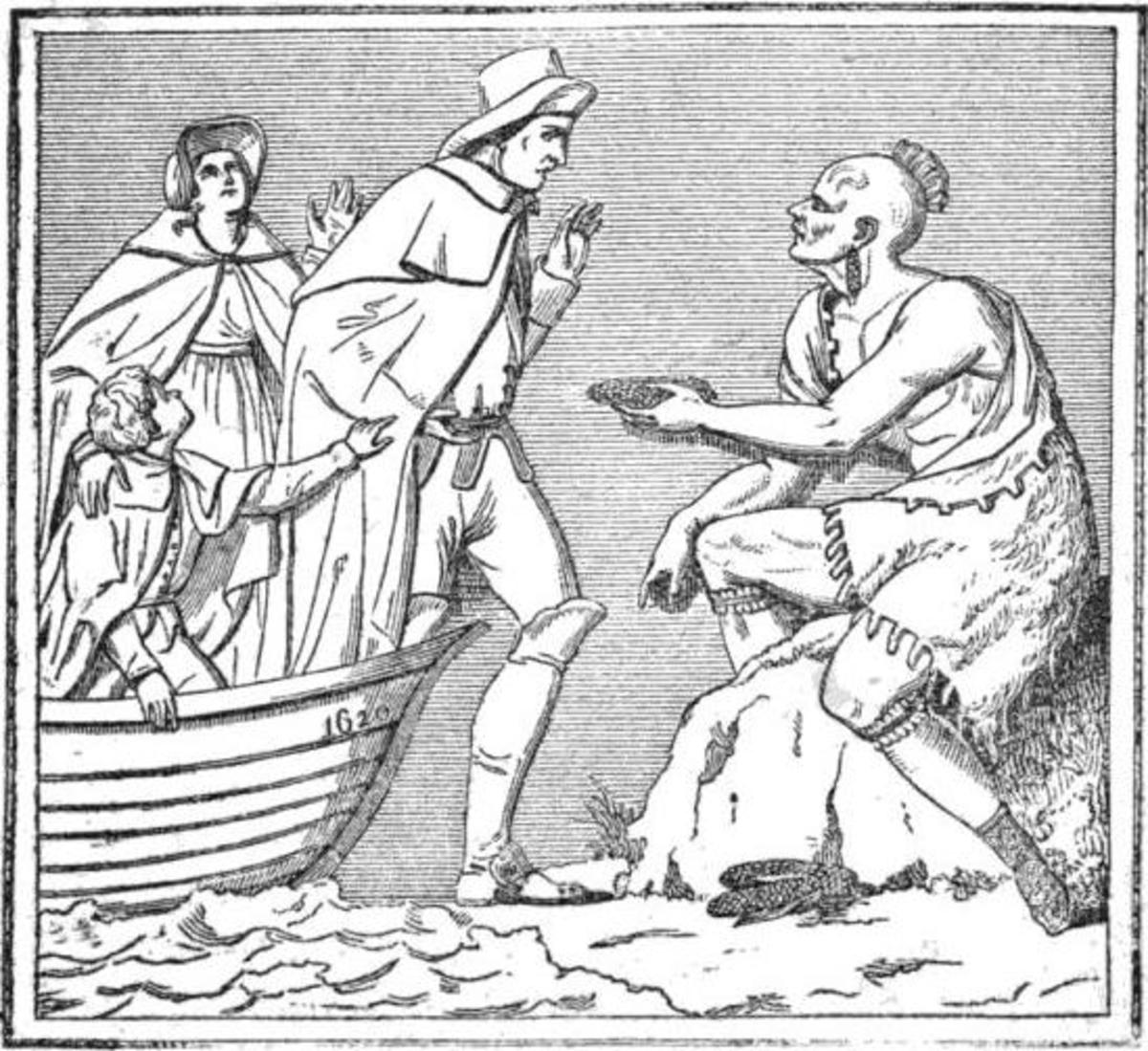
The next American colony was of a very different character; it was formed by religious exiles from England. A few Puritans, mostly from Lincolnshire, were disgusted with their treatment in England under King James I and left England to seek refuge in Holland. After ten years there, some of them decided to emigrate to North America. Other Puritans joined them, and the exiles, who became known as the Pilgrim Fathers, left Plymouth in the Mayflower in September 1620. They landed just north of Cape Cod and founded the first township which they called Plymouth.

Eight years later a larger body of Puritans in England formed a company which they called the Massachusetts Bay Company. The following year King Charles I granted them a charter and the whole body of shareholders crossed the Atlantic in 1630 to form the colony of Massachusetts. A steady flow of English immigrants during the next eleven years meant that the colony prospered. By 1644 the total population was more than 20,000.

Despite the fact that these Puritans had left their home to escape from religious intolerance, their own government was no less intolerant. John Winthrop, the first governor, was a man of considerable ability but had narrow views. Political rights in Massachusetts, no less than in England, depended on conformity with the narrow religious creed. This creed was determined by a small circle of strict Puritans who supported the governor. Anyone who differed from their rulers on minor points of religion could be subject to harsh punishment. Roger Williams, a clergyman who was driven from Massachusetts by this persecution, founded a new colony, that of Rhode Island, in 1636.

Other colonies followed, namely Connecticut and New Hampshire, the whole group becoming known as new England. These Puritan colonies were on the whole very prosperous, continuing to receive emigrants from England. Although the New Englanders tend to be less aristocratic than the Virginians, narrow religious opinion prevented the growth of a real democracy. The severance from England was more marked that of Virginia, because they regarded themselves as exiles rather than colonists.

© John Welford

Thursday, 2 April 2020

The poisonous myth of the Hamitic heritage


It should come as no surprise when people seek to justify immoral actions by appealing to a Biblical precedent. That was the case with the enslavement of black people by whites, which they claimed was sanctioned in the Book of Genesis.


Noah and Ham

Genesis Chapter 9 tells the story of Ham, the third son of Noah, finding the latter drunk and naked in his tent and telling his brothers, Shem and Japheth, who avert their gaze as they go into the tent to cover their father up and prevent any further embarrassment. On waking up, Noah is angry with Ham and lays a curse on the latter's youngest son, Canaan, which is that he is to be a bondservant to his two uncles. 

On the face of it, this seems to be particularly unfair to both Ham and Canaan. If Ham had not been first into the tent, presumably it would have been one of the other two. And why does Canaan, who was presumably only a child at the time, get it in the neck? However, that is the story as given, whatever the justice or otherwise of the case. Later interpreters have ascribed various degrees of significance to this passage. 


The descendants of Noah

Genesis Chapter 10 outlines the descendants of the three sons of Noah. This is not exactly a riveting read, but it is important as an account of how the world was repopulated after the Flood, bearing in mind that, according to Genesis, these were the only human beings left alive. 

Shem’s descendants are therefore the Semites, who include the Jews, with Abraham being a direct descendent of Shem by nine generations. Ham’s descendants are the Hamites, whose tribes include the Canaanites, who were to become the enemies of the Jews. This may explain the curse placed on Canaan. Other descendants of Ham were to populate much of North Africa.


Fact or myth?

Whether or not one regards the foregoing as fact or myth, depending on one’s interpretation of Genesis, what follows surely comes under the heading of myth, because it is based on such things as supposition, misreading and prejudice, with little if any Biblical justification. In short, Ham is judged to have been the father of the black races of the earth, and these are seen to be inferior to the white races.

For example, one early Jewish text has it that Ham was the only brother who had sexual intercourse during his time in the Ark (he is the only one mentioned as having a son immediately after the Flood) and for this he was “smitten in his skin”. Later writers also connected punishment with being made black, and linked blackness with slavery. For example, Patriarch Eutychius of Alexandria wrote: “Cursed be Ham and may he be a servant to his brothers … He himself and his descendants, who are the Egyptians, the Negroes, the Ethiopians…” 


The curse in modern times

These myths persisted down the centuries, so that the most terrible things could be written by people who were well-respected and venerated in their time and later. For example, the visionary Anne Catherine Emmerich (1774-1824), who was placed on the road to sainthood in 2004 by Pope John Paul II, was able to write: 

“I saw the curse pronounced by Noah upon Ham moving toward the latter like a black cloud and obscuring him. His skin lost its whiteness, he grew darker. His sin was the sin of sacrilege, the sin of one who would forcibly enter the Ark of the Covenant. I saw a most corrupt race descend from Ham and sink deeper and deeper in darkness. I see that the black, idolatrous, stupid nations are the descendants of Ham. Their color is due, not to the rays of the sun, but to the dark source whence those degraded races sprang".

One of the worst Victorian exponents of the myth was the explorer John Hanning Speke (1827-1864) who made three explorations of Africa in searching for the source of the Nile. He claimed that the Tutsis of Rwanda were superior to the Hutus because they had more “white” characteristics and did not suffer from the curse of Ham. This division into “good” and “bad” races led indirectly to the genocide of 1994 in which maybe as many as a million Tutsis and thousands of Hutus died within a hundred days.

It is an undisputed fact that the curse of Ham has been used as a justification for the enslavement of black people. Indeed, some have even regarded it as a virtual duty of white people to enslave black people, because of the Biblical example. In seeking to defend slavery at the time of the American Civil War, the crime of Ham was blown up to include rape and incest, with the clear implication that his black descendants were still guilty and deserved his punishment.

It is unfortunate that, in the eyes of many misguided people even today, black is bad and white is good. The perniciousness of this view, that has caused so much misery and injustice down the centuries, is largely due to the Hamitic heritage, and it is high time that we, as the human race, grew up and came to recognize the evil of maintaining this belief, and others that have no basis in reality but lurk under the cloak of religion to destroy so many innocent lives.

© John Welford

Wednesday, 1 April 2020

An appalling historical example of Christian violence


Lest anyone should forget that unspeakable savagery in the name of religion is not the preserve of any particular faith, the date of 15th July might be brought to mind. It was on this day in 1099 that the First Crusade achieved its aim of capturing Jerusalem from the Muslims who had occupied it for 400 years.

It had taken more than three years for the Crusading force to reach Jerusalem from western Europe, during which time the original army of 50,000 had been reduced by half. However, the force was still strong enough to breach the city’s defences, thus persuading the inhabitants to seek refuge in the Temple of Solomon.

When the Crusaders broke in they massacred everyone they could find – possibly as many as 10,000 men, women and children – and then cut open the bodies in case the victims had swallowed jewels or coins in the hope being able to escape with a little money to support themselves.

The Crusaders followed this episode by turning on the Jews of the city, herding them into the main synagogue which was then set on fire.

Having eliminated all opposition, the Crusaders set about establishing a permanent presence in Palestine in the form of the Latin Kingdom of Jerusalem, which was to last for nearly 200 years. However, Jerusalem itself fell to the great Saracen leader Saladin in 1187, which led to another Crusade being launched, notably featuring England’s King Richard I as one of its leaders.

Although Christians at the time would have regarded the sack of Jerusalem as a major triumph that showed that God was definitely on their side, later generations have come to see these events in their true light, namely an utterly revolting episode that did absolutely no credit to the religion it purported to be championing.

© John Welford

Muhammad's conquest of Mecca, 630


On 11th January 630 the Prophet Muhammad returned to Mecca, where he had been born some 60 years previously, at the head of an army of 10,000 followers. This show of force was enough to dissuade his opponents from putting up much resistance and so the conquest of Mecca was nearly bloodless.
Muhammad had spent most of his life in Mecca but had been forced to leave in about 622 due to the hostility he had aroused from some local people. His temporary home had been the rival city of Medina.
On his return, Muhammad negotiated a takeover of Mecca with Abu Sufyan, the leader of the Quraysh ruling tribe. As a result, only a few opponents tried to block his entry and most of those soon surrendered.
Muhammad also made sure that no reprisals were taken against his former enemies in Mecca, stating that “he who lays down arms will be safe. He who locks his door will be safe.”
Less assured of safety were the religious images that adorned the Kaaba, the holiest sanctuary in Mecca. Many idols were removed and destroyed, although some accounts maintain that images of Abraham, Jesus and Mary were spared. His main aim was to restore the status of the Kaaba as a sanctuary that was so “by virtue of the sanctity Allah has bestowed on it until the Day of Resurrection”. Mecca and the Kaaba have remained the focal points of Islam ever since.

© John Welford

The Shakers: The "Shaking Quakers" best known for their furniture


The Shaking Quakers, better known as Shakers, were a remarkable group of Christians that flourished in the United States during the late 18th and early to mid 19th centuries. Although their numbers were never all that large their name lives on mainly because of the artefacts they left behind them.
History of the Shakers
Although they are always thought of as an American religious sect, the Shakers had their origins in England. Their founder was Ann Lee, who was born in Manchester in 1742. She came from a very poor background and had to work in a factory. She sought solace in religion and joined a group that held meetings in which dancing and shouting in strange languages were encouraged.
Ann Lee fell out with this group over her belief that the root of all evil was lust, which was the real reason, according to her, why Adam and Eve were expelled from the Garden of Eden. She felt herself called to spread the word about the need for chastity, and became convinced that the American colonies would be the most receptive place for her message. She therefore left England for America in 1774, accompanied by her husband and a few followers.
It was not until 1780 that Ann Lee began her public ministry (at Niskeyuna near Albany, New York), but this was followed by a missionary journey through New England from 1781 to 1783. This led to the setting-up of a number of “Shaker villages” that were to become the nucleus of the sect. Ann Lee’s message about the value of hard work, meekness and simple living went down well with the Yankees in their newly freed states, but many were not so happy about the idea of enforced celibacy and this led to physical attacks on Shaker worshippers.
Ann Lee and her husband both died in 1784, but the movement was then led by James Whittaker, who was followed by Joseph Meacham. Whittaker stressed the need for communal ownership of property and Meacham developed the blueprint for gathering Shakers into communal villages. He was joined in the leadership by Lucy Wright, and this established a pattern within the villages of a male leader or official being matched by a female one.
There were originally eleven villages in the New England states, and the movement later spread westwards into Ohio, Kentucky and Indiana. 
Shaker communities
Shakers were allowed to marry but could not have sexual relationships. They therefore lived in separate dormitory-like buildings and children were raised in their own groups rather than directly by their parents.
Although new recruits to the movement would have brought their children with them, no further babies were born. Shakers therefore adopted orphans from outside their communities, and this no doubt solved many problems for non-Shaker women who bore children out of wedlock.
Shaker communities were founded on hard work and sharing various labours, but they did not believe in drudgery for its own sake. Shakers were responsible for producing several labour-saving devices, including the circular saw and a washing machine.
They traded extensively with the outside world, becoming known not only for the quality of their work but for their honesty in business dealings. Shakers became particularly well known for their furniture, which was basic in design but well-made and comfortable. Many pieces have survived to the present day.
By removing the burden of child-bearing from their women, the latter were able to play a full part in the life of their community to the extent that the sexes were regarded as equal in all material respects. It was true that certain tasks were regarded as men’s work and others as women’s work, but this did not mean that men’s tasks, such as blacksmithing and cabinet-making, were seen as being more important than the women’s tasks of cooking and cleaning. They were different in kind, not in status.
This attitude to gender roles and the importance of dual leadership were grounded in the Shakers’ theological view that God was both male and female and all creation was based on that duality. Ann Lee, who was revered as “Mother Ann” was the female counterpart to the male Jesus. 
The “shaking” of the Shakers continued to be an important feature of their worship meetings, in which the sober behaviour of the people in their day-to-day activities was replaced by dancing and shouting. However, at times during the 19th century the Shakers adopted a less exuberant form of worship, with choreographed dance movements and songs that were sung unaccompanied. They allowed non-Shaker visitors into these more restrained Sabbath meetings and drew large crowds. 
The decline of the Shakers
The Shaker movement was not attuned to modern times and it eventually faded away, starting from the late 19th century. The ban on sexual intercourse not only made it impossible for Shakers to maintain their numbers unless they adopted orphans, but it also made their way of life less attractive to those orphans when they grew up and, to be blunt, realised what they were missing. Many of them left the villages at the first opportunity. The Shaker lifestyle was in any case unappealing to most outsiders and recruitment became increasingly rare.
There is, however, one Shaker village still in existence. This is Sabbathday Lake in Maine, where the last few Shakers live out their days and the village acts as a museum of Shakerism. Meanwhile, genuine Shaker furniture attracts very good prices at antiques sales across the world on the rare occasions that it comes on the market.
© John Welford

Saturday, 22 February 2020

The myth of the Black Hole of Calcutta


The story of the Black Hole of Calcutta was one that was believed for decades to be the truth, the whole truth and nothing but the truth, but what really happened would appear to be very different from what the history books used to tell.

It was a story that grew from the days of the building of the British Empire, when everyone in Great Britain was convinced that empire-building was the right thing to be doing – spreading civilization and Christianity to the benighted people of far-distant lands. With that mindset, everything that the British did was right and proper and the actions of “lesser” people to frustrate British ambitions had to be wrong and improper. The Black Hole story fits into that scenario very well.

The East India Company

Britain’s early expansion into India was largely due to the actions of the East India Company, which had received its royal charter as far back as 1600. It pursued its aims – of trading in India on terms that were extremely beneficial to British interests – with considerable energy, which included imposing its will by force if necessary. The Company had its own army and navy, and at its peak in the 1850s it had control of more than 250,000 troops and a fleet that was larger than that of the Royal Navy.

By 1756 the East India Company was throwing its weight about in the region around Calcutta (modern Kolkata) and interfering in the internal affairs of the territory ruled by Siraj ud-Daulah, the Nawab of Bengal. The Company operated from Fort William, its fortified power base in the city.

The Nawab decided to frustrate the Company’s ambitions by launching an attack on Fort William on 20th June 1756. Seeing what was about to happen, most of the company troops and local recruits deserted the fort and fled, leaving only a token force behind. The fort was therefore easily taken after a short armed struggle, but the Nawab made it clear that he intended no harm to come to the prisoners he had taken. However, the reaction of the prisoners, led by the fort’s commander John Zephaniah Holwell, was far from cooperative so the Nawab ordered that all the Europeans in the fort, including Holwell, should be thrown into its jail briefly as a form of punishment.

The Black Hole Myth

The first element of the myth now comes into play, because the number of prisoners could not have been more than around nine, as opposed to the 146 in the account that reached the history books. In reality, only three of the prisoners died during the night of the incarceration and not the 123 that were claimed as the casualties. The three deaths were not from any mistreatment that they endured but the result of wounds suffered during the previous day’s battle.

The myth was created by John Holwell when he returned to London and put together a report with the title: “A Genuine Narrative of the Deplorable Deaths of the English Gentlemen and Others Who Were Suffocated in the Black Hole”. He was helped in its composition by two other executives of the East India Company who were not witnesses of the event. Holwell could therefore say whatever he liked because he knew full well that nobody would contradict him.

His account was plainly absurd. The room in question measured 18 feet by 14 feet and was therefore physically incapable of holding 146 people. Holwell included lurid details of the agony-twisted faces of the prisoners as they were denied water by their jailers. However, he was right about one thing, which was that the fort’s jail was not called the Black Hole for nothing – it had no windows and only two narrow ventilation slits, so it would have been impossible to see the faces of anyone in the pitch darkness that would have resulted.

But none of this mattered to the British public, who revelled in the horror story and pushed hard for revenge to be taken on the Nawab, who had dared to inflict such an atrocity on British subjects. The worse the atrocity appeared to be, the more likely it was that they would insist on the strongest possible measures.

Enter Robert Clive

Robert Clive has gone down in history as “Clive of India”, being the general most responsible for winning the battles and skirmishes that brought huge swathes of the subcontinent under British control. He had joined the army of the East India Company as a young man and risen rapidly through the ranks, although his reputation for bravery and skillful command may have been ill-deserved, given his use of trickery and cruelty to gain his objectives.

At all events, he was the man to whom the East India Company turned in order to sort out the problem of the Nawab of Bengal. Clive had little difficulty in recapturing Fort William and then went on to defeat the Nawab at the Battle of Plassey.

Clive used his time in India to enrich himself and acquire large amounts of loot from the various rulers that he defeated. When he finally returned to England he was challenged by Parliament to explain his vast wealth and justify his apparently underhand methods but was completely exonerated. In the end, winning an Empire for Great Britain was justification enough.

Challenging the Myth

It took a very long time for the Black Hole story to be properly challenged and exposed for the lie that it was. The first rebuttal did not come until 1915 with a paper entitled “The Black Hole: The Question of Holwell’s Veracity”, by the secretary of the Calcutta Historical Society. Other investigations were to follow. However, such was the power of the original story that it is still widely believed today, despite its impossibility.

The Black Hole of Calcutta is just one of many examples of “fake news” from past centuries. Telling huge lies has often proved to be profitable, especially when they are believed by enough people. Under search circumstances, why bother telling the truth?


© John Welford

Peter Minuit's big buy


On 24th May 1626, a director of the Dutch West India Company named Peter Minuit, a Dutch-speaking German, bartered a consignment of pots, pans, fish hooks, tools and cloth, together worth around 60 guilders, for an island at the mouth of the Hudson River. The value of that island, named Manhattan (“island of hills”) by the local Algonquin tribe, has risen considerably between then and now!

Two years before Peter Minuit had joined them, the Dutch West India Company had established the colony of New Netherland in the lower Hudson valley and had landed its first settlers there who subsequently established small communities dotted around the bay into which the Hudson River empties. However, war broke between local tribes over the fur trade they were conducting with the settlers, and the purpose of Minuit’s purchase from the native Lenape people was to provide a safe haven for the settlers at its southern tip.

He called the settlement New Amsterdam and had a wooden fort built at its centre into which the settlers could retreat if they came under threat.

In 1631 the Dutch West India Company called Peter Minuit back to Holland and, after more adventures in the New World, some on behalf of the Swedish government, he was drowned in 1638 in the West Indies when his ship foundered during a hurricane.

Even without Peter Minuit’s leadership the colony of New Amsterdam went from strength to strength, but things changed in 1664 when the colony was under the despotic and controversial governor Peter Stuyvesant.

As a prelude to the second Anglo-Dutch War, the English King Charles II decided that it would be a good move to annex the territory of New Amsterdam and join it to other English possessions in North America.  A fleet of warships was duly dispatched. Control of the colony was duly wrested from the Dutch after usual combination of threats and assurances had been delivered and received.

The English crown now held a colony named New Amsterdam, which clearly unsatisfactory. The king’s younger brother James, the Duke of York, was Lord High Admiral and nominally in charge of the naval action that seized the colony, so changing the name from Amsterdam to York seemed to be an appropriate move. It was therefore not the case that the colony took its name directly from the city of that name, which was typically the case when settlers from a particular town or city in Great Britain established a settlement in the New World.

James, Duke of York, who would later succeed his brother as King James II, had a personal interest in acquiring New Amsterdam because he foresaw a good deal of money flowing his way if Dutch sea power could be destroyed. He was far from being alone in this ambition and was therefore extremely popular with those colonists who shared his point of view. The choice of New York as the name did not therefore meet with much opposition.

However, once he became king in 1685, attitudes towards James changed considerably. After a reign of only three years he was forced to abdicate the throne and leave the country. He was never popular in England, having acquired the nickname “Dismal Jimmy” in contrast to his flamboyant brother who became known as “The Merry Monarch”.

Despite his later fall from grace, New York stayed as New York and that also became the name of the territory that the colonists settled between the Atlantic and Lake Ontario. Not only that, but another city also owes its name to James. This is the capital of New York State, Albany, this having been James Duke of York’s other royal title.


© John Welford


Thursday, 12 December 2019

The Crusader Cannibals


Wars of religion often seem to lead to the most despicable acts of cruelty and barbarism, with both sides claiming to have divine sanction for the horrors that they choose to visit on their enemies. This was certainly the case on 12th December 1098 when a Crusader army breached the defences of Ma’arat al-Numan, a fortified town that lies in what is now Syria.

In 1095 Pope Urban II had called on the Christians of western Europe to recover the Holy Land for Christianity from the Muslims who now occupied it. Being utterly convinced of the rightness of their cause, and having a firm belief that Muslims were a depraved form of humanity who deserved no mercy or respect, the Christian armies swept towards Jerusalem, slaughtering anyone who opposed them.

The Crusaders did not have everything their own way. The city of Antioch withstood a siege that lasted 21 months, and when it fell the inhabitants were treated extremely badly with many civilians losing their lives.

However, the long siege had meant that there was very little food left in the city, and the Crusaders, whose own supplies were running low, found nothing to replenish their stocks. With winter approaching, the surrounding countryside had little to offer either, so a plan was drawn up to advance the short distance to Ma’arat al-Numan and hope for more luck there.

When the town fell to the Crusaders some 20,000 people were killed and the children captured as slaves, but there was still no food to be found.

The Crusaders then turned to the only solution they could think of. They started to feed on the bodies of the people they had killed. Some reports said that they went as far as killing people for the purpose of eating them, including impaling children on spits so that they could be grilled, but these accounts cannot be relied upon.

Even so, for an army to turn to cannibalism, in the belief that they were fighting against people who were animals rather than humans, was terrible enough. This event placed a huge stain on the reputation of the Crusaders, and Christianity in general. The Muslim world has long held the Christian west in detestation, and this incident was one that caused that view to be created and to prevail down the centuries.


© John Welford

Tuesday, 6 August 2019

Great Britain's mandates in the Middle East, 1920


The date was 25th April 1920, which was perhaps one that should “live in infamy” every bit as much as that on which Pearl Harbor was attacked or the Twin Towers felled.

This was when the League of Nations granted Britain and France the right to govern the territories of the former Ottoman Empire and split them up as they saw fit. What followed has led to problems ever since.

Part of the deal saw Britain gaining mandates over Palestine and Mesopotamia. For the latter, which became the modern state of Iraq, Britain installed Faisal Hussein as king in recognition of his father’s support for Britain during World War One.

As for Palestine, Britain divided the territory between the Emirate of Transjordan, to the east of the River Jordan, and the Palestine Mandate to the West. Faisal Hussein’s brother Abdullah became the ruler of Transjordan. 

An added complication was the fact that Britain had already, through the Balfour Declaration of 1917, declared its support for a Jewish “national home” “in Palestine”, both of which terms were intentionally vague.

The 1920 decision therefore pleased nobody, given that the British had also proposed that Palestine should be governed by an international body and that the Arabs should have their own independent state. 

The assumption that 85,000 Jews and 600,000 Arab Palestinians could co-exist peacefully turned out to be a false one. The consequences of that mistake have haunted the world ever since.
© John Welford

Monday, 15 July 2019

Gandhi's 1930 Salt March


A protest march in 1930 that started with 80 people was seen in later years as a major step on the path towards India’s independence from the British Empire.

Mohandas Gandhi (1869-1948) was a London-trained lawyer who sought to fight against the British Raj by wholly peaceful means. One cause of discontent was the tax levied on the Indian population for the purchase of salt, which was essential for the preservation of food in the notoriously hot climate of India.

The protest march began in the state of Gujarat. It lasted for 24 days, averaging ten miles a day. The route of the march led towards Dandi, on the Arabian Sea coast.

As the march progressed it attracted thousands more followers and eventually the procession of people was more than two miles long. Gandhi also addressed large crowds of people at stops along the way and at the march’s conclusion.

At the end of the march Gandhi encouraged his followers to break the law by making their own salt from seawater, this being a significant act of civil disobedience.

The Salt March was the first major example of non-violent direct action against India’s colonial rulers. Seventeen years later Gandhi and his followers achieved their aim when the independence of India was declared.

© John Welford

Thursday, 13 June 2019

A torrent of transatlantic emigration in the 17th century


The story of the Pilgrim Fathers, who sailed across the Atlantic in the Mayflower from Plymouth (England) to the New World in 1620, is well known, but what is not so widely appreciated is that this was just the start of a virtual torrent of emigration from England to the colonies during the rest of the century.
Wave after wave of migrants left England for various reasons. It has been estimated that as many as 400,000 people may have set sail, with about half that number heading for North America and the rest going further south. Given that the total population of England at that time was about 5 million, that meant that getting on for 10% of the people of England simply departed and never came back. 
The first emigrants of the century – the Pilgrim Fathers – were Puritans who were sickened by what they regarded as lax religious standards on the part of the official Anglican clergy. They relied on God’s advice to Abraham to “Get out of thy country … unto a land that I will show thee”. They clearly believed that God was on their side when they arrived in America and vast numbers of the native population caught and died from diseases brought by the new arrivals and for which they had no immunity. God was obviously clearing the way for his new chosen people.
The next big wave of emigrants was in the late 1640s. Many of these had supported the cause of King Charles I against Parliament prior to and during the English Civil War, which eventually swung in Parliament’s favour. They could see no future for themselves under the regime that was likely to follow Charles’s defeat and headed off for Virginia and other American colonies. Given that the victors largely favoured the Puritan approach to religion, the new emigrants were of a very different nature from the previous batch.
The Restoration of King Charles II in 1660 caused problems for other religious groups in England, most notably the Quakers, who were appalled by the intolerance of the new regime towards non-conformist denominations. Most prominent of these emigrants was William Penn, the founder of Pennsylvania.
Not all the 17th century emigrants had political or religious motives for setting sail. There were plenty of economic migrants who left seeking to escape the poverty of their lives at home. Many had become victims of changes to the economic structure of England that made life very difficult for those at the bottom of the social pyramid. As woods and common land was enclosed to become private property, prices rose and wages fell.
As might have been expected, there was adequate opportunity for unscrupulous people to take advantage of the misery of others. Agents known as “spirits” became active at fairs, markets and taverns where they would entice people into emigrating with promises of vast riches to be made in the colonies.
A huge number of emigrants were indentured servants who had to work as virtual slaves for up to seven years before gaining their freedom, in return for board and lodging. It has been estimated that only around 10% of these people survived the experience.
Another source of emigration was the transportation of prisoners from English jails – a practice that lasted well into the 18th century until the American Revolution meant that Australia replaced North America in this respect.
Genuine emigration – i.e. by those who wanted to emigrate as opposed to doing so by force - waned towards the end of the 17th century, largely due to the increased toleration provided by the so-called “Glorious Revolution” of 1688.
A less acceptable reason was that the burgeoning slave trade, which shipped vast numbers of slaves to the colonies from Africa, meant that there was less need to import indentured servants from England, who were in any case less suited to the harsh conditions of the plantations in the southern colonies.
English migration may have declined at this time, but it was soon replaced by fresh sources of travellers from countries that included Ireland, Germany and Italy. However, the earlier dominance of English emigrants left several permanent marks on the population of what would eventually become the United States of America, most notably the universality of the English language.
© John Welford