Followers

Showing posts with label African history. Show all posts

Wednesday, 22 May 2019

South African history: the Great Trek


South Africa’s Afrikaners (Whites of Dutch origin) regard the Great Trek as the event that marked their identity as a people.

The Causes of the Great Trek

When – over a five-year period between 1835 and 1840 - some 14,000 Afrikaners packed their belongings into ox carts and set off from the Cape Colony to find new lands that they could call their own, they did so because life was becoming steadily less desirable for them where they were.

Dutch settlers had first arrived in the Cape in 1652, but they were later joined by British colonists who eventually seized control of the territory in 1805. The British had different ways of doing things – for example, they abolished slavery, gave Blacks and Whites equal status and introduced English as the official language in schools and churches.

Apart from these legal moves, perhaps the most important source of discontent for the Afrikaners was the fact that the influx of British settlers placed increasing pressure on the availability of land for farming. Many Afrikaner farmers decided that they would be better off if they found new lands for themselves further east and north.

The Routes of the Trek

The Great Trek was not a single journey by a large group of people but a succession of “treks” from various starting points in the Eastern Cape that used a number of different routes.

The first two “Voortrekker” (forward journeyer) parties were led by Louis Trichardt and Hans van Rensburg. They set off together in 1835 northwards across the Orange River but later split up after a quarrel, just south of the Limpopo River.

Van Rensburg took his group northwards along the course of the river but encountered hostile Tsonga tribesmen who wiped them out.

Trichardt’s party headed for the coast, although they were in no great hurry to reach it. When they did so, three years later, nearly half of them, including Trichardt himself, died of malaria. The survivors made their way to Port Natal.

Meanwhile, thousands more trekkers had set out on the journey of some 300 miles, many of them making for the mountain of Thaba Nchu, north of the Orange River. From there, they headed eastwards over the Drakensberg Mountains.

Making the Trek

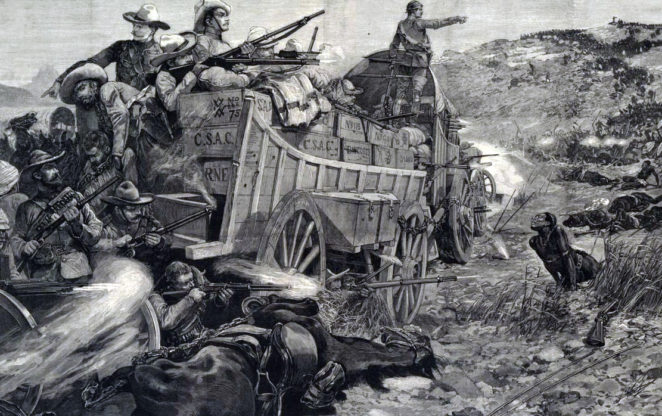
The Trekkers had many different environments to contend with on their journey, including vast stretches of dusty veldt and steep mountain slopes. All a family’s possessions would be loaded into an ox-drawn wagon and at night the wagons would be arranged in a circle to provide some protection from attack.

Progress was never rapid, averaging around 6 miles (10 km) a day. When climbing or descending steep slopes there was always the danger that the ox wagons would run out of control, so the practice was to remove the rear wheels and tie branches under the axles.

The Trekkers were not advancing into empty territory and they met considerable opposition from native tribes, especially the Zulus. Zulu power was eventually broken at the Battle of Blood River in December 1838.

The End of the Trek

The Trekkers, who became known as Boers (meaning farmers) set up a republic in Natal, on the east coast. However, this was annexed by the British in 1843 and the Afrikaners had to move again, finally settling in the high veldt to the north and west. Two Boer republics were established and recognized by the British, these being the Orange Free State and the Transvaal (or South African Republic).

An unexpected consequence of the Great Trek, and the expulsion from Natal, was that the Boers now controlled areas that contained extensive gold and diamond reserves. Not surprisingly, the British sought to take over these areas, and this ambition was a major cause of the two Boer Wars (1880-1 and 1899-1902) which led to the Boer Republics becoming part of the British Union of South Africa.
© John Welford

Monday, 23 July 2018

The origin of the Cape Colony


The Cape of Good Hope, at the southern tip of Africa, was always going to be an important place for a European nation that was interested in establishing colonies anywhere further east. Before the Suez Canal opened in 1869, the Cape had to be rounded by any ship bound in that direction. Seeing that several countries besides Britain, most notably the Netherlands, France and Portugal, had imperial ambitions to the east of the Cape, it is hardly surprising that competition for control of the Cape was fierce.

The Portuguese were the first to use the Cape as a repair and refreshment station on the way to India, in the mid-16th century, but it was the Dutch who established a permanent colony there in 1652, under the auspices of the Dutch East India Company.

The hinterland of the Cape itself is notable for its suitability for European settlement, having a temperate climate that supports both arable and pastoral farming, and is mercifully free of the banes of much of tropical Africa, namely the tsetse fly and the mosquito. However, the Dutch did little at first to develop their colony, their main interests lying elsewhere. Hence the small Dutch community was not augmented by new arrivals, and for 150 years the population only increased by natural means. Whereas there were probably a million settlers of British origin in North America by 1760, the Dutch population of the Cape was only 5,000.

The Cape Colony came into British hands in 1795 during the Napoleonic Wars, when the Netherlands had become part of France’s continental empire. It was not in Britain’s interest for the French to have control of such a strategically important place on the route to India. The British recognised that this was essentially a Dutch colony and fully expected to return it to Dutch hands at the end of hostilities. Indeed, in 1803 this was just what they did, when it looked as though the Netherlands would be free of French domination. However, the situation changed again in 1806, so the Cape Colony was recaptured. After that, especially after the 1815 Treaty of Vienna decided how Europe was to look in the post-Napoleonic era, it seemed expedient to keep control of the Cape.

The Dutch settlers, who became known as Afrikaners, had far more interest in developing the hinterland of the Cape than did the British. They were essentially farmers, and during the years of British ownership of the Cape they had moved eastward along the coast, where they came increasingly into conflict with native Africans. The Xhosa wars lasted, on and off, for much of the 19th century, with the Africans gradually losing out and having their lands in the eastern Cape appropriated by the Europeans.

The Afrikaners’ attitude towards the Africans reflected their religious belief that the black-skinned races were condemned by God to be subservient to the white-skinned ones, this being rooted in the legend that the descendants of Ham (son of Noah) were black and were cursed by God for Ham’s disrespect towards his father. This Afrikaner mindset was to percolate down through the generations to culminate in the Apartheid system that bedevilled South Africa until late in the 20th century.

Having not been particularly interested in colonizing the Cape, as long as the French did not do so, the British began to encourage settlement there from around 1820. About 5,000 settlers, whose passage was paid for by the British Government, arrived and established themselves as farmers in the eastern part of the Cape Colony, with a view to countering the Dutch influence and, if possible, protecting the Africans who were being threatened with oppression and slavery. The British farmers started by attempting to grow grain, but later found that sheep farming was easier and more profitable.

However, many of the British settlers had no background in farming and preferred to settle in towns and cities where they could practice their crafts and skills. The division between urban Brits and rural Afrikaners soon became clear. This strengthened the position of the British governor, and English became the official language of the Colony. The Afrikaners, on their remote farms, had no great problem with this at first.

For some years the Cape Colony carried on as three fairly distinct communities, with a prosperous and flourishing community around the port of Cape Town to the west, occupied almost entirely by the British, a farming community to the east and along the coast, peopled by a mixture of Brits and Afrikaners, and the interior, where the more adventurous Afrikaners were developing greater tracts of land. These pioneers were independent-minded people who tended to mistrust governments of any kind, be they British or Dutch.

It was the efforts of the British to curtail the Afrikaners’ oppression of the Africans that led to trouble. Not having the same religious attitudes as the Afrikaners, the British governors, encouraged by missionaries who had travelled widely throughout the colony, administered justice according to British principles, which meant that British, Afrikaners and Africans were to be treated as equals in legal terms. This was established by law in 1828, which the Afrikaners simply could not understand; to them, the British were acting contrary to the laws of God. Justice was served against a number of Afrikaners, including the death sentence being passed on those found guilty of the murder of Africans.

In time, many Afrikaners found it impossible to live under British rule, and thousands of them made the “Great Trek” to the north and east in the 1830s and 1840s to set up their own Afrikaner provinces of the Transvaal, Orange Free State and Natal. The Cape Colony, now the Cape Province, therefore lost many of its Afrikaans-speaking population, which accounts for the high proportion of English-speakers who live there to this day.

© John Welford

Friday, 27 April 2018

The Second Chimurenga: Zimbabwe's successful War of Independence


After the end of World War Two the liberation struggle in Africa began in earnest, as the nations sought to free themselves from colonial rule. The desire for independence often resulted from perceived disparities in living conditions between Africans and white settler populations, as well as the manifest racial prejudice exercised by the colonists. In what was then the British colony of Southern Rhodesia, the black uprising took place between 1964 and 1980. To the whites it was the Rhodesian Bush War and to the blacks it was the Second Chimurenga, the first having been the failed attempt at independence that happened in 1896-7. The end result was present-day Zimbabwe.

The origins of the Second Chimurenga go back to the 1950s, when growing resentment among the blacks led to the formation, in 1957, of the Southern African National Congress, which succeeded in gaining support in both urban and rural areas. This was seen by its founders as a revolutionary movement, bent on striking at the economic roots of the colonial system by carrying out acts of sabotage. The aim was also to excite terror so that the whites would give way to demands to repeal discriminatory legislation such as the Land Apportionment Act of 1930 that created a form of apartheid and gave the best land to white farmers. Actions during the 1950s mainly consisted of acts of civil disobedience, such as strikes. 

In 1960, the National Democratic Party was founded, its leading lights being Joshua Nkomo, Robert Mugabe, Ndabaningi Sithole and Herbert Chitepo. After the leaders were arrested, Nkomo founded the Zimbabwe African People’s Union (ZAPU), and disagreements among the nationalists led to a rival organisation being set up, namely the Zimbabwe African National Union (ZANU), led by Robert Mugabe.
The first act of war could be said to be the assassination of Petrus Oberholtzer on 4th July 1964. He was a white farmer and an official of the Rhodesian Front, the political party (led by Ian Smith) that was opposed to any move towards black majority rule and which had gained power in 1962. Oberholtzer was stabbed to death when he stopped at a roadblock. The action was carried out by ZANLA, the Zimbabwe African National Liberation Army which was the military wing of ZANU.
The whites under Ian Smith had their own agenda as far as independence was concerned, reckoning that they could best preserve their way of life without interference from London. This led to the UDI (Unilateral Declaration of Independence) declared by the Smith government on 11th November 1965. With moderation now being off the agenda on both sides, violence was the only likely outcome.
The war consisted largely of guerrilla actions against white farmers, often launched from bases in neighbouring countries. In response, Rhodesian Front forces mounted raids against bases that they said were guerrilla training camps, mostly in Zambia and Mozambique.
On 18 April 1966, at Sinoia (Chinoyi) in Mashonaland West, a group of ZANLA guerrillas who had invaded from Zambia to blow up power lines were confronted by the Rhodesian Air Force and seven of the former were killed. A second ZANLA group then attacked a farmstead, killing the farmer and his wife, and were subsequently beaten back.
Many other such operations were to follow, with the Rhodesian forces, which had helicopters at their disposal, usually being able to repel guerrilla raids. This was despite the sanctions that were imposed on the Smith government by most of the world community, the notable exception being the apartheid regime of South Africa that continued to support the white Rhodesians.
During the 1970s the war intensified, with the Rhodesian forces developing guerrilla tactics themselves through the formation of the “Selous Scouts”, which acted like a commando brigade, while the nationalists were supported by countries such as China and the Soviet Union that supplied them with more sophisticated weapons such as heat-seeking missiles and AK47 assault rifles.
Internationally, efforts to arrange a negotiated settlement were rejected by both sides, and the Smith government was roundly condemned, at the United Nations, for its actions including bombing raids deep into Mozambique territory.
Civilian casualties of guerrilla actions continued to mount, with black workers on white-owned farms becoming targets. In May 1978, 50 civilians died in crossfire between nationalists and Rhodesians.
Eventually, both sides came to realise that a military solution was impossible and that negotiation was the only answer. In particular, it became increasingly apparent to white Rhodesians that majority rule had to come eventually, and negotiation was the only way of preserving their lifestyles. The sanctions imposed on Rhodesia were making life very uncomfortable, especially when support from South Africa began to weaken. The apartheid regime of South Africa had its own agenda, including a policy of “detente” with several black African republics that made continued support for Rhodesia untenable.
On 3rd March 1978, Ian Smith signed an agreement with several moderate black leaders, including Abel Muzorewa and Ndabaningi Sithole, to create a power-sharing government for “Zimbabwe Rhodesia”. This did not have the support of ZANU or ZAPU, and the new arrangement clearly could not last long with the Bush War continuing.
The Lancaster House Agreement that ended the war was brokered by the British government in 1979, under the chairmanship of Lord Carrington, who was the first Foreign Secretary of Margaret Thatcher’s first administration. The conference that led to the agreement lasted from September to December, with participation from all the major players in the conflict. The net result was a power-sharing government in which 20% of seats in the Zimbabwe government were reserved for whites. Land reform was the most difficult point at issue, with Robert Mugabe being least willing to agree a settlement that still left vast areas of farmland in white ownership. The elections of February 1980 gave ZANU 57 seats, and therefore control of the new Parliament.
Although the Second Chimurenga was now over, and Zimbabwe was an internationally-recognised country under the control of the majority black population, this was not to be the end of bloodshed and misery in this part of the world.
© John Welford


Monday, 26 March 2018

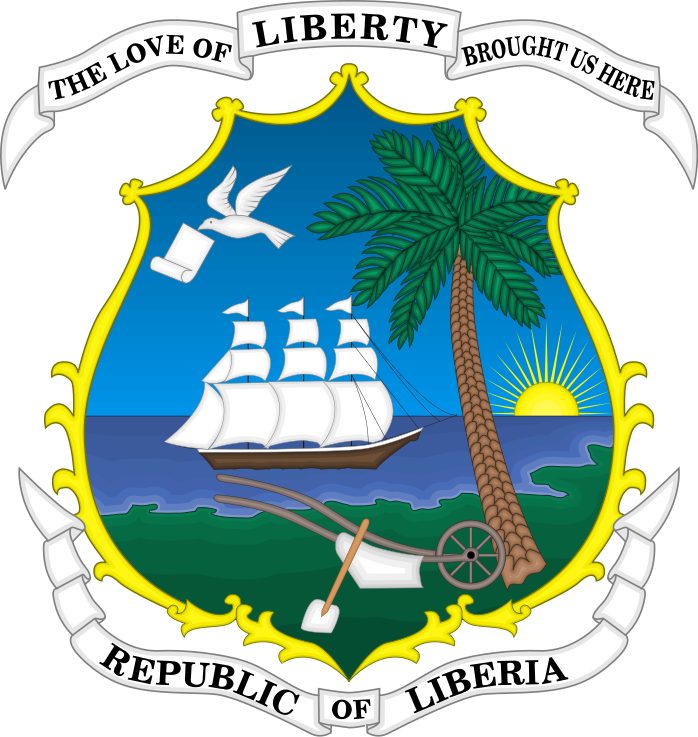
The shameful story of the founding of Liberia


The story of how Liberia came to be is a shameful one that comes high up the list of history’s tragedies of social engineering.

The creation of Liberia

At first sight, the idea of creating a new country in Africa, to which freed American slaves could return and live in peace and harmony, free from the hardships and indignities to which they had been subjected all their lives, might seem to be a noble cause that would attract nothing but praise from all liberal-minded persons.

However, the motivation behind the creation of Liberia, and the reality of the situation in which the first Liberians found themselves, had little to do with noble thoughts or humanitarian deeds.

Abolitionist movements in the early 19th century

Slavery was endemic in all the states of the American Union in its early years. However, abolitionists were very active, especially in the northern states, during the first quarter of the 19th century. Even in the south, many emancipation societies were agitating for an end to slavery.

One particularly active abolitionist was Benjamin Lundy, a Quaker from Ohio, who in 1825 took eleven ex-slaves to Haiti where they were resettled. His efforts did not always meet with approval, although he urged only a gradual winding down of the institution of slavery.

On the other hand, some abolitionists wanted to go further and faster, and they coupled this with a desire to remove all black people from the United States, based on nothing less than naked racial prejudice. The slaves had to be freed so that they could be removed from the country, leaving the United States as a “white” country.

The motives of the American Colonization Society

In 1816 the American Colonization Society (ACS) was formed with a view to petitioning Congress to establish a colony in Africa to which freed slaves could be sent. A prominent member of this Society was Francis Scott Key, who wrote “The Star-Spangled Banner”.

Congress liked the idea but did not offer any funds to make it happen. By 1820, private fundraising efforts had produced enough to send 88 former slaves to the British colony of Sierra Leone. However, no preparations were made to receive them and most of the emigrants died in what was, for them, a very hostile environment.

However, this did not stop the ACS from trying again, with other shiploads of emigrants being sent to the uncolonized stretch of coast next door to Sierra Leone, which was named Liberia (based on the Latin word for “free”). A settlement was established in 1822 which was named Monrovia in honour of President James Monroe. Despite fierce opposition from local tribes many of the newcomers survived, and the ACS continued to export black people from the United States, sending around 3,000 emigrants over a 30-year period.

In 1847 Liberia became an independent state, and in later years was notable for being the only part of Africa not to be colonized by a European power. However, the United States was not particularly proud of its offspring and only established diplomatic relations with the country in 1862.

Attitudes towards emigration to Liberia

The attitude of black people to emigration was mixed. Some clearly welcomed the opportunity to make a fresh start in the continent of their ancestors, and volunteered to go. However, a more common attitude was that this “repatriation” was unwelcome. As stated in a resolution passed by a convention of freed slaves in New York in 1831:

“This is our home, and this is our country. Beneath its sod lie the bones of our fathers; for it some of them fought, bled and died. Here we were born and here we will die”.

There is little doubt that many of the emigrants were pressured into going, with freedom from slavery being offered on condition that the ex-slaves joined to exodus to Liberia. The experience must have been similar to that of British convicts being transported to Australia or Russian dissidents being exiled to Siberia.

Looking back at the foundation of Liberia

The aims of the American Colonization Society could never have been realised. As was pointed out in 1827, for the entire black population of the United States to be removed, more than 50,000 people would have had to be shipped over a period of 30 years, at an annual cost of around a million dollars, a sum which the Society was never remotely close to raising.

The ACS continued to operate right up to the Civil War, with one of its later supporters being Abraham Lincoln. However, by that time it was virtually bankrupt, having never received the state funding that it sought.

The founding of Liberia was therefore made on the basis of a desire to rid the United States of an unwanted sector of its population, with little thought given to the welfare of the people involved. It is not something to be looked back on with any degree of national pride.

© John Welford

Saturday, 24 March 2018

The First Chimurenga: Zimbabwe's first war of independence


Zimbabwe gained her independence from British rule after a long struggle that began with the “Unilateral Declaration of Independence” by the white Prime Minister Ian Smith in 1965 and ended in 1980 after the Bush War that brought Robert Mugabe to power. However, this was not the first war of independence but the second.

The land that is now Zimbabwe came under British rule thanks to the imperialist ambitions of Cecil John Rhodes, whose British South Africa Company annexed vast areas of territory north of the Limpopo River. By 1895 Rhodes had acquired more than a million square kilometres between the Limpopo and Lake Tanganyika, land that was given the name Rhodesia in May 1895. Today, the northern part comprises Zambia and the southern part Zimbabwe.

However, the British advance into tribal lands was not without opposition. The indigenous people, the Ndebele and the Shona, took up arms to regain their lands and their cultural and political dignity. The resistance offered in 1896-7 became known as the First Chimurenga by the Africans but the Second Matabele War by the British. The name Chimurenga was coined by Sororenzou Murenga, who had led his people during First Matabele War in 1893. It can be roughly translated as “revolutionary struggle”.


Mlimo and Nehanda

The inspiration for revolt came from spiritual mediums such as Mlimo, who persuaded the Ndebele that the white men were responsible for all their woes, including introducing the cattle disease rinderpest (he may have been correct in this) and bringing drought and plagues of locusts (for which the whites were unlikely to have been guilty). However, the Ndebele had good cause for revolt, in that the settlers had been responsible for thefts of land and cattle and acts of rape and murder against the people.

Like most mediums of his kind, Mlimo was able to convince the warriors that they were immune to the bullets of the white men, a claim that has never been proved in reality. Also credited with inspiring the people was a female warrior called Mbuya (Grandmother) Nehanda Nyakasikana, who was largely responsible for getting the Ndebele and Shona to fight against a common foe. The title of Mbuya was given much later in recognition of her role as the grandmother of Zimbabwean independence.


The siege of Bulawayo

Mlimo had hoped to capture the town of Bulawayo, because most of the British garrison was absent dealing with the “Jameson Raid” emergency in the Transvaal, but attacks on settlers in the countryside started before he could make his move, which he did in March 1896 by which time many white people had escaped into the town for safety. There they built a “laager”, a makeshift fortification along the lines of the Wild West “corral”, into which they could gather at night for protection.

To say that Mlimo laid siege to Bulawayo would be something of an exaggeration, because the Ndebele were fearful of the British maxim guns that they had encountered during the 1893 war, and had no great desire to get within range, despite any spiritual protection that their mediums might offer. They even overlooked the need to cut the telegraph wires that connected Bulawayo with the outside world, so the settlers were able to communicate and call for assistance.

The settlers were able to send patrols out into the countryside to rescue other settlers and to fight back against the Ndebele. This became known as the Bulawayo Field Force, led by the remarkable American adventurer Frederick Russell Burnham, who was to leave his mark on the world for a different reason, mentioned below.

It was not until late May that two relief columns reached Bulawayo, one from the north and the other from the south. These were able to break the siege, and the settlers were saved. The second-in-command of the restored garrison was Lt-Col Robert Baden-Powell, whose meeting with Frederick Russell Burnham was to have consequences that spread far beyond Bulawayo.


The death of Mlimo

The British were now able to take the offensive against the Ndebele, but they did so in more subtle ways than simply mounting full-scale assaults, which were impossible when their enemy had the advantage of being able to melt away into a countryside that was alien to the white invaders. After the relief of Bulawayo, Mlimo and his warriors had retreated to the Matobo Hills, an area of sacred significance about 20 miles to the south that is dotted with many caves, in one of which Mlimo took refuge.

Burnham and an associate were able to infiltrate the area and enter Mlimo’s cave without being seen, by using the skills of scouting such as tracking and camouflage. There they waited for Mlimo to enter and shot him dead when he appeared. They were able to escape back to Bulawayo despite being chased by a hundred angry warriors. With Mlimo dead, the Ndebele resistance was broken, and Cecil Rhodes was able to accept their surrender in person in October 1896, offering them a land settlement in return for peace.


The war in Mashonaland

However, the war in Mashonaland, to the north and east of Matabeleland, continued. The Shona were particularly cunning and calculating in the planning of their rebellion. The official British report of the war stated: “So cleverly was their secret kept, and so well laid the plans of the witchdoctors, that when the time came the rising was almost simultaneous, and in five days over five hundred white men, women and children were massacred in the outlying districts of Mashonaland.”

In June 1896, the Shona launched an attack on the Alice goldmine at Mazowe, and a number of settler families were murdered as they tried to flee the area. The Native Commissioner, a man named Pollard, was captured and killed by being beheaded.

It took many months for the rebellion to be brought under control, and for the Shona leaders to be captured. Nehanda was eventually caught in December 1897 and was tried for the murder of Commissioner Pollard. She refused to convert to Christianity, as some other leaders did, and was hanged. Her last words were “My bones shall rise again”, and many Zimbabweans believe that it was her spirit that led to the successful Second Chimurenga that created the modern country.

Apart from the legacy of the spirit of rebellion, the First Chimurenga had another consequence that was much less to be expected. The friendship that developed between Frederick Russell Burnham and Robert Baden-Powell at Bulawayo led to Burnham passing on his scouting skills, which Baden-Powell was later to apply to great effect during the Boer War and to develop as a movement that has prospered and spread around the world, namely the Boy Scouts (now known simply as The Scouts).

(See also: The Second Chimurenga: Zimbabwe's Successful War of Independence)
© John Welford

Friday, 23 March 2018

The Battle of Adwa, 1896


During the 19th century the continent of Africa was thoroughly colonized by the European powers – Great Britain, France, Germany, Belgium, Spain and Portugal; to the extent that eventually only two nations remained “free”, these being Liberia – settled by former slaves from the United States – and Ethiopia.

That meant that when the Italians decided that they also wanted a piece of the action, their choice was severely limited. Ethiopia was by far the more attractive option, so that became their target.

Their efforts at conquering Ethiopia met with only partial success at first, with defeat at the hands of King Johannes IV at Bogali in 1887, but they did manage to control much of the country, at least nominally, for the next nine years.

However, in 1995 King Menelek II decided that the Italians should go. The Prime Minister of Italy, Francesco Crispi, was determined to resist and sent an army to Ethiopia under General Baratieri.

The Italians were convinced that they would have no trouble in defeating the Ethiopians, whom they regarded as primitives when compared with their own army with its superior training and technology.

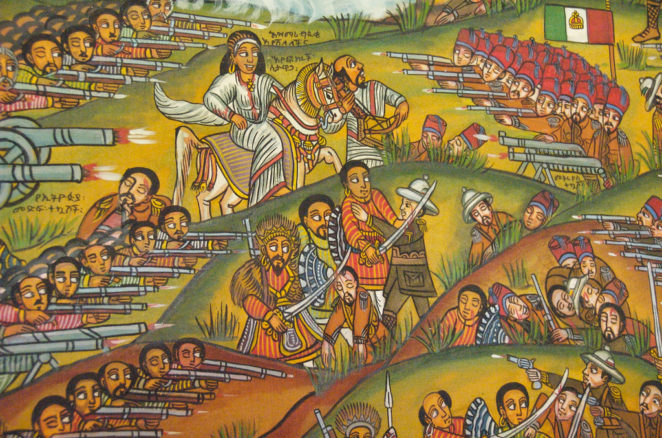
The Italian force of 17,000 men and 50 artillery pieces was supplemented by a brigade of local troops from Eritrea who were known as askari. The Ethiopians could muster an army of 100,000 riflemen with significant cavalry support.

The forces joined battle at Adwa, in northern Ethiopia, on 1st March 1896. The result was not long in doubt, with the Italians being caught in crossfire and overwhelmed by vastly superior numbers.

Some Italians were able to escape the slaughter, but more than 10,000 were killed, wounded, or captured and held for ransom. 3,000 captives were eventually released, but the Ethiopians did not treat the askari as well as they did the Italians. 800 of them suffered the loss of their right hands and left feet.

The defeat put paid, for the time being, to Italy’s ambition of becoming a colonial power in Africa. In 1935 Benito Mussolini had another go at conquering Ethiopia and was successful, with the “Empire of Ethiopia” lasting from 1936 to 1941.

However, the Battle of Adwa stands as the only example of a would-be colonial power being thwarted by an African nation.
© John Welford