Sutton Hoo is an important archaeological
site in Suffolk, England. It is the burial site of an early English king, and
has been described as the English equivalent of the tomb of Tutankhamun.
King Raedwald of East Anglia
After the recall of the Roman
administration of England in 410 AD, the land became open to settlement by
tribes from the near continent, notably from what is now Denmark and northern
Germany. One of these tribes was the Angles, who originated from what became the German state of Schleswig-Holstein, immediately south of the Danish
peninsula.
The Angles settled mainly in what are now
the English counties of Norfolk, Suffolk and Cambridgeshire, and would have
been well established in the area before the reign of King Raedwald, who was
probably king from 599 to 624.
By this time, the Anglo-Saxon kingdoms had
come under the influence of Christian missionaries, most notably Augustine who
had arrived in Kent in 597. Raedwald was the second English king to be baptized
as a Christian, the ceremony taking place at the court of the first such
convert, namely King Ethelbert of Kent, in about the year 605.
However, it would take a long time for the
culture and practices of Christianity, as directed by bishops from Rome, to
wholly replace those of the formerly pagan English monarchies, and this is
evident from the burial customs that are revealed by the Sutton Hoo site, and
others.
Raedwald was therefore buried in a manner
that was consistent with the Norse tradition of laying the king’s body in one
of his ships, together with many of his former possessions, and burying the
ship under a raised mound of earth. There is no evidence that ships were ever
set on fire and pushed out to sea, as Hollywood directors might fondly imagine,
but the body was often cremated within the ship before it was buried.
The Sutton Hoo burial
The site is close to the River Deben at
Woodbridge, Suffolk. Visitors are able to walk round the site, which contains a
total of 17 burial mounds that date back to prehistoric times, and view an
exhibition that tells the story of King Raedwald and explains how the site was
excavated, but the treasures that were found are now housed in London’s British
Museum, with replicas being on view at the site itself.
It is evident that Raedwald acquired
considerable power and wealth during his lifetime, because the items that were
buried with him were of extremely high quality. It is clear that the Angles
shared with the ancient Egyptians the belief that a monarch needed to be well
provided for in the afterlife, hence the nature of the possessions that he was
expected to take with him.
The excavation of the site began in 1939
when the owner of the land, Mrs Edith Pretty, decided to dig into the mounds on
her land. She soon handed the task over to a local archaeologist, Basil Brown,
who found that some of the burial mounds had been stripped of anything of
interest by grave robbers, but that “Mound 1” seemed to have been untouched.
Within Mound 1 he found the famous ship
burial, in the form of an impression in the sandy soil of a 27-metre long ship.
Within the “ship” was an astonishing collection of grave goods.
Basil Brown contacted other archaeologists
with a national reputation, and they continued to work on the site while
keeping the knowledge of their finds secret from the general public. This was
in any case wartime, when public attention was on more pressing matters.
The site continued to be excavated after
the war, right up to the 1990s. It is now managed by the National Trust,
although Mrs Pretty had decided at an early stage to donate all the finds to
the British Museum. She died in 1942.
The finds at Sutton Hoo
There was no sign of King Raedwald’s body,
which would have been dissolved by the acidic soils of the burial mound, but it
is clear from the position of the grave goods that he was not cremated.
It is also clear that his was a Christian
burial, because close to the body were two silver spoons inscribed “Saulos” and
“Paulos”, these being the names of St Paul before and after his conversion.
There were also ten silver bowls from the Holy Land.
However, most attention has been focused on
the items that indicate the Pagan traditions still recognised in East Anglia at
the time of Raedwald’s death. There was, for example, a sword with a jewelled
pommel and a purse containing coins to “pay the ferryman” who would take the
dead king to his final reward of an afterlife among the gods and warriors of
the past.
The coins in the purse, which was of an
intricate design and would have hung from the king’s belt, came from different
continental mints, thus indicating the extent of foreign trade that was carried
out at the time.
Raedwald would have been buried in a fine
cloak, the cloth of which has long since disappeared. However, the jewelled
gold clasps and buckles from this cloak were of the highest quality and
demonstrate an advanced degree of workmanship. The “great buckle” is
particularly fine, being made of gold and inscribed with an intricate pattern.
It contains a small secret compartment that might have been used to house a
holy relic.
One very interesting find was a coat of
chain-mail in which the links were alternately riveted and welded. Other
clothing included leather shoes.
The grave contained fragments of textiles,
of which a considerable amount had clearly been buried. From what has been
preserved, it is clear that weavers of the time were skilled in design
techniques and had access to a range of coloured threads. Some of the textiles
may well have been imported.
The king had a quantity of household goods
to accompany him, including drinking horns, cups, knives and plates.
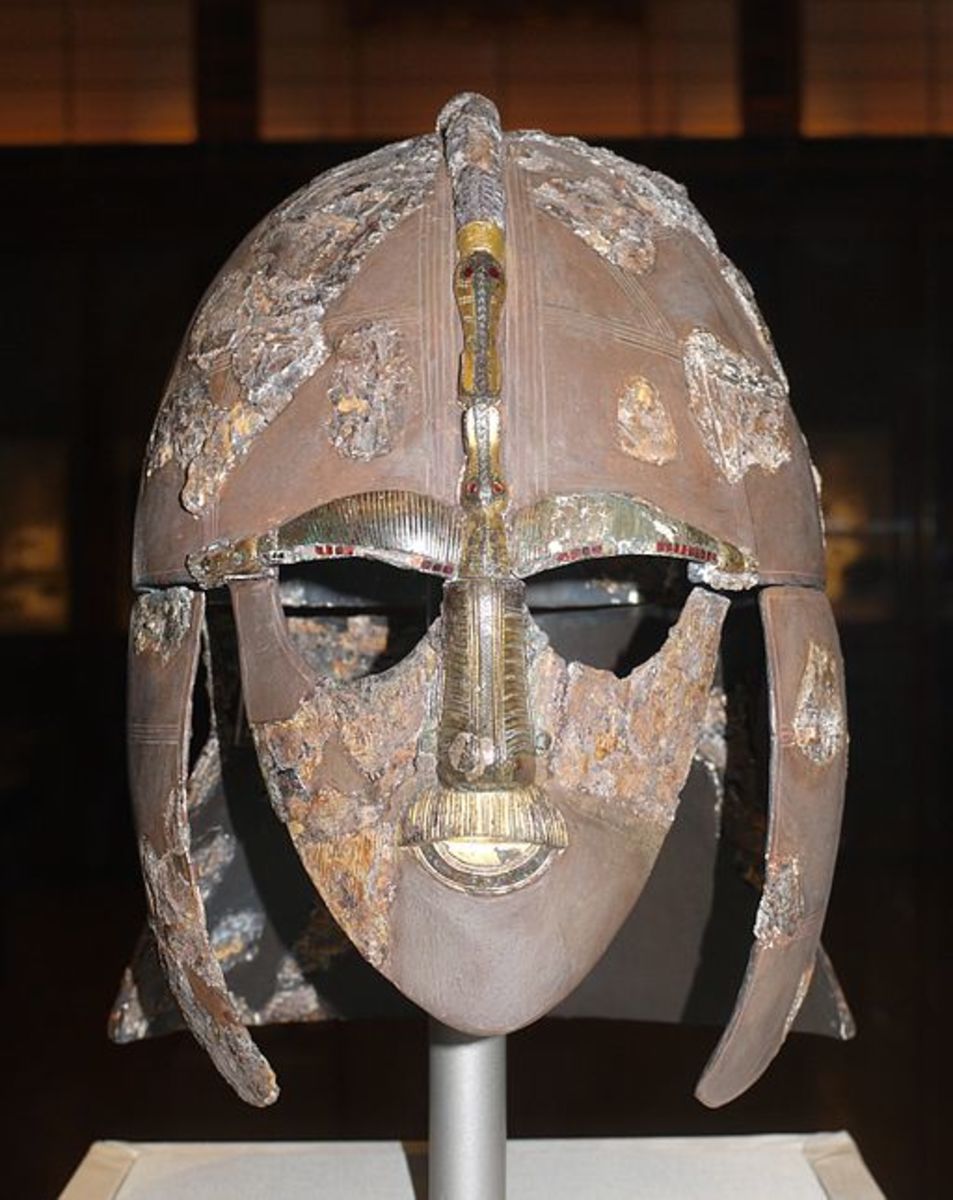
Pride of place among the objects found at
Sutton Hoo must go to the king’s helmet, which has become the symbol of Sutton
Hoo. Intricately worked bronze and iron plaques were attached to an iron skull
cap, but even more remarkable was the face mask that included eyebrows picked
out in garnets and a full bronze moustache. One has to assume that this was intended
to be a portrait of King Raedwald – if so he continues to look at us from a
distance of 1400 years.
What Sutton Hoo teaches us
The main lesson of Sutton Hoo is that the
term “Dark Ages” to describe the period of around 300 years after the departure
of the Romans from Britain is hardly fair. This implies that civil society
broke down completely and that the country was in a virtual state of anarchy.
However, the Sutton Hoo finds show that the
early Anglo-Saxon kingdoms recognised the rule of law and were sufficiently
peaceful for trade to flourish and craftsmen to develop a high degree of
sophistication in the good they produced. At least as far as the upper strata
of society were concerned, it was possible to live a secure life surrounded by
the trappings of luxury.
The evidence of the spread of Christianity
to the kingdoms of men such as Raedwald implies that literacy and education
would have been encouraged, as would the social order that comes from the
development of dioceses and parishes that Christian bureaucracy would have
introduced.
As well as marvelling at the treasures of
Sutton Hoo, one can also reflect on the fact that the so-called Dark Ages
admitted a greater degree of light than had previously been thought.
© John Welford