Followers

Sunday, 18 March 2018

How did the Sphinx lose its nose?


The Great Sphinx of Gisa, which stands next to the Pyramids, is one of Egypt’s most famous monuments. It is believed to be around 6,500 years old and its head to be a representation of the Pharaoh Khafra.

One notable feature of the Sphinx, which has the head of a man but the body of a lion, is that it has no nose. This has given rise to considerable speculation down the years as to why this might be. The question is therefore: “who broke the Sphinx’s nose?”

One oft-supposed culprit is Napoleon Bonaparte, who fought two battles in Egypt, one of which – fought in 1798 – is known to history as the Battle of the Pyramids. Maybe a misdirected cannon shot removed the nose of the Sphinx? One problem with this scenario is that - despite the name – the battle was fought nine miles away from the Pyramids, and thus well out of range of a cannon shot at that time.

Napoleon returned to Europe after the defeat at Trafalgar in 1805, leaving behind 55,000 soldiers and a team of “savants” who were civilian experts with a mission to study the artefacts of ancient Egypt. The story is still put about by Egyptian guides at the Pyramids that it was one of these savants who stole the nose and took it back to the Louvre in Paris.

However, not only does the Louvre not have the nose in its possession – and this was never the case – but there are sketches in existence that show a nose-less Sphinx as long ago as 1737, which was 32 years before Napoleon was born.

The only reliable account of vandalism to the Sphinx dates from 1378, when an Islamic cleric was summarily executed for damaging the statue – but not for removing the nose.

The most likely reason why the Sphinx has no nose is that sand-laden desert winds are very good at eroding soft limestone. After 6,500 years, it should be no surprise that the Sphinx does not look the same as it did originally!

© John Welford

HMS Dreadnought and the Abyssinian princes


One day in 1910 the crew of HMS Dreadnought played host to a rapidly arranged royal visit. The ship, which was the British Navy’s flagship and its pride and joy, was lying at anchor in Weymouth Bay off the Dorset coast as part of the Home and Atlantic Fleets. The visitors, so the ship’s officers were informed, would be four princes from Abyssinia, who were to be made welcome, shown every courtesy, and – in effect – treated like the royalty they were. A telegram, signed by the Under-Secretary of State at the Foreign Office, made this abundantly clear.

At about the time that the telegram was being received, the stationmaster at London’s Waterloo Station was being harangued by a man in a posh suit and a top hat who told him that he was Herbert Cholmondesly from the Foreign Office and that he needed a special VIP coach to be added to the next train to Weymouth so that four princes from Abyssinia could be conveyed on a visit to the Royal Navy. They would, of course, need to be welcomed appropriately at the other end of the line.

And that is what happened. The coach was duly provided, the princes boarded it, and a few hours later they arrived at Weymouth to be given the full VIP treatment with a guard of honour.

They were ferried out to HMS Dreadnought where they were piped aboard the ship which had been duly decked with flags and bunting. One problem was that the ship did not have a flag of Abyssinia that they could fly, nor did the ship’s band have the music for the Abyssinian national anthem. They did the next best thing, in their view, by running up the flag of Zanzibar and playing the Zanzibar national anthem. They might have been concerned that the princes would be offended, but in the end their worries were groundless – these “princes” were none the wiser, because they were not from Abyssinia or anywhere remotely close to it.

The Royal Navy, and the stationmaster at Waterloo, had fallen victim to a superbly organized prank, courtesy of William de Vere Cole, who must count as one of the greatest practical jokers Britain has ever produced. It was he who sent the telegram to HMS Dreadnought and he was the man who claimed to be Herbert Cholmondesly of the Foreign Office.

The four princes were nothing of the sort. One of them was actually the novelist Virginia Woolf! The four friends of de Vere Cole were fully made up and costumed by a professional theatre make-up artist – another friend of the joker. They were accompanied on the trip by Woolf’s brother Adrian (as “interpreter”) and de Vere Cole himself.

Once on board HMS Dreadnought the “princes” performed their roles in ways that would have excited the suspicion of anyone who knew anything about life in Abyssinia, but fortunately for them that did not include any of the people they met.

The jokers handed out visiting cards printed in Swahili and spoke in Latin, disguised by what they hoped was a passable East African accent. The only non-Latin expression they uttered was “bunga-bunga!”, which was their appreciation when shown anything of interest.

As they were shown around they bestowed Abyssinian military honours on the senior officers. At sunset they requested prayer mats. However, they refused all offers of refreshment, this being done just in case any of their false lips fell off while eating or drinking.

There were two occasions on which the hoax might have backfired. The first was when half of one of the princes’ moustaches flew off when he sneezed – he was able to recover it and stick it back on before anyone noticed.

The second was when the group was introduced to an officer who was not only related to Virginia Woolf but was also well acquainted with William de Vere Cole, who was not in disguise. Either the officer really did not recognize them or he realized that the arch-joker was up to his tricks again, and spilling the beans would cause far too much embarrassment all round.

After photographs were taken (see above), the visitors returned to shore and thence to London, presumably laughing all the way.

There must have been red faces at the Admiralty when the story emerged that all it took for the pride of the Royal Navy to be boarded by perfect strangers was a fake telegram and a brilliant piece of theatrical make-up. Fortunately, military security has been improved in the century since this trick was pulled off with such great success!

© John Welford


Friday, 16 March 2018

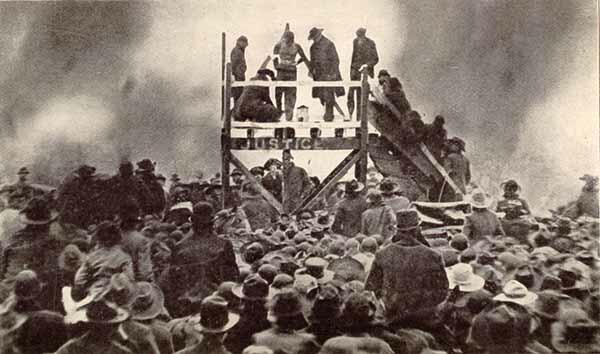
Don't blame the Lynches for Deep South lynchings


One of the ugliest aspects of an ugly time in American history was the upsurge in violence by whites against blacks in the Southern States during the late and 19th and early 20th centuries. A particularly unpleasant custom was lynching – a black victim would be accused of an offence, dragged from their home by group of white men, tried by a kangaroo court and executed in public, usually by hanging. Records show that more than 2,800 deaths could be attributed to the activities of lynch mobs between 1880 and 1930.

The custom of mob violence leading to summary execution has by no means been limited to the Deep South or the era of “white supremacy”, and the terms lynch mob and lynching can be applied far more widely than to that context. But where does the word “lynch” come from?

There seems no doubt that it derives from a person’s name but which Lynch can take the credit, if that is the right word to use? On the one hand is Charles Lynch, a Virginia planter (born in 1736, died in 1796) who was a revolutionary during the War of Independence who punished suspected loyalists in his own irregular court, thus dispensing “Lynch law”.

However, there was an unrelated Lynch, Captain William Lynch (1742-1820), who claimed that he was the originator of the term.

William Lynch came from Pittsylvania County, Virginia. In 1780 he made a formal agreement with a group of his neighbours to deal with local troublemakers by taking the law into their own hands and inflicting whatever punishment they saw fit on any miscreants that they captured, although they did not go as far as actually executing anyone – a severe thrashing was as far as they went in terms of chastisement.

It does seem strange that two Virginians named Lynch, who were probably unknown to each other, were doing something similar at roughly the same time that could easily have led to a new word entering the language. It sounds like a remarkable coincidence, but could this be an example of a double attribution – Lynch law and Lynch mob deriving from different Lynches?

Whatever one might think of the rightness or otherwise of their actions, they cannot be blamed for the utterly despicable deeds carried out more than a century later to which their name was attached.

© John Welford

Thursday, 15 March 2018

Berwick-upon-Tweed's peaceful war with Russia


Berwick-upon-Tweed is England’s most northerly town, although that has not always been the case because it has changed hands between England and Scotland no less than 13 times in its history. Having said that, it has been part of England ever since 1482 so that argument would appear to be over.

Even so, the town’s status is odd in several respects. For one thing it lies on the northern – Scottish - side of the River Tweed. For another, the former county of Berwickshire was in Scotland, and Berwick Rangers Football Club plays in the Scottish League, not the English one.

Stranger still is the fact that for 110 years Berwick-upon-Tweed was (it is said) at war with Russia when this did not apply to either England or Scotland! How so?

As mentioned above, the status of the town was in dispute for much of the medieval period, which made it necessary to quote the name of the town specifically in all state documents. This tradition continued for hundreds of years after the final settlement of Berwick’s status in 1482.

The story goes that Britain’s declaration of war on Russia in 1853 (the Crimean War) was signed by Queen Victoria as “Queen of Great Britain, Ireland, Berwick-upon-Tweed and all British Dominions”. However, the Treaty of Paris in 1856, which ended the war, did not mention Berwick-upon-Tweed. That meant that Great Britain, Ireland and the British Dominions were no longer at war with Russia, but Berwick-upon-Tweed still was!

The “Hundred Years War” between Berwick and Russia turned out to be a remarkably peaceful affair, with no shots fired and no residents of the town being seized as potential spies should they have ventured to Moscow or St Petersburg.

The anomaly was eventually sorted out in 1966 when a Soviet official made a goodwill visit to Berwick to declare peace and the mayor of the town replied: “Please tell the Russian people that they can now sleep peacefully in their beds”.

But is the basis of this story what it appears to be? A later investigation showed that, although the 1856 peace treaty did not mention Berwick-upon-Tweed, neither did the original declaration of war. It simply did not need to. Not only was Berwick firmly part of Great Britain, along with England and Scotland, but an Act of 1746 had already made it clear that English law applied to Berwick-upon-Tweed and thus legal documents (including declarations of war) that applied to England would apply equally to Berwick.

On the other hand, it made a good story and people believed it for a very long time!

© John Welford

Saturday, 30 December 2017

The Battle of the Herrings, 1429


The Battle of the Herrings did not involve any herrings as combatants, and none of them was actually alive at the time, but their presence was a vital factor in an incident during the Hundred Years War that would come to have important and unexpected ramifications.

In February 1429 an English army was besieging the French city of Orleans. The season of Lent was approaching, during which time meat was off the menu for Christians, which naturally meant the entire English army. With starvation being preferable to eternal damnation, an alternative source of protein was needed, and the solution took the form of a convoy of carts loaded with barrels of salted herrings.

The herring carts were under the protection of Sir John Fastolf, whose name would later be the inspiration for William Shakespeare’s Sir John Falstaff. Problems arose when the convoy, protected by Fastolf’s troops, reached Rouvray, north of Orleans, on 12th February. A combined French and Scottish army intercepted the English and opened a bombardment of cannon fire against which the English had no reply.

This assault should have been enough to put paid to the herrings, but the Scottish commander made the mistake of sending in his men on foot to finish the job. The English had no cannons but they did have archers, and as soon as the Scots came within range they were the recipients of volleys of arrows. The French commander then sent his men in to rescue the Scots, but they suffered the same fate. Sir John then attacked with his own men-at-arms and put the combined French/Scottish force to flight.

The herrings were thus able to continue their journey to Orleans and the besiegers of the city could carry on with the siege.

The net result of the battle was that the French had to have second thoughts about lifting the siege of Orleans. It so happened that on the very day of the Battle of the Herrings, when the force that should have been doing the job of relieving Orleans was being routed at Rouvray, a would-be commander was pleading for a chance to show how it should be done. With no other alternatives on offer, the high command agreed and thus the legend of Joan of Arc was born.

© John Welford

Friday, 29 December 2017

The Amistad case and the slavery debate


A revolt aboard a ship transporting slaves from one part of Cuba to another in 1839 led to a celebrated case before the US Supreme Court that some have seen as a precursor to the US Civil War.

La Amistad was a two-masted schooner in private ownership that was used to transport goods along the coast of Spanish-owned Cuba and to other parts of the Caribbean. On 28th June 1839 La Amistad set sail from Havana bound for a small port in eastern Cuba. The ship’s crew was captained by the owner, Don Ramon Ferrer.

On this occasion the ‘cargo’ included 53 slaves who had been sold in Havana and were being taken to the sugar plantation where they would be put to work and probably spend the rest of their lives. Also on board were the slaves’ new owners. The slaves were members of the Mende tribe from Sierra Leone who had been shipped across the Atlantic not long before. By this time the Atlantic slave trade had been declared illegal, although the institution of slavery had not.

The slaves were not conveyed in La Amistad in the conditions that they would probably have experienced during their previous voyage. Some of them were kept in the ship’s hold and others on deck.

After a few days at sea the slaves in the hold were able to free themselves and get hold of knives that were used for cutting cane. They overpowered the crew, some of whom were killed, including the captain. They demanded that the navigator set a new course, namely for Africa. However, he was able to trick the slaves and sailed north instead of east. The ship was eventually intercepted by an American naval ship, USS Washington, and escorted to New York.

The United States was now in possession of a Spanish ship together with its cargo of slaves, and it was the status of that cargo that was to occupy the best legal minds of the country over the next two years or so.

The Spanish demanded the immediate return of La Amistad and the slaves, and President Martin Van Buren was at first minded to agree with the request. However, it was pointed out to him that the transport of slaves in ships had been outlawed by both the United Kingdom and the United States, so under American law the slaves were the victims of a crime, not the perpetrators of one.

When the case came before the Supreme Court it was stated that the slaves had been ‘unlawfully kidnapped and forcibly and wrongfully carried on board’. This view was supported by Justice Joseph Story and the slaves therefore won their case, the verdict being delivered on 9th March 1841.

There was already a strong abolitionist movement, especially in the northern United States, and funds were raised to accommodate the freed slaves and give them lessons in English, as well as Bible classes. Further funds were raised to pay for their repatriation to Sierra Leone, which happened the following year.

One of the former slaves later returned to the United States to study at college, after which she became a Christian missionary back in Sierra Leone.

The Amistad case exposed the deep divide in American society between those who supported the institution of slavery and those who did not. Many southerners took the line that the slaves were non-persons who were the property of their owners and should therefore be returned to them, as would any other stolen and subsequently recovered goods. The abolitionists (led by former President John Quincy Adams) argued that persons who had been illegally transported to Cuba, and were therefore free, were entitled to the protection of the American legal system.

The Supreme Court verdict undermined the racist assumptions of the southerners and gave the abolitionists a significant moral victory. Tensions between north and south were heightened, and the case therefore constituted a step on the path that would eventually lead to civil war.

The case was remembered in 1997 when Steven Spielberg directed the film ‘Amistad’ that brought the case before a modern audience. Criticisms have been levelled at the film for its historical inaccuracies, and for portraying the case as a vital turning point in the story of the ending of slavery in the United States. It has to be remembered that the former slaves of the Amistad had returned home nearly 20 years before the first shot was fired in the war that finally settled the matter.

© John Welford

Wednesday, 4 October 2017

The Battle of Aljubarrota, 1385


14th August is an important date in the history of Portugal and in Portuguese/British relationships. It was the day of which the Battle of Aljubarrota was fought in 1385, with far-reaching consequences.

The central figure of the story was João o Bastardo, which translates as John the Bastard. He was the illegitimate son of King Pedro I, and therefore not able to inherit the throne when his father died. However, when João’s half-brother also died the throne fell vacant and widowed Queen Leonor was persuaded to invite John I of Castile (a Spanish kingdom) to become King of Portugal as well.

This move did not please a group of Portuguese noblemen, one of whom, Pereira Nuno Alvares, urged João to seize power on his own behalf. Queen Leonor fled the country and implored John of Castile to invade Portugal in order to defeat her late husband’s half-brother. This he did, assisted by a contingent of 2,000 knights from France.

John’s army was met by that of João and Pereira at Aljubarrota, which was on the road to Lisbon. João also had a powerful ally, namely England, which supplied a brigade of longbowmen.

1385 was well within the period known as the “Hundred Years War” when English and French monarchs did battle against each other for mastery within western Europe. On this occasion the struggle for Portugal became a proxy battle in a much larger conflict. The battle turned out to be an echo of earlier ones (notably Poitiers in 1356) and a model for later ones (such as Agincourt in 1415) in that it featured French mounted troops facing English bowmen and coming off worse.

The most familiar feature was the ability of a relatively small force to defeat a much larger one by the use of superior tactics. John of Castile sought to outflank the Portuguese/English force by taking a long march on a hot day that only succeeded in exhausting his troops. João and Pereira merely had to wait in their well-defended positions for the enemy to approach and be soundly defeated. Losses were heavy on both sides, but the Portuguese victory was decisive.

The French and Castilians were eventually forced to withdraw, with many of them being killed by Portuguese civilians as they tried to escape back to Spain. King John fled the field but was able to escape by sea to Seville.

João, now firmly established as King of Portugal, thus established the independence of his country. He showed his gratitude to the English the following year by signing the Treaty of Windsor that pledged “an inviolable, eternal, solid, perpetual and true league of friendship”. The alliance has indeed remained solid down the centuries and is the oldest in European history. João cemented the alliance by marrying Philippa, the daughter of John of Gaunt, brother to Edward the Black Prince.

Pereira was also well rewarded for his efforts and later used his riches to found a Carmelite monastery. Some would say that his reward was the best of that of all the participants in the Battle of Aljubarrota, in that – some 500 years later – he was declared a saint.
© John Welford